After the deep cold of January, the first festival of spring arrives dressed in yellow. On Vasant Panchami, fields of mustard bloom gold across the north, people wear yellow, sweets are tinted with saffron, and Saraswati, the goddess of knowledge, music and the arts, is worshipped in homes and schools. It is the day spring is welcomed and learning is honoured, and the two belong together more closely than they first appear.
The fifth day of spring
Vasant Panchami falls on the fifth day, panchami, of the bright fortnight of Magha, and vasant means spring. It marks the season's beginning, the point when winter starts to lift and the year turns toward warmth and growth.
The colour of the day is yellow, the colour of the mustard flowers that cover the fields at this time, of the spring sun, and of ripening. People dress in yellow, yellow sweets are made, and yellow flowers are offered. The whole festival is a single bright note struck against the grey of the departing winter.
Saraswati, worshipped on this day
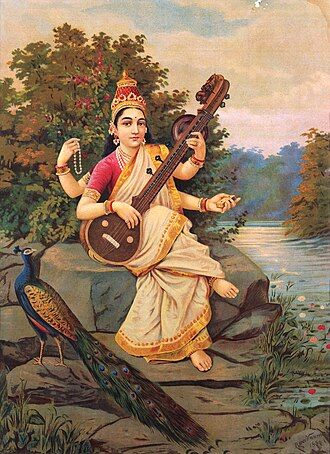
Vasant Panchami is, above all, Saraswati Puja. The goddess is shown seated on a white lotus, dressed in white, holding the veena, with a book and a mala in her other hands and a swan beside her. She is knowledge itself, vidya, and the patron of music, speech, learning and every art.
On her day she is installed and worshipped in homes, schools, colleges and especially in Bengal, where Saraswati Puja is a major festival kept with great devotion by students. Books, musical instruments and the tools of learning are placed before her and worshipped, set aside from ordinary use for the day in her honour.
Vidyarambham, the beginning of learning
The most touching custom of the day is Vidyarambham, the beginning of letters. Vasant Panchami is held to be one of the most auspicious days of the year for a young child to be introduced to learning, to write their first letter, often guided by an elder's hand tracing the shapes in a tray of rice or on a slate.
There is deep meaning in placing the start of a child's education on the first day of spring. Learning, the festival says, is itself a kind of springtime, a season of growth and new life for the mind. The seed of knowledge is planted on the day the earth itself begins to bloom.
Why spring and knowledge belong together
The pairing is the festival's quiet wisdom. Spring is the season when what was dormant wakes and begins to grow. Knowledge does the same within a person. To honour Saraswati at the start of spring is to recognise that the mind, like the field, has its seasons, and that this is the time to sow.
It is also a reminder of where the tradition places its highest value. Of all the things one might pray for at the start of a new season, prosperity, success, comfort, the festival chooses to ask first for knowledge, treating learning as the wealth that makes all other wealth worthwhile and the one possession that cannot be taken away.
How to keep the day
Wear yellow. Offer yellow flowers and sweets to Saraswati. Place your books, your instrument, the tools of your work or study before her image and let them rest in her honour for the day. If there is a small child in the house, let this be the day they trace their first letter. And ask the goddess for the one gift she gives: a clear mind and a love of learning that the years only deepen.