The day the sun turns north
Every year on 14 January, something quiet happens in the sky. The sun completes its six-month southern arc and begins its northern journey. The earth tilts back toward the light. In jyotish, the sun enters Makara rashi (Capricorn). This is Makar Sankranti.
It is one of the few Sanatani festivals that follow the solar calendar rather than the lunar one, which is why its date barely shifts from year to year. In 2026, Makar Sankranti falls on 14 January. In 2027, also 14 January. The astronomical event it marks, the sun's apparent entry into the tropical sign of Capricorn, is fixed to the season.
This is a festival of the sun, of the harvest, and of the turning of the year. Every region of India celebrates it under a different name and with different rituals, but the underlying observance is the same: gratitude for what has grown, and welcome for the light that is now returning.
Many names, one festival
In Punjab it is Lohri, celebrated the night before with bonfires, sesame and jaggery sweets, and the song "Sundar mundariye" sung around the flames.
In Tamil Nadu it is Pongal, a four-day festival where new rice is boiled in milk in a clay pot until it overflows, signaling abundance for the year ahead.
In Gujarat and Rajasthan it is Uttarayan, the day the sky fills with kites of every colour from dawn to dusk.
In Assam it is Magh Bihu or Bhogali Bihu, marked by community feasts and bamboo bonfires called meji.
In Karnataka it is Suggi, a harvest festival where families exchange ellu-bella, a mixture of sesame, jaggery, peanuts, and coconut, with the saying "ellu bella thindu olle maathadi" (eat the sesame and jaggery, and speak only good words).
In Maharashtra families exchange tilgul (sesame and jaggery laddoos) with the same blessing: "tilgul ghya, god god bola" (take the tilgul, speak sweetly).
The shared substance across regions, jaggery and sesame, is not coincidence. Both warm the body in mid-winter, when ojas and digestion need support. The festival's foods are the season's medicine.
What the sun's turn means in jyotish
Uttarayana, the sun's six-month northward journey from Makar Sankranti to Karka Sankranti in mid-July, is considered the auspicious half of the year. Daksinayana, the southward half from July to January, is its counterpart.
The shastras give Uttarayana a particular weight. In the Mahabharata, Bhishma waits on his bed of arrows through Daksinayana so he can leave his body during the more auspicious northward turn. Many traditional Sanatani households still avoid major undertakings, weddings, and griha pravesh during Daksinayana, scheduling them after Makar Sankranti.
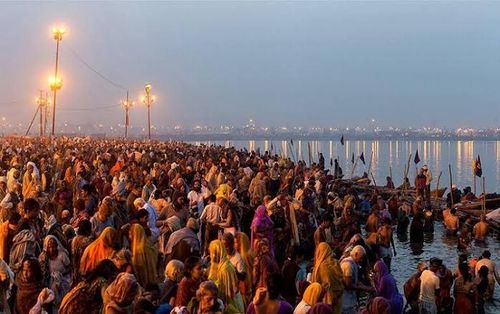
The day itself is also one of the most powerful punya days in the lunar-solar calendar. Bathing in the Ganga at Prayag, Haridwar, or any sacred river, donating sesame and warm clothing, and offering arghya to Surya at dawn are the day's three classical observances.
How to mark the day
The traditional observances are simple and worth doing even if you have lapsed from them.
At sunrise: Offer arghya to Surya. Stand facing the rising sun, take water in a small kalash or copper vessel, and pour it slowly while reciting the Surya mantra "Om Suryaya Namaha" or the longer Aditya Hridaya Stotram.
Through the day: Eat foods made with sesame and jaggery. Til ke laddoo, gajak, chikki. The body needs this combination in January. Sanatani tradition embeds nutrition into ritual.
Daan: Sesame seeds, jaggery, woollen clothing, blankets. Donations on Makar Sankranti are considered particularly effective for clearing pitru-rin and Saturn-related afflictions.
Sacred bath: If a holy river is accessible, this is the day for it. If not, water sprinkled over the head with the intent of holy-bath has the same effect, according to tradition.
Kite flying: In Gujarat the practice is rooted in welcoming the sun. The body absorbs vitamin D, the mind absorbs the open sky, the household gathers on rooftops. There is no shastric injunction here; it is regional joy.
Why the festival has held
Makar Sankranti is older than most things in the calendar. The Surya Siddhanta, the foundational text of Hindu astronomy, locates this day at the heart of timekeeping. Megasthenes, the Greek ambassador to Chandragupta Maurya's court in 300 BCE, recorded a celebration of the winter sun-turn observed across the Indian subcontinent. The Tamil Sangam literature from the second century CE describes Pongal in terms recognizable today.
A festival that has survived 2300 years of recorded history, across every region of an enormous and varied subcontinent, is not surviving on inertia. It survives because what it marks, the body's need for warm food in winter, the farmer's gratitude after harvest, the home's reunion in the season of long nights, has not changed.
This 14 January, regardless of where you live or which name you grew up calling it by, observe something small. Offer water to the morning sun. Eat a piece of til-gud. Say a kind word to someone you have been silent with. Welcome the light back. It has been a long winter, and a long way around.