
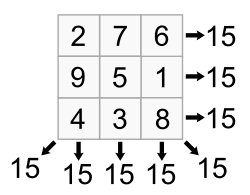
Long before there were birth charts, there were numbers. The ancient seers held that the cosmos is ordered, that nothing in it is random, and that number is one of the languages in which that order is written. Numerology, ank jyotish, is the reading of that language as it appears in a person's life. It is a companion to astrology, simpler in its tools, and a good place to begin for those new to the predictive sciences.
The idea behind it
Numerology rests on a single principle: that each number from one to nine carries a distinct quality, an energy, and that the numbers woven into our lives, above all through our date of birth and our name, describe something true about our nature and our path.
In the Vedic tradition this is tied to the navagraha, the nine planets. Each of the nine numbers is governed by one of them. The Sun rules one, the Moon two, Jupiter three, Rahu four, Mercury five, Venus six, Ketu seven, Saturn eight, and Mars nine. To read a number is, in this view, to read the planet behind it. This is what joins ank jyotish to the larger science of jyotish.
The two numbers that matter most
For a beginner, two numbers carry most of the meaning.
The first is the Mulank, the root or psychic number, found from the day of the month on which you were born. Reduce the date to a single digit. A person born on the twenty-third has a Mulank of five, because two plus three is five. Born on the ninth, the Mulank is nine. This number is said to describe your basic nature, how you see yourself and approach the world.
The second is the Bhagyank, the destiny or life-path number, found from the full date of birth, the day, the month and the year all added together and reduced to a single digit. This number is said to describe the broader arc of your life and the lessons it tends to bring. Where the Mulank is who you are, the Bhagyank is where you are going.
A reading begins by finding these two and considering both the qualities of each number and the relationship between them.
A short character of the nine
Each number has a temperament. One, ruled by the Sun, is the leader, original and self-reliant. Two, the Moon, is gentle, sensitive and cooperative. Three, Jupiter, is wise, expansive and drawn to learning. Four, Rahu, is unconventional and restless. Five, Mercury, is quick, communicative and adaptable. Six, Venus, is warm, artistic and devoted to home and beauty. Seven, Ketu, is introspective, spiritual and a seeker. Eight, Saturn, is disciplined, enduring and tested by hard work before reward. Nine, Mars, is courageous, energetic and protective.
These are starting points, not verdicts. A whole life is never contained in a single digit.
What numerology is, and is not
Used rightly, numerology is a mirror, not a cage. It offers a vocabulary for self-understanding, a way to notice your own tendencies and to work with them rather than against them. It is interpretive, like all the jyotish sciences, and it is at its best when it helps a person reflect, not when it is used to predict misfortune or to stoke worry. No number is unlucky, and no combination is a sentence. The shastras speak of free will and effort as the deciding forces; the numbers describe the terrain, not the journey you choose to make across it.
If you find your Mulank and Bhagyank and want to understand how they sit within your full birth chart, a jyotishi on Apna Sanatan can read the two together with you.
Begin with your own date of birth. Reduce it, find the two numbers, and read their qualities. It is the simplest door into a very old way of seeing.