The forest scriptures
Every spiritual tradition has its peak texts. The texts where the tradition's deepest insights are concentrated, where the language becomes most precise about what cannot easily be said, where the seeker who reaches them realizes they have found what the rest of the literature was pointing toward.
For Sanatan dharma, those texts are the Upanishads.
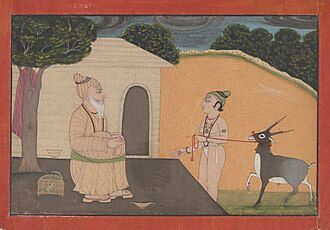
The word Upanishad means "sitting down near." It refers to the practice of a student sitting at the feet of a teacher to receive direct teaching that cannot be transmitted any other way. The Upanishads are the records of those teaching transmissions, written down between roughly 800 BCE and 200 BCE, mostly in dialogue form.
There are 108 recognized Upanishads. Of these, ten or eleven are considered principal: the Mukhya Upanishads. The rest are minor, sectarian, or later additions. The principal ones, taken together, contain the philosophical foundation of Vedanta, which has shaped Sanatani thought for over two thousand years.
This article walks through what the Upanishads are, which ones to read first, and what they teach.
The basic claim
The Upanishads make a small number of central claims, expressed in many different ways across the texts.
Brahman is real. There is an ultimate reality, undivided and unchanging, that underlies the world of multiplicity. This is Brahman. Brahman is not a god in the ordinary sense; Brahman is the source of which all gods, beings, and things are partial expressions.
The self is Brahman. The atman (the individual self, the consciousness in each being) is not different from Brahman. This is the great equation of Vedanta: tat tvam asi, "thou art that." What you most fundamentally are is what reality most fundamentally is.
The world is illusory in a specific sense. Maya is not the claim that the world is unreal. It is the claim that the world is real in one way but its appearance of being separate from Brahman is illusory. The mistake is not in seeing the world; the mistake is in seeing it as fundamentally separate from the source.
Knowing this directly is liberation. The full project of human life, in the Upanishadic view, is to realize directly (not merely intellectually) the identity of atman with Brahman. This realization is moksha, liberation from the cycle of birth and death.
These are the basic moves. The Upanishads explore them in many different ways: through dialogue, through metaphor, through direct argument, through ritual reinterpretation, through analysis of states of consciousness.
The principal Upanishads
The ten or eleven principal Upanishads are:
- Isha Upanishad
- Kena Upanishad
- Katha Upanishad
- Prashna Upanishad
- Mundaka Upanishad
- Mandukya Upanishad
- Taittiriya Upanishad
- Aitareya Upanishad
- Chandogya Upanishad
- Brihadaranyaka Upanishad
- Shvetashvatara Upanishad (counted sometimes as the eleventh, sometimes as a major minor)
Each has a distinctive character. The longer ones (Chandogya, Brihadaranyaka) are rich and varied, with multiple dialogues and themes. The shorter ones (Isha, Mandukya) are dense and concentrated, with very high content-to-length ratios.
For someone reading the Upanishads for the first time, certain texts are easier entry points than others.
Where to start
The Isha Upanishad. Eighteen verses, the shortest of the principal Upanishads. The first verse alone is a complete teaching:
Isha vasyam idam sarvam yat kincha jagatyam jagat Tena tyaktena bhunjitha ma gridhah kasya svid dhanam
"All this, whatever moves in this moving world, is enveloped by the Lord. By renunciation enjoy. Do not covet anyone's wealth."
The entire ethical and metaphysical program of the Upanishadic tradition is compressed into these two lines. The world is divine. Engage with it, but with the right attitude (without grasping). Do not claim what is not yours.
The Isha Upanishad is the right place to begin because its compression forces close reading and reveals how much can be packed into very few words.
The Katha Upanishad. A young brahmin named Nachiketa, sent to Yama (the lord of death), receives from Yama three boons. For his third boon, Nachiketa asks what happens at death. Yama's answer fills the Upanishad.
The dialogue format makes the teaching accessible. Yama's progression, from refusing to answer, to offering substitutes, to finally giving the deepest possible teaching, dramatizes the way truth is offered to those who can receive it.
The Katha is one of the most beloved Upanishads, often the second one a student reads after the Isha.
The Mandukya Upanishad. Twelve verses, the shortest principal Upanishad. It is the foundational text on Om and on the four states of consciousness. Despite its brevity, it is one of the most consequential Upanishads: Gaudapada's commentary on it, the Mandukya Karika, established much of the foundation for Advaita Vedanta.
The Mandukya is dense and benefits from being read alongside a commentary.
The Chandogya Upanishad. Eight chapters, one of the longest. Famous for several teachings: the dialogue between Uddalaka Aruni and his son Shvetaketu (which contains the "tat tvam asi" mahavakya), the dialogue between Satyakama and his teacher, the gradual teaching of the Self through multiple definitions.
The Chandogya is rich and rewarding but takes substantial time. It rewards patience.
The Brihadaranyaka Upanishad. The longest. The most varied. Contains the famous dialogue between Yajnavalkya and his wife Maitreyi, the teaching of "neti neti" (not this, not this), the analysis of the dream state and deep sleep, and many other passages.
The Brihadaranyaka is the deepest of the Upanishads. It is best approached after the others, when the basic framework is familiar.
The four mahavakyas
Four "great statements" from the Upanishads are traditionally singled out as the most concentrated expressions of the Upanishadic teaching. Each is associated with one of the four Vedas.
Prajnanam Brahma ("Consciousness is Brahman") — Aitareya Upanishad (Rig Veda)
Aham Brahmasmi ("I am Brahman") — Brihadaranyaka Upanishad (Yajur Veda)
Tat Tvam Asi ("Thou art that") — Chandogya Upanishad (Sama Veda)
Ayam Atma Brahma ("This self is Brahman") — Mandukya Upanishad (Atharva Veda)
These four statements, each in different words, point at the same insight: the identity of individual consciousness with the absolute. They are the central teaching of Vedanta in compressed form.
How the Upanishads teach
Unlike the Vedas (which are largely ritual instructions and hymns), the Upanishads teach through dialogue and inquiry. A few characteristic methods:
Question and answer. A student asks. A teacher answers. The dialogue often refines the question itself before any answer is given.
Negation (neti neti). The teacher describes what Brahman is not, removing false identifications one by one until what remains is what is.
Concentration on syllables and sounds. The teaching often uses Om (the most concentrated example) and other sacred sounds as objects of contemplation.
Description of states of consciousness. The Upanishads carefully distinguish waking, dreaming, deep sleep, and the fourth state (turiya), using these distinctions to point at what the self really is.
Metaphor and parable. The teacher often uses stories: the salt dissolving in water (Chandogya), the two birds in the tree (Mundaka), the chariot of the self (Katha).
The teaching is layered. A first reading gets the surface. Subsequent readings, especially alongside disciplined practice and the commentaries of realized teachers, open deeper layers.
A practical reading plan
For someone serious about reading the Upanishads:
Month 1: Read the Isha and Kena Upanishads, with commentary. Both are short. The two together give the essential framework.
Month 2: Read the Katha Upanishad slowly. The dialogue structure makes it accessible. Many of the most-quoted Upanishadic verses are here.
Month 3: Read the Mundaka and Prashna Upanishads. Both are medium-length and continue building the framework.
Month 4: Read the Mandukya with the Mandukya Karika. Difficult but essential. The fourfold analysis of consciousness is foundational.
Months 5 and 6: Read the Chandogya Upanishad. The longest accessible Upanishad. Many famous passages.
Year 2: Read the Brihadaranyaka Upanishad slowly. Read it more than once. This is the deepest of the principal Upanishads.
Throughout, maintain a daily practice (japa, meditation, asana). The Upanishads are not merely texts; they are pointers to states of being. Practice opens what reading alone cannot.
A word about translations
Several good translations exist:
Eknath Easwaran: Most accessible for beginners. Modern English. Gentle.
Swami Nikhilananda: Classic, complete, with traditional commentary integrated.
Swami Gambhirananda: Closer to the Sanskrit, useful for the serious student.
Patrick Olivelle: Scholarly, with academic apparatus. Useful but less devotional.
For first reading, Easwaran. For sustained study, Nikhilananda or Gambhirananda. For scholarly precision, Olivelle.
A closing observation
The Upanishads are among the deepest texts produced by any civilization. They were studied by Schopenhauer, who called the Oupnek'hat (a Latin translation of the Persian Upanishad anthology) "the consolation of my life." They were studied by Emerson, who carried Upanishad quotes in his journal. They shaped, indirectly, the modern global interest in meditation and inner inquiry.
But the Upanishads belong, first and last, to those who use them for what they were intended for: to dissolve the false sense of separation that distorts ordinary perception, and to come to direct experience of the unity underneath.
This work is available. The texts exist. The teachings are accessible. The methods (sitting, inquiry, the slow study) are within everyone's reach.
Begin with the Isha. Eighteen verses. One sitting. The rest of the path opens from there.