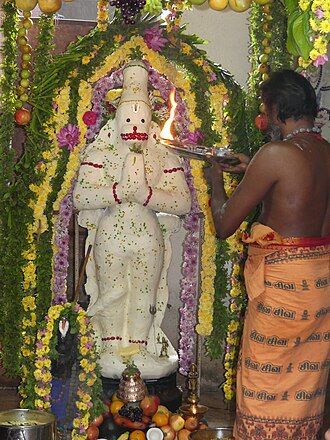
A few days after Ram Navami comes the birthday of the one who served Ram most completely. Hanuman Jayanti celebrates the appearance of Hanuman, the mighty vanara whose devotion is the tradition's highest example of what it means to give yourself entirely to something greater. On this day, his temples fill, the Hanuman Chalisa is recited without pause, and his images are freshly coated in the orange-red sindoor that is his alone.
The day of his birth
Across much of the north, Hanuman Jayanti is kept on the full moon of Chaitra, the bright spring month, close upon the heels of Ram Navami, a nearness that feels fitting: first the king is born, then the devotee who will live for him. In other regions the day is observed at different times of the year, in the south often in the Tamil month of Margazhi and in Maharashtra on the Chaitra full moon, so the date you keep may depend on where your family is from. All of them honour the same birth.
The tradition tells that Hanuman was born to Anjana and Kesari, and is regarded as a son of Vayu, the wind god, from whom he draws his speed and his boundless strength. A loved story of his childhood has the infant Hanuman, hungry at dawn, mistaking the rising sun for a ripe fruit and leaping into the sky to seize it, a first sign of the being who would one day leap across the ocean to Lanka.
Why his birthday matters
We celebrate the birthdays of gods and kings. Hanuman's birthday is the celebration of a servant, and that is exactly why it is precious.
Hanuman holds nothing for himself. His strength is without limit, yet every bit of it is laid at Ram's feet. His learning is deep, his courage absolute, and he asks for no throne, no reward, no worship of his own, only to serve. To celebrate his birth is to honour the quality the tradition prizes above power: devotion that has forgotten itself.
There is comfort in him too. He is Chiranjivi, one of the immortals, believed to be present still wherever Ram's name is sung, and he is the great remover of fear. This is why people turn to him in trouble, reciting his Chalisa as a refuge. On his birthday, that closeness is celebrated openly.
How the day is kept
Devotees often keep a fast, and the day begins early, many rising before dawn, the hour associated with his birth. Temples hold special worship from first light. The Hanuman Chalisa and the Sundara Kanda, the section of the Ramayana that tells of Hanuman's leap to Lanka, are recited, sometimes around the clock.
Hanuman's images are offered sindoor, recalling a beloved story in which Sita applied sindoor to her parting for Ram's long life, and Hanuman, learning this, covered his whole body in it out of love, so that his devotion to Ram might be even greater. Offerings of laddus, and the chanting of Jai Hanuman and Bajrangbali, fill the day. Many wrestlers and akharas, who hold Hanuman as their patron, keep his birthday with special devotion.
What to take from the day
Hanuman Jayanti asks a simple question of anyone who keeps it. Here is the strongest of beings, who chose to serve. What might we do with whatever strength we have, if we held it as he did, not for ourselves?
In 2027, the Chaitra Hanuman Jayanti falls in mid-April. Rise early if you can, recite the Chalisa, offer what you can at his shrine, and remember the one whose greatness was measured entirely by his devotion.
Jai Hanuman.