Every year a section of the internet insists Raksha Bandhan is on two different days, and every year the reason is the same: the Hindu day and the Gregorian day are different objects.
Raksha Bandhan is observed on Shravan Purnima — the full-moon tithi that closes the month of Sawan. A tithi is not a calendar date. It is the time the Moon takes to gain twelve degrees on the Sun, which runs anywhere from about 19 to 26 hours. So a tithi routinely begins on one English date and ends on the next.
The 2026 numbers
For New Delhi, the Purnima tithi begins around 09:10 AM on Thursday, 27 August 2026 and ends around 09:50 AM on Friday, 28 August 2026.
Which of the two dates carries the festival? The rule that settles most such cases is the presence of the tithi at sunrise. On 28 August the Purnima is running at sunrise and continues for several hours after. On 27 August it does not begin until mid-morning, well after sunrise.
So: Raksha Bandhan 2026 is Friday, 28 August. This is also the pan-India observation, and the date on which schools, offices and the greeting-card economy will all be operating.
Why 2026 is an easy year
Most Raksha Bandhans involve a wait. Bhadra — technically Vishti Karana, one of the eleven karanas of the panchang — is treated as unfit for auspicious beginnings, and tying a rakhi counts as one. In years when Bhadra occupies the morning, families end up tying rakhi at odd hours or after dark.
In 2026, Bhadra ends before sunrise on 28 August. The morning is clear from the start.
That leaves a straightforward window:
| Marker | Time (Delhi, 28 August 2026) |
|---|---|
| Sunrise | ~05:57 AM |
| Bhadra | Already ended before sunrise |
| Purnima tithi ends | ~09:50 AM |
| Strict rakhi window | ~05:57 AM to ~09:50 AM |
If your household wants to be precise, tie the rakhi in that morning window.
And if the morning is impossible
It often is. Siblings live in different cities. Sisters travel. Offices do not pause at 08:00 on a Friday.
Two honest positions exist among practising pandits. The strict one says the ritual belongs inside the tithi and should be completed before it releases. The practical one says that once the tithi is present at sunrise the whole day carries the festival, and the rakhi may be tied when the family can actually assemble — a reading with long precedent, since the shastra also holds that a ritual performed with shraddha at an imperfect hour outranks one performed resentfully at a perfect one.
Pick one on purpose. What we would not recommend is spending the day anxious about a thread.
The thali, and what each item is doing
Not decoration — each element has a function.
- Roli or kumkum — the tilak, applied at the ajna between the brows. Marking the seat of attention, not the forehead as such.
- Akshat — unbroken rice. Unbroken is the whole point: what is offered as a wish must itself be whole.
- Diya — the witness. In Sanatan practice a vow is not made to a person alone; the flame stands in for Agni, who carries it.
- The rakhi — a raksha sutra, a protection thread. The same object class as a mauli tied at the start of any puja.
- Mithai — the sweetening of speech that is supposed to follow the vow.
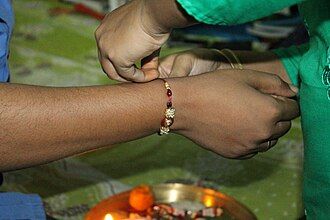
The brother sits facing east or north. The sister applies tilak and akshat, ties the thread on his right wrist, performs aarti, and offers sweets. He gives a gift and, in the older framing, a commitment.
What the vow actually was
The reduction of Raksha Bandhan to sibling sentiment is recent and slightly lossy. The Puranic account most often cited has Lakshmi tying a thread on Bali's wrist — not a sister to a brother, but a petitioner to a king, converting a stranger into a protector by the act of binding.
That is the older meaning of raksha: not muscle, but obligation. The thread creates a duty where none existed. Read that way, the festival is less about affection between siblings — which needs no festival — and more about the deliberate manufacture of responsibility. Which is a harder and more interesting thing to celebrate.
The eclipse, and the grahan panic
A deep partial lunar eclipse also falls on 28 August 2026. It peaks around 09:43 AM IST, while the Moon is below the Indian horizon, and is not visible from anywhere in India. Sutak is observed only where a grahan is visible, so no sutak applies in India and the rakhi is entirely unaffected. Full working in Chandra Grahan on Raksha Bandhan 2026.
For families abroad
In the United States, the United Kingdom and Canada, the Purnima tithi in local reckoning falls on 27 August. Diaspora households should follow their local panchang for both the date and the muhurat, since sunrise and tithi transitions are computed locally, not lifted from IST.
One further wrinkle for North American families: the eclipse is visible there, so local sutak does apply — which can genuinely interact with rakhi timing in a way it does not in India.
Common questions
Is Raksha Bandhan on 27 or 28 August 2026?
28 August in India. The Purnima tithi is present at sunrise that day.
What is the Bhadra time on Raksha Bandhan 2026?
Bhadra ends before sunrise on 28 August, so it does not affect the day.
Can rakhi be tied on the previous evening?
Some families do so once Bhadra has cleared on the 27th. In 2026 there is no need, since the 28th is clear.
Does Shravan end on Raksha Bandhan?
In North India, yes — Sawan runs 30 July to 28 August 2026. In Maharashtra, Gujarat, Karnataka and the South, the Amanta Shravan runs 13 August to 11 September.
Timings for New Delhi on the drik convention. Regional panchangs may differ by a few minutes; outside India, use a local panchang.