Pitru Paksha 2026 opens with the Purnima shraddha on 26 September, with Pratipada following on 27 September, and closes on Sarva Pitru Amavasya, 10 October 2026. Fifteen tithis in which the tradition holds that offerings reach the ancestors most directly.
Almost every guide to it assumes you have a riverbank, a family purohit, a courtyard, and knowledge of the exact tithi on which your grandfather died. A great many people now have none of the four. They then either skip the fortnight entirely or perform something anxiously, half-remembered, convinced they are getting it wrong.
That anxiety is the thing worth dismantling, because the shastra on this subject is considerably more accommodating than the folklore around it.
What shraddha actually requires
Strip it to the load-bearing elements and there are four.
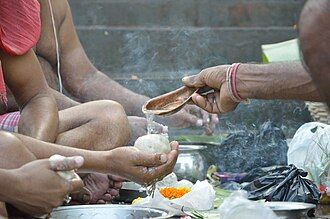
Water. Tarpan is an offering of water. Not Ganga water necessarily, not river water necessarily. Water.
Black sesame — til. The one material the texts treat as close to non-negotiable. Available in any kirana or any Indian grocery abroad.
Direction and posture. Facing south, the direction of the pitrs. The sacred thread, if you wear one, moved to the right shoulder — apasavya, the reversed position used specifically for pitr rites. Water offered over the pitr tirtha, the part of the palm between thumb and index finger, rather than over the fingertips as in deva rites.
Sankalpa. The naming. You state who you are, and you name the ancestors you are offering to — father, grandfather, great-grandfather on the paternal line, and the maternal line, and where the names are unknown, the relation alone.
That is the ritual. Everything else — the purohit, the river, the pind of rice and barley, the sixteen-day full sequence, the feeding of brahmins — is elaboration, and elaboration is good where it is available and not a precondition where it is not.
Doing it in an apartment
Entirely permissible. The practical form:
- Bathe. Wear clean, preferably unstitched or simple cotton clothing.
- Sit facing south, on the floor or on a mat. A balcony, a terrace or beside a window is fine; so is any clean room.
- Take a vessel of water, black sesame, and darbha or kusha grass if you have it. Tulsi leaves are acceptable in many household practices.
- Move the thread to the right shoulder if you wear one.
- State the sankalpa. Name the pitrs. Offer water with til over the pitr tirtha of the palm, into a plate or vessel — not down the drain.
- Afterwards, pour the collected water at the base of a plant or tree.
- Cook a simple satvik meal. Set aside a portion — the traditional five shares include one for the cow, one for the crow, one for the dog, one for the devas, one for a guest. If you have no access to any of them, offering the portion to a person in need discharges the intent.
The crow, incidentally, is not superstition-filler. It is the designated messenger of the pitrs in this tradition, which is why its arrival is read as acceptance. In cities where crows have thinned out, families set the portion out and let its absence be absence rather than omen.
Doing it abroad
Two questions come up and both have clean answers.
Which date? Tithis are computed from local sunrise. The Pitru Paksha tithi for a household in New Jersey or Melbourne may fall on a different Gregorian date than the same tithi in Delhi. Use a panchang computed for your city. Do not lift IST dates.
Does it work at that distance? The tradition's own position is that the offering is carried by sankalpa and by Agni, not by geography. There is no shastric requirement of Indian soil. Where a river is wanted, any flowing water serves; where a tirtha is wanted, the sankalpa can name one.
For families who want the full sequence performed at a tirtha, remote shraddha through purohits at Gaya, Trimbakeshwar, Haridwar or Rameswaram is an established practice, not a modern shortcut — a proxy performing rites named for an absent karta has long precedent. If you use one, use one you can identify and speak to, and understand what specifically is being performed.
If you do not know the tithi
This is the most common blocker and it has an explicit remedy built into the fortnight.
Sarva Pitru Amavasya — 10 October 2026 — exists for exactly this case. It is the catch-all: for ancestors whose death tithi is unknown, for those who died in accident or violence, for those who left no one to perform their rites, and for anyone the family has lost track of. If you know nothing, offer on this day and the tradition considers the fortnight discharged.
Other placements worth knowing:
- Chaturthi and Panchami — for those who died young or unmarried in some regional practice.
- Navami — Avidhava Navami — for married women who predeceased their husbands.
- Dwadashi — for sanyasis.
- Chaturdashi — traditionally for those who died by weapon, accident or violence.
Who may perform it
The default in most traditions is the eldest son, then sons in order, then grandsons, then the brother's line.
Where there is no son, or where the son will not, the question of daughters performing shraddha arises. This is genuinely contested rather than settled. A substantial body of pandits now supports it, citing precedent for a daughter or daughter's son performing rites where no male heir exists, and Gaya's purohits have performed daughter-led shraddha for years. A more conservative reading restricts it. Both positions are held by serious people.
Our view, stated plainly: an ancestor unremembered because the family could not resolve a procedural dispute is the worse outcome. If you are the person who is going to do it, do it.
What Pitru Paksha is not
Some clearing-up, because a fair amount of fear attaches to this fortnight.
- It is not inauspicious. It is a period of restraint, which is different. New ventures, purchases and celebrations are traditionally deferred — not because harm follows, but because the fortnight is given over to a different purpose. Emergency and necessary work is not deferred.
- Pitru dosha is not diagnosed by the calendar. If you are told during this fortnight that your chart carries pitru dosha requiring an expensive remedy, that is a sales cycle timed to a season. A genuine reading of Rahu, Ketu, Surya and the ninth house is a chart matter, available in any month.
- Shraddha is not a transaction. The offering is not a payment for protection. It is the acknowledgment of debt — pitr rina, one of the three debts a person is born into. The word shraddha comes from shrat plus dha: to place one's faith. It is named after the attitude, not the act.
The 2026 dates
| Date | Observance |
|---|---|
| 26 September 2026 | Purnima Shraddha — Bhadrapada Purnima |
| 27 September 2026 | Pratipada Shraddha — Pitru Paksha proper begins |
| 10 October 2026 | Sarva Pitru Amavasya — Mahalaya, final day |
| 11 October 2026 | Sharad Navratri begins |
Note the adjacency at the end. The fortnight of the ancestors closes and the nine nights of the Devi open the next day. Descent, then ascent. The calendar is not arbitrary about this.
For the fortnight's fuller ritual sequence, see Pitru Paksha and Shraddha, and for what follows it, Sharad Navratri.
Common questions
What are the Pitru Paksha 2026 dates?
Purnima shraddha on 26 September, Pratipada on 27 September, and Sarva Pitru Amavasya on 10 October 2026.
Can shraddha be done at home without a pandit?
Yes. Tarpan with water, black sesame, southward facing and a stated sankalpa is a valid household observance.
What if I do not know my ancestor's death tithi?
Offer on Sarva Pitru Amavasya, 10 October 2026. That day exists for this case.
Can a daughter perform shraddha?
The position is contested. Many practising pandits and the purohits at Gaya support it, particularly where there is no son. Follow your family's guidance if it has one.
Should major purchases be avoided during Pitru Paksha?
Traditionally deferred as a matter of restraint rather than danger. Necessary and urgent matters are not deferred.
Dates follow the Delhi panchang on the drik convention. Outside India, use a panchang computed for your city — tithis shift with local sunrise.