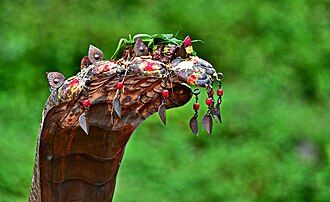
Monday, 17 August 2026 carries an unusual stack. It is Nag Panchami, the day of serpent worship. It is also the third Sawan Somwar, the third of this month's four Monday fasts for Shiva. And in most panchangs the Sun's entry into Simha — Simha Sankranti — falls in the same window.
Nothing about this is contrived. The overlap happens because Nag Panchami is fixed to Shravan Shukla Panchami, and the Somwar count is fixed to the weekday. Every few years they coincide, and when they do, the day is treated as considerably weightier than either observance alone.
Sawan 2026, for orientation
In North India, following the Purnimanta reckoning, Sawan runs 30 July to 28 August 2026. The four Sawan Somwars are 3, 10, 17 and 24 August. Sawan Shivratri fell on 11 August.
In Maharashtra, Gujarat, Goa, Karnataka, Andhra Pradesh, Telangana and Tamil Nadu, the Amanta Shravan runs 13 August to 11 September, with Somwars on 17 and 24 August and 31 August and 7 September. Note that 17 and 24 August are Sawan Somwars under both reckonings — which is why those two Mondays will be the busiest at Shiva temples nationally this year.
Why serpents, and why now
The easy answer — monsoon flooding drives snakes out of their burrows and into human space, so a festival of respect and non-harm is placed exactly there — is true and insufficient.
The deeper placement is theological. In Sanatan cosmology the serpent is the form that holds what cannot be held. Vasuki around Shiva's throat. Shesha as the couch of Vishnu on the causal ocean. Kundalini coiled at the base of the spine. The Nagas as custodians of subterranean water, of treasure, of boundaries, and in Jyotisha of the Rahu–Ketu axis — the karmic inheritance you did not choose.
What all these share is containment of the dangerous. Vasuki drank the halahala; the serpent is what makes poison survivable. That is the actual subject of Nag Panchami: not fear of snakes, but reverence for whatever in the order of things absorbs what would otherwise destroy.
What is done on Nag Panchami
The observance is unusually simple and unusually strict about non-harm.
- No digging or ploughing. The traditional prohibition is absolute — you do not break the earth on the day you honour those who live inside it. In practice this means no tilling, no excavation, no garden work.
- Nag pratima puja. A serpent form drawn in haldi or sandalwood paste on a wall or wooden board, or a metal or clay image, or a snake carving at a temple. Offerings: milk, water, haldi, roli, akshat, durva, flowers, and often lotus or champa.
- Do not pour milk into snake holes or feed live snakes. This has become widespread and it is a genuine cruelty — snakes are lactose-intolerant, cannot digest milk, and captive snakes displayed for this purpose are routinely defanged and dehydrated. The offering is made to the deity, at the image. Every serious sampradaya makes this distinction; a great deal of popular practice has lost it.
- Feeding and charity. Where the family custom exists, feeding brahmins or the poor, and abstaining from fried food.
Regionally: Nag Panchami is central in Maharashtra, where the Battis Shirala tradition is the best known and most contested; in Bengal it is observed for Manasa Devi; in the South, serpent worship attaches to Nagaraja temples and to the Subrahmanya connection; and in Rajasthan and Gujarat there are distinct household forms.
The Somwar vrat, held on the same day
The Sawan Somwar fast is the most widely kept vrat of the Hindu year. The form is stable across regions:
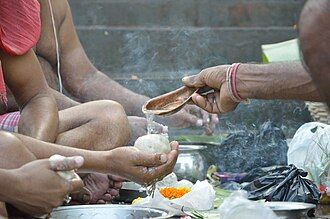
- Bathe early. Perform jalabhishek — the pouring of water on the Shivalinga. Plain water offered with faith is sufficient and always has been; this is one of the very few pujas the shastra explicitly refuses to gatekeep by expense.
- Offerings: water, milk, bel patra, white flowers, sandal paste, dhatura, bhang, akshat. Do not offer tulsi to Shiva, or ketaki flowers.
- Fast through the day — most keep phalahar, some a single evening meal after puja, some nirjala. Choose what your body can hold; a vrat broken by collapse is not merit.
- Evening Shiva puja during Pradosh Kaal, at sunset.
- Mantra: Om Namah Shivaya, the panchakshari, is the complete instruction. If you want a longer sadhana, the Mahamrityunjaya.
Running both on 17 August
You do not need two separate pujas. The convergence has an obvious structure to it, since the serpent is already Shiva's ornament.
A workable sequence: bathe and begin with jalabhishek at the Shivalinga. Offer bel patra and the Somwar offerings. Then, at the same altar, place or draw the nag pratima and make the Nag Panchami offerings — the milk in particular, which suits both. Chant Om Namah Shivaya through the day. Break the fast after the evening Pradosh Kaal puja.
If your family also marks Simha Sankranti, the sankranti observance is a snan and a daan — a bath and a giving, traditionally of grain, ghee or cloth. Fold it into the morning.
Simha Sankranti, briefly
Sankranti is the Sun's entry into a new rashi — twelve of them a year, of which Makar Sankranti is merely the most famous. Simha Sankranti marks entry into Leo, the Sun's own sign, and falls in the Dakshinayana half of the year that began at Karka Sankranti in July.
In Kerala it is observed as the start of Chingam and the Malayalam new year month; in Uttarakhand as Ghee Sankranti, when ghee is eaten and applied. It is a snan-daan parva rather than a celebratory one.
There is a further significance in 2027 worth filing away now: the Simhastha Kumbh at Nashik takes its name from Jupiter's entry into Simha, not the Sun's — a different and much slower cycle. We have written that up in the Simhastha Kumbh guide.
The rest of Sawan 2026
| Date | Observance |
|---|---|
| 15 August | Hariyali Teej |
| 17 August | Nag Panchami, third Sawan Somwar, Simha Sankranti |
| 24 August | Fourth and final Sawan Somwar (North India) |
| 28 August | Shravan Purnima, Raksha Bandhan — Sawan closes in the North |
Common questions
What is the date of Nag Panchami 2026?
Monday, 17 August 2026, on Shravan Shukla Panchami.
Is it correct to offer milk to live snakes?
No. Snakes cannot digest milk and the practice causes real harm. Offer at the image or the temple carving.
Why should digging be avoided on Nag Panchami?
The prohibition follows from the observance itself — the Nagas are held to inhabit the earth, and the day's central principle is non-injury to them.
Can the Somwar vrat and Nag Panchami puja be done together?
Yes. Begin with jalabhishek and the Shiva offerings, then make the nag offerings at the same altar.
Dates follow the Delhi panchang on the drik convention. Amanta and Purnimanta reckonings differ; follow your family's calendar.