Search for the next Kumbh Mela and you will be told it is in Nashik in 2027. That is where the crowds will be, so the shorthand is forgivable. But it is wrong in a way that matters if you are planning anything.
The Simhastha Kumbh Mela begins on 31 October 2026, with the traditional dhwajarohan — flag hoisting — at Trimbakeshwar, Ramkund and Panchavati. It runs continuously from that day and the flag is not lowered until 24 July 2028. Twenty-one months. The 2027 dates everyone quotes are the peak bathing days inside a mela that will already be two-thirds of a year old by then.
Which means the window opens in under three months.
The announced schedule
The Maharashtra government finalised the dates in a meeting with saints from the thirteen akharas and the Purohit Sangh. One notable decision from that meeting: the royal bath is to be called Amrit Snan rather than Shahi Snan, following the terminology adopted at Prayagraj.
| Date | Event |
|---|---|
| 31 October 2026 | Dhwajarohan — flag hoisting at Trimbakeshwar, Ramkund, Panchavati. Mela formally opens. |
| 29 July 2027 | Nagar Pradakshina — circumambulation of Nashik, roughly 14 km on foot |
| 2 August 2027 | First Amrit Snan |
| 31 August 2027 | Second Amrit Snan |
| 11 September 2027 | Third Amrit Snan — Nashik |
| 12 September 2027 | Third Amrit Snan — Trimbakeshwar |
| 24 July 2028 | Flag lowering. Mela concludes. |
You will find other flag-hoisting dates circulating, including a July 2027 one. The 31 October 2026 date is the one announced from the Chief Minister's review meeting with the akharas. Before committing money to travel, confirm against the official Simhastha portal run by the Divisional Commissioner, Nashik — a mela of this length will see the secondary Parva Snan calendar amended more than once.
What Simhastha means
The four Kumbh sites do not rotate on a simple twelve-year timer. Each is triggered by a specific planetary configuration, and Nashik's is Brihaspati in Simha — Jupiter in Leo.
Jupiter takes roughly twelve years to complete the zodiac, spending about a year in each sign. When it enters Simha, the Godavari basin becomes Kumbh ground, and the mela is called Simhastha: situated in Simha. That single fact explains the twenty-one-month duration. The mela is not sized to a festival; it is sized to a planet's residency in a sign, with some ceremonial overhang on either end.
Note the distinction from Simha Sankranti, which is the Sun entering Leo and happens every year in August. Same sign, different body, different cycle. Simhastha is the slow one.
Why Nashik has two Kumbhs at once
This is what makes Nashik structurally unlike Prayagraj, Haridwar or Ujjain, and it is the thing most guides skip.
The Simhastha unfolds across two separate sacred sites, twenty-eight kilometres apart, serving two different monastic traditions:
- Ramkund, Panchavati (Nashik city) — on the Godavari, revered as the place where Rama bathed during the exile. This is where the Vaishnava akharas take their Amrit Snan.
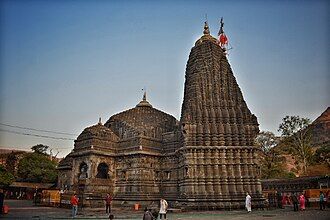
- Kushavarta Kund, Trimbakeshwar — at the symbolic source of the Godavari, in the forested Brahmagiri range, beside one of the twelve Jyotirlingas. This is where the Shaiva akharas bathe.
The separation is not administrative convenience. It is the settlement of an old and once-violent question of precedence between Shaiva and Vaishnava akharas at the bathing ghats — a dispute that produced real bloodshed at Indian melas in the eighteenth and nineteenth centuries. Nashik's answer was to give each tradition its own water. The third Amrit Snan is even held on consecutive days at the two sites rather than simultaneously.
If you are planning a visit, this bifurcation is the single most important planning fact. You must choose a base. Attempting both sites on an Amrit Snan day is not realistic once crowd zoning and road closures are in force.
Trimbakeshwar, which is worth the trip regardless
Trimbakeshwar is a Jyotirlinga — one of the twelve shrines where Shiva is held to be present as a pillar of light rather than as an installed image. Its lingam is unusual: three faces, worn, for Brahma, Vishnu and Rudra, and visible only in the depression of the linga rather than standing proud.
The Brahmagiri hill above it is treated as the origin of the Godavari, the second-longest river in India, which reaches the Bay of Bengal fifteen hundred kilometres away. Kushavarta Kund is the tank into which that origin is gathered, and it is the actual bathing site — pilgrims do not bathe at the mountain spring.
Trimbakeshwar is also the principal centre in India for Narayan Nagbali, Tripindi Shraddha and Kaal Sarp Dosh Nivaran rituals. Whatever your view of dosha-based prescription, the concentration of purohits performing these here is unmatched, and it is a large part of the town's year-round traffic.
Planning notes, twelve weeks out
- The opening is the quiet window. Dhwajarohan on 31 October 2026 is a genuine ritual event with a fraction of the 2027 crowd. For anyone who wants Simhastha darshan without a stampede risk, the last quarter of 2026 and the first half of 2027 are the intelligent months.
- Avoid the three Amrit Snan dates unless the akhara procession is specifically what you came for. The Maharashtra government has been explicit that the schedule is deliberately long so that devotees need not concentrate on a handful of days.
- Accommodation. Nashik has a real hotel base and a wine-tourism economy; Trimbakeshwar has dharamshalas and limited rooms. Book by site, not by city.
- Getting there. Nashik is on rail and road from Mumbai and Pune, with limited air. Trimbakeshwar is road-only from Nashik, and that road will be under crowd regulation during peak windows.
- Expect 15 to 20 crore visitors across the mela period per the state's own projections. Plan around that number, not around your memory of an ordinary temple town.
The story underneath
The Kumbh's charter myth is the Samudra Manthan — the churning of the ocean, from which the pot of amrita emerged and, in the struggle that followed, spilled at four places on earth. Nashik is one of them.
Whether you read that as history, as cosmology, or as a very old story about the cost of extracting something valuable from chaos, the ritual logic is consistent: the water at these four places is treated as retaining the contact. The bath is not a metaphor within the tradition. It is a claim about the water.
Common questions
When does the Nashik Kumbh Mela 2027 actually start?
The mela opens with dhwajarohan on 31 October 2026 and concludes with the flag lowering on 24 July 2028. The peak bathing days fall in 2027.
What are the Amrit Snan dates?
2 August 2027, 31 August 2027, and 11 September 2027 at Nashik with 12 September 2027 at Trimbakeshwar.
Should I go to Nashik or Trimbakeshwar?
Vaishnava akharas bathe at Ramkund in Nashik; Shaiva akharas at Kushavarta Kund in Trimbakeshwar. Choose by tradition or by which darshan you want, and base yourself there.
Why is the Nashik Kumbh called Simhastha?
Because it is triggered by Jupiter entering Simha, the sign of Leo — a roughly twelve-year cycle distinct from the annual Simha Sankranti of the Sun.
Dates as announced by the Government of Maharashtra following consultation with the thirteen akharas. Verify against the official Simhastha portal before booking; the secondary Parva Snan calendar is subject to revision.