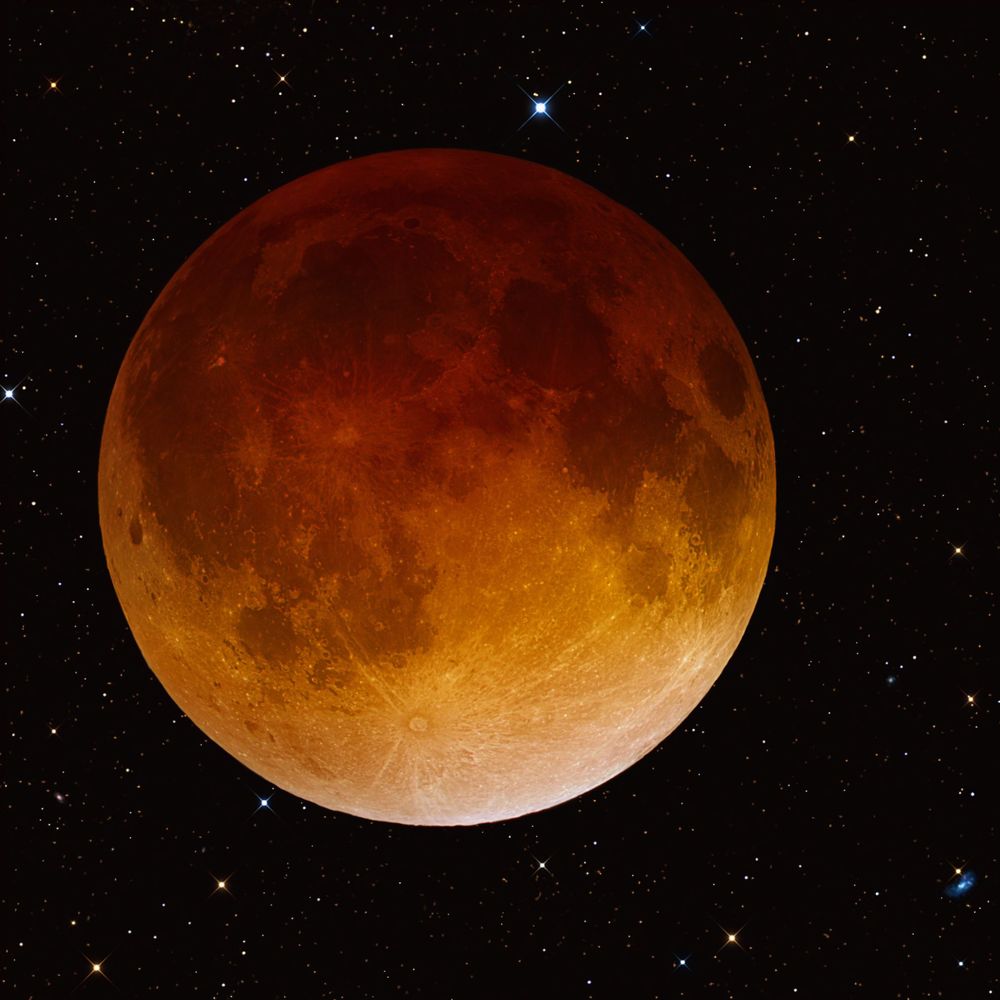
Two things happen on Friday, 28 August 2026. It is Shravan Purnima, and so it is Raksha Bandhan. It is also the date of a deep partial lunar eclipse, with an umbral magnitude of roughly 0.93 — a Moon almost entirely swallowed by Earth's shadow.
Put those two facts in the same sentence and a certain kind of content industry goes to work. Sisters are being told to tie the rakhi before sutak begins. Families are being told to avoid the afternoon. Some pages have simply invented a sutak window and published it.
None of it applies in India. Here is the reasoning, laid out so you can check it yourself.
The eclipse happens while India is in daylight
The eclipse window on 28 August runs approximately 06:54 to 12:32 IST, with the deepest phase near 09:43 IST.
Read that again against your own clock. At 09:43 in the morning, the Moon is not in the Indian sky. It is below the horizon. In Delhi, moonrise that day is not until around 18:54 IST — six hours after the eclipse has ended and the Moon has left Earth's shadow. Mumbai, Kolkata, Chennai and Bengaluru all experience ordinary daylight through the entire event.
This eclipse belongs to the night side of the planet — the Americas and the Pacific. Not to us.
Which settles the sutak question
Sutak for a lunar eclipse runs three prahar, roughly nine hours, before the eclipse begins — where the eclipse is visible. That last clause is not a modern softening. It is the condition the classical texts attach, and it is the clause that popular calendars quietly delete because a sutak table gets more clicks than an empty one.
Since the Moon's entire body stays below the Indian horizon for the whole event, there is nothing seized in the sky above India. Therefore:
- No sutak in India. Not at 21:43 the previous night, not at any hour on the 28th.
- Temples stay open. Any that close are choosing to.
- Rakhi rituals proceed normally. The tilak, the thread, the aarti, the sweets, the gift — all of it, at whatever hour suits your family.
- Shravan Purnima observances stand. Satyanarayan Katha, Yajur Upakarma, Narali Purnima, tarpan — unaffected.
If you are reading this from the United States, Canada, or the Caribbean, the position reverses: the eclipse is visible where you are, sutak applies on local timings, and — separately — the Purnima tithi itself falls on 27 August in your local reckoning. Diaspora families should work from a local panchang, not from IST.
The rakhi muhurat, since you came for it
For New Delhi, the Purnima tithi runs from about 09:10 AM on 27 August to about 09:50 AM on 28 August. Because the tithi is present at sunrise on the 28th, the festival is observed on the 28th.
And 2026 hands you an unusually clean morning: Bhadra has ended before sunrise on 28 August. There is no anxious waiting for a malefic window to pass, which is the single most common source of rakhi-day stress in other years.
The clearest window is therefore the morning — from sunrise, around 05:57 AM, until the Purnima tithi releases at about 09:50 AM. That is the strict reading, and it is what we would recommend if your household wants to be precise.
A note on the looser reading: many families treat the whole of the festival day as valid once the tithi is present at sunrise, and tie rakhi in the afternoon or evening when siblings can actually be in the same room. Both positions have defenders among practising pandits. The strict reading follows the tithi; the practical reading follows the principle that the bond is the point and the clock is the servant. Choose deliberately rather than anxiously.
What Bhadra actually is
Since it comes up every year: Bhadra, or Vishti Karana, is one of the eleven karanas — the half-tithi divisions of the panchang. Traditional texts treat it as unfit for auspicious beginnings, and rakhi-tying is classed as such a beginning. It is not an eclipse, not a planetary position, and not related to sutak. In 2026 it simply is not in the way.
The chart question, honestly
An invisible eclipse still exists astronomically, and the Sun–Moon opposition across the Rahu–Ketu axis is a real configuration. The Moon sits in Kumbha for this one.
Whether it does anything in your life depends on your kundli, not on the calendar. If the eclipse degree falls on a sensitive natal point, or if you are running a Rahu or Ketu period, the fortnight around 28 August is worth reading against your own chart. If not, it is a fortnight. Both August eclipses sit on the same nodal axis, two weeks apart, which is why they arrive as a pair — see Surya Grahan 12 August 2026 for the first of them.
We would rather you knew this than bought a remedy for it.
One more thing happening that day
28 August is also the concluding day of the Amarnath Yatra, when the Chhari Mubarak reaches the holy cave. Shravan Purnima is one of the densest tithis in the Hindu year — five distinct observances land on it. We have mapped them in Shravan Purnima 2026: Five Festivals, One Tithi.
Common questions
Is the 28 August 2026 lunar eclipse visible in India?
No. The Moon is below the horizon across India for the entire eclipse window of roughly 06:54 to 12:32 IST.
Is there sutak kaal in India for this eclipse?
No. Sutak is observed only where a grahan is visible, and this one is not visible from anywhere in India.
Can rakhi be tied after 09:50 AM on 28 August?
The Purnima tithi ends around then, so the strict window closes. Many families nonetheless observe through the day. Neither choice involves the eclipse.
Should temples close on 28 August?
There is no shastric requirement to do so in India this year.
Timings are computed for New Delhi on the drik convention. Confirm against your local panchang, particularly outside India, where both the tithi date and the eclipse visibility differ.