## A festival between sisters and brothers
In the bright fortnight of the lunar month of Shravan, on the day of the full moon, sisters across India tie a thread around their brothers' wrists. The thread is sometimes simple cotton, sometimes silken, sometimes elaborate with beads and small ornaments. The brother accepts the thread, gives the sister a gift, and promises to protect her. In 2026, this day falls on 28 August.
This is Raksha Bandhan. Raksha (protection) and bandhan (bond). A thread of protection.
It is one of the most widely observed festivals in Sanatani India, cutting across regions, languages, and caste lines. It is also one of the most often misunderstood. Modern critics call it patriarchal: a custom that requires sisters to seek protection rather than offering it equally. The traditional response is layered and worth hearing out.
## The stories underneath
Several stories anchor Raksha Bandhan in the Sanatani tradition. None alone is sufficient; together they form the festival's meaning.
**Yamuna and Yama.** Yama, the lord of death, was once visited by his sister Yamuna who tied a thread around his wrist as a token of love. Yama, moved, granted her a boon: that any sister who tied such a thread for her brother on this day would extend his life and grant him protection.
**Indra and Sachi.** Indra, the king of the devas, was facing a losing battle with the asuras. His wife Sachi prepared a sacred amulet, recited mantras over it, and tied it on his wrist. With this raksha, Indra returned to battle and won. This story is in the Bhavishya Purana and is among the oldest references to the practice.
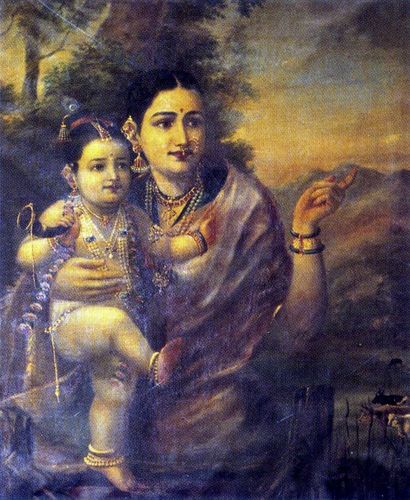
**Krishna and Draupadi.** Krishna once cut his finger and Draupadi, without hesitation, tore a piece from her sari to bandage it. Krishna, moved by her quick affection, declared that he would always protect her. Years later, when Dushasana attempted to disrobe Draupadi in the Kaurava court, Krishna extended her sari endlessly, fulfilling his promise.
**Rani Karnavati and Humayun.** In 1535 CE, Rani Karnavati of Mewar, facing siege by Bahadur Shah of Gujarat, sent a rakhi to the Mughal emperor Humayun. Humayun, accepting the rakhi, marched his army toward Mewar to defend her. He arrived too late; Karnavati had already performed jauhar. But Humayun avenged her, defeated Bahadur Shah, and restored her son to the throne. This historical episode is one of the most famous practical instances of the rakhi's significance.
These stories accumulate. The festival is not based on a single myth but on a tradition of moments, real and remembered, where a thread mattered.
## What the thread actually means
A rakhi is, in the traditional understanding, a binding agreement. The sister, by tying the thread, formally invokes her brother's protection. The brother, by accepting it, formally accepts the obligation.
The protection is not only physical, though it includes that. It is also:
**Emotional protection.** The brother is, in the tradition, the person the sister can turn to in difficulty without question or condition. The rakhi is a renewal of this standing arrangement.
**Material protection.** Historically, in joint family structures, the brother was often the family member who could intervene if the sister's marital situation became unsafe. The rakhi formalized this responsibility.
**Spiritual protection.** The thread is consecrated with mantras and applied with the sister's intention. It is held to carry her prayers for the brother. In return, his presence in her life is held to carry protective effects on her.
The exchange is reciprocal in less obvious ways. The brother does not simply receive protection-duty; he receives the sister's blessing. A sister's blessing, in the tradition, is among the most potent kinds.
## The modern question
A common contemporary critique: the festival positions women as those needing protection and men as those offering it. In an era of women's equality, is this gender frame still appropriate?
Several Sanatani responses are worth considering.
**The historical context.** Raksha Bandhan arose in eras when women's physical security was genuinely precarious. The rakhi was a practical tool in a real world. Treating the tradition as outdated requires asking whether the world has changed enough to make it unnecessary, which is its own empirical question.
**The role reversal practice.** Many modern families have evolved the tradition. Brothers tie rakhis on sisters' wrists too, in reciprocal protection. Sisters who are older or more financially established protect younger brothers. The basic structure of the tradition (mutual bond, formalized through a thread) survives the gender reversal.
**The non-sibling expansion.** Rakhis are now widely tied between non-siblings: between close friends, between adopted siblings, between protectors and protected in various civic and political settings. The festival's logic of formalized protection-bond travels well beyond the strict sister-brother pair.
**The dharmic argument.** The tradition's deeper claim is that human relationships flourish when they have explicit, ritualized commitments. The Western trend toward purely affective and non-ritualized relationships has not, by every measure, produced better outcomes. The rakhi is an argument for ritual as a form of relational care.
These are not arguments that the tradition must be preserved unchanged. They are arguments that it should be understood charitably before being judged.
## How the festival is observed
The traditional vidhi:
**Preparation:** The sister prepares a thali in advance. It contains the rakhi, a small diya, kumkum, chawal (rice grains), sweets, and sometimes a small gift.
**The aarti:** When the brother arrives (or the sister visits), she performs an aarti for him. She lights the diya, circles it before him, applies a tilak on his forehead with kumkum, and places a few grains of rice on the tilak (the rice should stick).
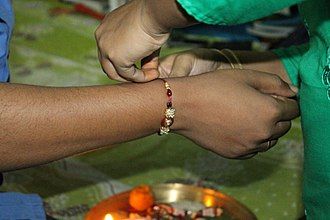
**The rakhi tying:** The rakhi is tied on his right wrist. The sister recites a small mantra or simply a prayer. The traditional Sanskrit verse:
> Yena baddho Balī rājā, dānavendro mahābalaḥ
> Tena tvām abhibadhnāmi, rakṣe mā cala mā cala
> By the thread that bound the great Balī, king of the danavas
> I now bind you. O protective thread, do not slip, do not slip.
This verse references the story of Bali, the asura king, to whom Vishnu (as Vamana) tied a similar binding thread.
**The sweet:** The sister offers a sweet to the brother, who eats a small piece and then offers her a sweet in return.
**The gift:** The brother gives the sister a gift. The traditional gift was money, but modern practice has expanded to clothing, jewelry, books, anything meaningful. The amount is less important than the gesture.
**Aashirvad:** The two exchange blessings. The elder gives blessings to the younger.
The ceremony takes ten to fifteen minutes. Across India, on this single day, hundreds of millions of these small ceremonies happen simultaneously.
## What to do if siblings are not nearby
A common contemporary situation: the sister and brother are in different cities, sometimes different countries. The festival can still be observed.
**Send a rakhi by post.** Indian Post and private courier services have dedicated Raksha Bandhan delivery options. The rakhi can arrive in time even from another country if sent two to three weeks in advance.
**Tie it virtually.** Video calls with the rakhi held up, the brother symbolically receiving it on the other side, the aarti performed through the camera, are increasingly common. The traditional view is that the intention carries the practice; physical presence is preferred but not strictly required.
**Tie it on a representative.** Some families have the sister tie a rakhi on a family deity image, or on a photograph of the brother, with the intention that the brother is symbolically present.
**Hold the rakhi for next visit.** If the brother is expected to visit later, the rakhi can be kept aside and tied at the next meeting. The festival's energy carries.
## The non-blood rakhi
Some of the festival's most powerful uses have been outside the immediate family.
Rakhis have been tied between Hindu sisters and Muslim brothers (and vice versa) as a gesture of protection across community lines, particularly during periods of communal tension. The practice has long historical precedent, especially in Bengal and Punjab.
During the freedom movement, Rabindranath Tagore proposed mass rakhi-tying between Hindus and Muslims in Bengal in 1905, to protest the British partition of the province. The practice contributed to the eventual reversal of the partition.
Soldiers at India's borders receive rakhis from women across the country every year. The exchange formalizes the protection-bond between civilian and soldier.
These uses suggest that the rakhi is, at its deepest, a technology for formalizing protection-relationships of any kind. The sister-brother relation is the prototypical case. It is not the only case.
## A closing thought
A thread on a wrist seems like a small thing. The festival around it has, by some accounts, the largest single-day participation of any Sanatani celebration. Hundreds of millions of small ceremonies happen in one twenty-four-hour window. Brothers travel hundreds of kilometres to be home. Sisters who have not spoken to brothers in years sometimes find this is the day they call.
The festival's persistence across two thousand years suggests it is doing something real. Not the magic of the thread itself, perhaps, but the discipline of the relationship the thread represents. To formalize, once a year, the commitment to a sibling. To say it explicitly, with a ritual that requires showing up. To accept the reciprocal obligations that come with the blessing received.
This Raksha Bandhan, 28 August 2026, if you have a sibling, observe the festival. The thread itself is symbolic. What it symbolizes is not. The relationship has been there your whole life. The festival is one of the few times that lets you formally acknowledge what is otherwise assumed.
The grandmother who taught your mother to tie the rakhi was taught the same way. So was hers. The thread is much older than any of you. So is the bond it asks you to renew.
Festival Story
Raksha Bandhan: The Thread of Protection
A simple thread tied around a brother's wrist on the full moon of Shravan. The stories underneath, the modern question of whether the tradition has aged well, and how millions still observe it every August.
29 May 2026