A planet's chapter of your life
Most Sanatani families have a story like this: their grandfather had a great run in his sixties, despite struggling earlier. Their mother's life unexpectedly turned around at fifty after decades of hardship. Their cousin had three brilliant years in his twenties, then a long quiet stretch.
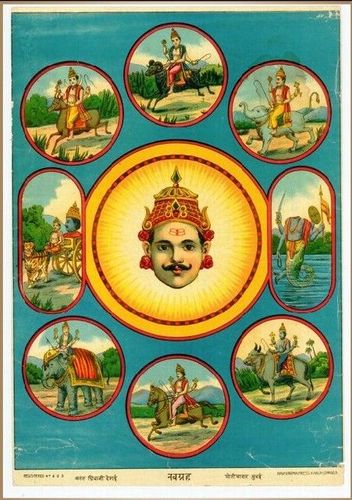
These uneven life-arcs are not random. In jyotish, they correspond to the planet ruling each life-period: the mahadasha. Different planets activate at different times in your life. Each planet's dasha brings forward the qualities of that planet, both its blessings and its difficulties. Knowing which dasha you are in tells you a substantial part of what to expect, and what to work with.
This article walks through what the Vimshottari dasha system is, how to read your current dasha, and what each planet's mahadasha brings.
The Vimshottari system
The Vimshottari dasha is the most widely used dasha system in Indian jyotish. The word vimshottari means "120," because the total cycle spans 120 years.
The system divides this 120-year cycle into nine planetary periods, each governed by one of the nine grahas. The lengths are fixed:
- Ketu: 7 years
- Shukra (Venus): 20 years
- Surya (Sun): 6 years
- Chandra (Moon): 10 years
- Mangal (Mars): 7 years
- Rahu: 18 years
- Brihaspati (Jupiter): 16 years
- Shani (Saturn): 19 years
- Budha (Mercury): 17 years
The cycle always runs in this order. After a Ketu period, Shukra follows. After Shukra, Surya, and so on.
The order in which you encounter these periods in your life depends on the nakshatra in which your Moon was placed at birth. This determines your starting dasha: the planet whose period you were already partway through when you were born. The cycle continues from there.
A worked example
Say you are born with the Moon in the Ashwini nakshatra. Ashwini is ruled by Ketu. Your starting dasha is therefore Ketu. Depending on exactly where in Ashwini the Moon was, you might have started with anywhere from 7 years of Ketu down to less than a year.
If you happened to be born with 5 years of Ketu mahadasha still ahead of you, your sequence would be:
- 0 to 5 years: Ketu (remainder)
- 5 to 25 years: Shukra
- 25 to 31 years: Surya
- 31 to 41 years: Chandra
- 41 to 48 years: Mangal
- 48 to 66 years: Rahu
- 66 to 82 years: Brihaspati
- 82 to 101 years: Shani
- 101 to 118 years: Budha
- 118 to 120 years: Ketu (next cycle begins)
This is the framework. Within each mahadasha, there are sub-periods (antardashas) governed by other planets in similar proportions. The dasha system is fractal: each planet's dasha contains sub-periods of all nine planets, each containing further sub-periods, down to days and hours.
For practical reading, the mahadasha and antardasha are the two layers most often considered.
What each mahadasha brings
The character of any mahadasha depends on three factors:
The planet itself. Each planet has its own nature.
The planet's placement in your chart. A planet well-placed gives mostly positive results in its dasha. A weak or afflicted planet gives mostly challenging results.
The planet's strength. Dignity (own sign, exalted, friendly sign, neutral, debilitated) determines how powerfully the planet expresses its nature.
A general guide to each planet's mahadasha follows. These are the unmodified characters; your chart's specifics will adjust them.
Surya mahadasha (6 years)
The sun's period. Authority, recognition, government connections, leadership. Often a period of visible success in career. The body's vitality is strong. Father figures play important roles. The ego asserts itself, both positively and as a potential source of conflict.
Pitfalls: arrogance, conflicts with authority, problems with the father, heart-related health issues.
Chandra mahadasha (10 years)
The moon's period. Emotional life is foreground. Connection to the mother and to the home is strong. Mental fluctuations more pronounced. Often a period of marriage, family formation, or significant home changes.
Pitfalls: mood instability, water-related afflictions, troubles with the mother.
Mangal mahadasha (7 years)
Mars's period. Action, energy, decisiveness, often conflict. The body's heat increases. Drive to achieve is strong. Land acquisition, property dealings, surgical interventions, may all happen in this period.
Pitfalls: anger, accidents, disputes, blood-related health issues.
Budha mahadasha (17 years)
Mercury's period. The intellect dominates. Education, business, writing, speech, communication all flourish. A long period that can be transformative for career and intellectual development.
Pitfalls: nervous strain, deceptive partners, communication breakdowns.
Brihaspati mahadasha (16 years)
Jupiter's period. Considered the most auspicious of the nine. Wisdom, dharma, prosperity, expansion. Spiritual life often deepens. Children, education, philosophy, all favorable areas.
Pitfalls: overconfidence, weight gain, liver issues, occasional unrealistic optimism.
Shukra mahadasha (20 years)
Venus's period. Pleasure, beauty, art, romance, marriage, comforts. The longest single planetary period at 20 years. Often produces material prosperity and refined enjoyment.
Pitfalls: indulgence, romantic complications, kidney issues, financial extravagance.
Shani mahadasha (19 years)
Saturn's period. The most feared of the nine, often unfairly. Discipline, longevity, service, hard work. Saturn rewards consistent effort and punishes carelessness. Almost always involves significant burdens or responsibilities.
Pitfalls: depression, isolation, chronic health issues, loss, delay.
But: Shani well-placed can give one of the most enduring kinds of success. The lessons of a Saturn period stay with the native for life.
Rahu mahadasha (18 years)
Rahu's period. Desire, ambition, foreign connections, technology, unconventional paths. Rahu can give dramatic worldly success or equally dramatic falls. Often the period of greatest material expansion in a chart.
Pitfalls: maya (illusion), addictions, deceptive gains, scandals, mental disturbances.
Ketu mahadasha (7 years)
Ketu's period. Detachment, spirituality, sudden insight, dissolution. Often a period of release: of old patterns, of relationships, of identities. The shortest of the planetary periods, but often the most transformative spiritually.
Pitfalls: feelings of meaninglessness, sudden losses, accidents.
What to do with this
Knowing your dasha helps in three ways.
Calibrating expectations. A Saturn mahadasha is not the time to expect dramatic worldly expansion. A Jupiter mahadasha is not the time to fear catastrophic loss. Working with the dasha's natural grain is easier than fighting against it.
Timing major decisions. Jyotishis traditionally advise clients on when to undertake significant ventures: marriage, business launches, property purchases. The interaction of mahadasha and antardasha tells whether the timing is favorable.
Understanding the past. Looking back at your life, you can often identify how the dasha periods correlated with your actual experience. The Saturn period was when you struggled with the long-term project that taught you discipline. The Jupiter period was when your career took off. The Rahu period was when you became obsessed with that one venture.
This retrospective recognition is itself useful. It helps you trust the system going forward.
The antardasha layer
The antardasha (sub-period within a mahadasha) modifies the mahadasha's character considerably.
For example, you may be in Shani mahadasha (19 years, often difficult). But within that, you might currently be in Shani-Brihaspati antardasha (Brihaspati sub-period within Shani). The Brihaspati sub-period typically gives several years of upliftment within the otherwise challenging Saturn period. This is when, traditionally, marriages happen during Saturn periods, or when career breakthroughs occur.
Conversely, Shani-Rahu antardasha is one of the most challenging combinations possible. Even an otherwise well-placed chart can produce difficulty during these periods.
A skilled jyotishi reads both layers together: the mahadasha gives the chapter, the antardasha gives the scene within the chapter.
How to know your current dasha
Generate your kundli on this platform or any reliable kundli service that includes the Vimshottari dasha calculation. Most modern kundli generators include this by default.
The output will show your current mahadasha and antardasha, along with the start and end dates. Some show several layers further (pratyantar, sookshma, prana), useful for very fine timing work.
A note on dasha-only readings
Some jyotishis offer "dasha-only" readings: telling you what the next few years will bring based on your dasha sequence. These can be useful but should not be taken as the full picture.
The dasha tells the timing. The chart tells the content. A dasha-only reading is like knowing what season is coming without knowing what was planted. It is partial information.
A complete reading combines dasha sequence with chart placements, current transits, and the specific yogas in your chart. This is what skilled jyotishis do. It takes longer but is more reliable.
Closing
The dasha system is one of the most distinctive contributions of Indian jyotish. It gives the chart a temporal dimension that most other astrological systems lack. Your life is not just shaped by planetary positions; it unfolds through planetary periods, each one bringing forward a different set of themes.
Knowing your dasha is one of the simplest and most practical pieces of jyotish information you can have. The shastras have refined this system across two thousand years. Modern jyotishis continue to test and validate it.
If you do not know your current dasha, find out. The next several years are running on it. Knowing what planet is the host of your current chapter, the rest of your chart will tell you much about how to navigate it well.