The instruction manual the rishis left
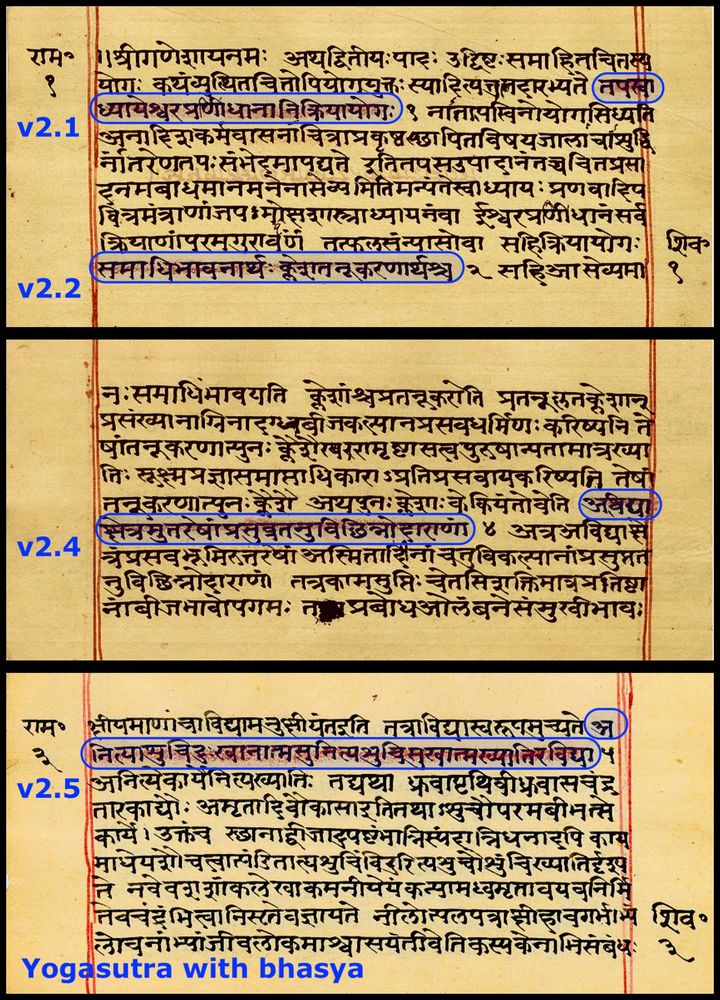
The Yoga Sutras of Patanjali are the foundational text of yoga as a practice. Written approximately two thousand years ago, they are short, dense, and systematically organized. The full text is 196 sutras (short verses), arranged in four chapters. A careful reading takes a few hours.
What the Sutras give is a complete instruction manual for the inner work. Not philosophy in the abstract, not devotion to a deity, not ritual practice. A method. Step by step, from the first stirrings of attention to the deepest states of consciousness. Two thousand years on, the method still works.
This article walks through what the Yoga Sutras are, what they teach, and why this text is worth a serious place on your shelf.
What yoga actually is
Patanjali's definition of yoga, given in the second sutra of the first chapter, is one of the most famous lines in the text:
Yogas chitta vritti nirodhah
Yoga is the cessation of the modifications of the mind.
This is technical. Let me unpack it.
Chitta is the mind, understood as the whole field of mental activity: thoughts, feelings, sensations, memories, the continuous narration that runs in your head.
Vrittis are the modifications of that mind: the specific thoughts, feelings, and mental movements that arise and pass moment to moment.
Nirodha is cessation, stillness, the bringing to rest.
Yoga, in this definition, is the practice of bringing the mind's continuous motion to stillness. Not blanking the mind, which is impossible. Not stopping all thought, which would mean stopping all life. But coming to a state where the mind's activity does not own you, where you can rest in a deeper level of awareness underneath the activity.
This is the entire project. The 196 sutras describe how to do it.
Patanjali's identity
Almost nothing is known about Patanjali the historical person. The Yoga Sutras are attributed to him, but the text itself does not say who he was, when he wrote, or where he lived. Scholarly estimates of the text's date range from 200 BCE to 400 CE.
What can be said is that the text is the work of someone who had thoroughly mastered the practices it describes. The Sutras are too systematic, too precise, and too internally consistent to be the product of theoretical speculation. They read like the work of someone who is teaching from direct experience.
The text was preserved by oral tradition before being widely written down. Commentaries on the Sutras began appearing centuries after the original text; Vyasa's commentary, written around the 5th century CE, is the most influential.
The eight limbs
The most famous teaching in the Yoga Sutras is the ashtanga (eight-limbed) path, given in chapter 2. Patanjali divides the yoga practice into eight progressive stages:
1. Yama: ethical restraints
Five practices that prepare the ground for inner work:
- Ahimsa: Non-violence in thought, word, and action
- Satya: Truthfulness
- Asteya: Non-stealing
- Brahmacharya: Continence and proper use of energy
- Aparigraha: Non-grasping, non-attachment to possessions
These are not abstract ethics. They are practical foundations. A person living a violent, dishonest, or grasping life cannot do serious inner work; the agitation those lifestyles produce overwhelms any sitting practice.
2. Niyama: observances
Five personal disciplines:
- Saucha: Cleanliness, of body and environment
- Santosha: Contentment with what one has
- Tapas: Austerity, voluntary acceptance of difficulty
- Svadhyaya: Self-study and study of scriptures
- Ishvara pranidhana: Devotion to the divine
Where yamas govern outer behavior, niyamas govern inner discipline. Together, the yamas and niyamas constitute a complete ethical foundation.
3. Asana: posture
The seat. Specifically, in Patanjali's framing, the steady and comfortable seat in which the meditator can sit for extended periods. The modern conflation of yoga with physical postures and exercise classes is a development of the past hundred years, mostly post-1900s. In the Sutras, asana is one limb of eight, and refers narrowly to the meditation seat.
This is not a criticism of modern yoga practice; many of the postures developed in the modern era do support the eight-limb structure. But it is worth noting that when Patanjali says "asana," he does not mean an hour of vinyasa flow.
4. Pranayama: breath control
The discipline of breath, which we covered in our earlier article on pranayama. In the eight-limb context, pranayama is the bridge between the outer practices (yamas, niyamas, asana) and the inner practices (the four that follow). Stabilizing the breath stabilizes the mind enough to begin serious meditation.
5. Pratyahara: withdrawal of senses
The first of the inner limbs. The senses, normally pulled outward to their objects (the eye to sights, the ear to sounds), are voluntarily withdrawn. This is not the same as not seeing or not hearing; it is the practice of not following each sensory input with attention. The senses become like a tortoise drawing in its limbs, available but not exposed.
Pratyahara is the threshold between outer and inner yoga. Below this stage, the practice is mostly preparation. Above it, the real inner work begins.
6. Dharana: concentration
Sustained attention on a single object. The mind, which normally moves continuously, is held on one chosen focus: the breath, a mantra, an image, a candle flame, the third eye. The mind will wander; the practice is to return it, again and again, to the chosen object.
Dharana is hard work. The early stages of meditation practice are almost entirely dharana, returning the wandering mind to the object hundreds of times in a single sitting. There is no shortcut to this stage.
7. Dhyana: meditation
When dharana has been sustained long enough that the mind no longer needs to be returned, when attention rests effortlessly on the object, that is dhyana. The flow of consciousness toward the object becomes continuous, like oil being poured from one vessel to another.
This is what most modern people imagine when they say "meditation." But it is the seventh limb, not the first. Six stages of preparation come before it. People who try to begin with dhyana, without the preceding limbs, usually find that the mind refuses.
8. Samadhi: absorption
The final limb. The meditator's awareness merges with the object of meditation. The distinction between meditator, meditation, and the meditated dissolves. Only awareness remains.
Patanjali describes several levels of samadhi, from the relatively superficial to the ultimate (kaivalya, complete liberation from the cycle of bondage). The deeper levels of samadhi are rare even among long-time practitioners. The shallower levels can be reached by sustained practice.
What the Sutras actually deliver
Reading the Yoga Sutras, several characteristics stand out:
Precision. Every term is defined. Every step is sequenced. Patanjali is not poetic; he is precise. This makes the text harder to read but more useful as a practical manual.
Empirical orientation. The Sutras describe what to do and what to expect from doing it. They are not arguing from metaphysical premises; they are reporting from practice. Like a chemistry textbook, the value is in the reliability of the procedures, not in their philosophical pedigree.
Universal applicability. Patanjali does not require belief in specific deities, specific cosmologies, or specific lineages. The Sutras can be practiced by a devout Hindu, a secular westerner, a Buddhist, or anyone with the willingness to follow the procedures. This universality is part of why yoga has spread globally as it has.
Realistic timeline. Patanjali does not promise quick results. The Sutras describe practices that take decades to mature. They also describe what intermediate stages look like, so the practitioner can track progress.
A practical reading approach
If you want to read the Yoga Sutras, here is the approach that works for most people:
Find a good translation. Several exist. Iyengar's "Light on the Yoga Sutras of Patanjali" is widely respected. Edwin Bryant's "The Yoga Sutras of Patanjali" is more scholarly. Swami Satchidananda's translation is accessible for beginners. Any of these will serve.
Read the text once, completely. First read for general structure. Do not stop to try to fully understand each sutra. The first complete read should take three or four hours.
Then read it again, slowly. Second read with attention to each sutra. Notice which sutras feel alive to you and which feel theoretical. The alive ones will change as your practice deepens.
Use a commentary alongside. The Sutras are too compressed to read on their own. The commentary unpacks each sutra into a paragraph or page of explanation, which is what makes the meaning accessible.
Read with practice. The Sutras come alive when read alongside actual sitting practice. Even fifteen minutes of meditation a day, while reading the Sutras, will deepen your understanding of the text faster than any amount of intellectual study without practice.
A final observation
The Yoga Sutras are one of the few ancient texts that have proven directly applicable across two millennia of human change. The methods Patanjali describes work for a software engineer in Bangalore in 2026 as they worked for a monastic in India in 200 BCE. The methods are universal because the mind they address has not changed.
This is one of the most striking features of the inner traditions of Sanatan dharma. The outer world has transformed beyond recognition; the inner work remains the same. The mind that becomes still, in Patanjali's description, is the same mind anyone today can bring to stillness with sufficient practice.
If you have not encountered the Yoga Sutras directly, this is a text worth knowing. It is short. It is practical. It is durable. It contains, in compressed form, much of what the Sanatani tradition has discovered about the human mind across thousands of years.
Read it. Practice with it. The instructions are there. The methods have been verified by countless practitioners. The work remains for each of us to undertake.