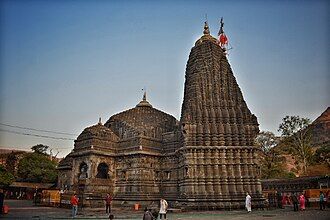

Twelve shrines, one form of Shiva
Across the length and breadth of Bharatvarsha, twelve specific Shiva shrines are held to enshrine a particular kind of lingam: the Jyotirlinga, the lingam of light.
The Jyotirlinga, according to the Shiva Purana, is a self-manifest pillar of light that Shiva produced to settle an argument between Brahma and Vishnu about which of them was greater. The pillar had no beginning and no end. Brahma flew up to find its top, Vishnu dove down to find its bottom. Neither succeeded. They returned and acknowledged Shiva as the supreme.
The pillar of light, in the tradition, eventually condensed into twelve stone lingams across the subcontinent. These are the twelve Jyotirlingas. To visit all twelve is one of the most consequential pilgrimages in Sanatani tradition.
This article walks through all twelve: where they are, what each is known for, and what makes a Jyotirlinga different from any other Shiva lingam.
Why these twelve
The twelve Jyotirlingas are spread across the subcontinent in a pattern that, on a map, traces a rough outline of Bharatvarsha:
- The far north (Kedarnath in Uttarakhand)
- The far south (Rameshwaram in Tamil Nadu)
- The far west (Somnath in Gujarat, Nageshwar near Dwarka)
- The far east (none traditionally, though Vaidyanath is the easternmost)
- The Deccan plateau (Bhimashankar, Trimbakeshwar, Grishneshwar, Mahakaleshwar, Omkareshwar)
- The Gangetic plain (Kashi Vishwanath in Varanasi)
- The south-central (Mallikarjuna at Srisailam)
The geographic distribution is, by tradition, deliberate. The Jyotirlingas are anchor points across the subcontinent, defining the sacred geography of Bharatvarsha. A devotee who visits all twelve has, in effect, traversed the country's spiritual perimeter.
The Dwadasha Jyotirlinga Stotram
The Shiva Purana includes a verse that lists all twelve in order, known as the Dwadasha Jyotirlinga Stotram. It is among the most commonly recited verses in Sanatani worship:
Saurashtre Somanatham cha Srisaile Mallikarjunam Ujjayinyam Mahakalam Omkare Mamleshwaram Paralyam Vaidyanatham cha Dakinyam Bhimashankaram Setubandhe tu Ramesham Nagesham Daruka vane Varanasyam tu Vishwesham Tryambakam Gautami tate Himalaye tu Kedaram Ghusrunesham cha Shivalaye Etani Jyotirlingani sayam pratah pathennarah Sapta janma kritam papam smaranena vinashyati
The reciter of this verse, morning and evening, is said in the verse itself to be freed from the sins of seven lifetimes.
Walking through each:
1. Somnath (Gujarat)
The first. On the Arabian Sea coast of Saurashtra in Gujarat. The temple destroyed seventeen times and rebuilt every time. The lingam is said to have been originally consecrated by Chandra Dev (the moon god) to recover from Daksha's curse.
Currently a major pilgrimage destination. The seventh temple stands on the original site.
2. Mallikarjuna (Andhra Pradesh)
At Srisailam, in the Nallamala hills on the banks of the Krishna river. The temple combines a Jyotirlinga (Shiva as Mallikarjuna) with a Shakti Peetha (the form of Devi worshipped here is Bhramaramba).
The temple is one of the few major shrines where both Shiva and Devi are equally prominent. The two are considered to manifest here together.
3. Mahakaleshwar (Madhya Pradesh)
In Ujjain on the Shipra river. The only Jyotirlinga that faces south. Notable for the Bhasma Aarti performed at 4 AM, in which the lingam is anointed with the ash of the deceased from the previous day's cremations. This is the most viscerally striking ritual in any Sanatani temple.
Ujjain has been a center of Shaivite worship for over two thousand years and was, in ancient times, the second largest city of India.
4. Omkareshwar (Madhya Pradesh)
On an island in the Narmada river. The island itself is shaped like the Sanskrit syllable "Om," which gives the shrine its name. Two temples sit on the island: Omkareshwar (Shiva) and Amaleshwar (Shiva again, in a slightly different form). Pilgrims worship at both.
The Narmada parikrama (circumambulation of the entire Narmada river, a journey of about 2,600 kilometres on foot) traditionally passes through Omkareshwar.
5. Vaidyanath (Jharkhand, by major tradition)
At Deoghar in Jharkhand. The name Vaidyanath means "Lord of physicians"; the lingam is associated with healing. Pilgrims visit to seek cure for serious illness.
A regional debate exists about the location of the true Vaidyanath Jyotirlinga, with some scholars arguing for Parli Vaidyanath in Maharashtra. The Deoghar tradition is the more widely accepted.
The Kavadiya pilgrimage during Sawan month draws several million pilgrims annually to Vaidyanath specifically.
6. Bhimashankar (Maharashtra)
In the Sahyadri hills near Pune. The shrine sits at the source of the Bhima river. Surrounded by dense forest, the area is also home to wildlife sanctuaries.
The Bhimashankar form of Shiva is associated with the destruction of the demon Bhima (different from the Pandava Bhima) and is invoked for victory over difficult situations.
7. Rameshwaram (Tamil Nadu)
On Pamban Island at the southern tip of Tamil Nadu. The lingam was consecrated by Bhagwan Ram himself, returning from Lanka, to atone for the brahmin-hatya dosha incurred by killing Ravana.
The temple has the longest temple corridor in India, lined with carved pillars. The 22 sacred wells inside the complex, each with different water, are bathed in by pilgrims before darshan.
Already covered in our Char Dham Yatra guide.
8. Nageshwar (Gujarat)
Near Dwarka in Gujarat. The shrine is associated with the demon Daruka, who was destroyed by Shiva here. The lingam is enclosed in a small underground sanctum.
A relatively modest shrine compared to the others, often visited as part of the Dwarka pilgrimage.
9. Vishwanath (Uttar Pradesh)
The Kashi Vishwanath, in Varanasi. The most famous of the twelve. The lingam at the heart of the city of Shiva.
Already covered in our Kashi Vishwanath article.
10. Trimbakeshwar (Maharashtra)
Near Nashik in Maharashtra, at the source of the Godavari river. The lingam is unusual: it has three faces, representing Brahma, Vishnu, and Mahesh (Shiva), the trimurti united in one form.
Trimbakeshwar is also one of the principal sites for the Pitri Karma rituals (offerings to ancestors) and the Narayana Nagbali pujas for resolving family karmic burdens.
11. Kedarnath (Uttarakhand)
In the high Himalayas at 3,500 metres. The northernmost of the Jyotirlingas. The temple, accessible only six months a year due to snow, is one of the most arduous Jyotirlinga pilgrimages.
The lingam at Kedarnath is in the shape of a buffalo's hump, said to be the back of the Lord Shiva who, fleeing from the Pandavas, dove into the ground at this spot leaving only his back exposed.
12. Grishneshwar (Maharashtra)
Near Aurangabad in Maharashtra, adjacent to the famous Ellora caves. The smallest and least frequented of the Jyotirlingas, but no less consequential in the tradition.
Grishneshwar is associated with the story of Kusuma, a devoted woman whose dead son was restored to life by Shiva at this site, in answer to her prayers.
The pilgrimage
Visiting all twelve Jyotirlingas is one of the most ambitious pilgrimages in Sanatani tradition. The traditional view: completing the full circuit accumulates significant punya and brings the devotee close to moksha.
In practice, most devotees visit one or two Jyotirlingas in any given pilgrimage, accumulating the full set over many years. The Char Dham circuit covers two (Somnath and Rameshwaram). The Pancha Jyotirlinga in Maharashtra (Bhimashankar, Trimbakeshwar, Grishneshwar, plus Aundha Nagnath if counted) is a popular regional pilgrimage. The Mahakal and Omkareshwar pair in Madhya Pradesh is often done together.
For someone who wants to attempt the full twelve in a single yatra, a 30-40 day circuit by road or rail is possible but demanding. More common is the gradual accumulation across multiple trips spread over years or decades.
The shastras hold that the pilgrim who completes all twelve sees Shiva himself before death.
What makes a Jyotirlinga different
All Shiva temples house a lingam. What makes the twelve Jyotirlingas particularly powerful?
Self-manifestation. Each of the twelve lingams is svayambhu (self-manifest), not installed by human hands. The lingam emerged from the earth or appeared in the sanctum of its own accord, according to the tradition. Other Shiva lingams are sanctified by pratishtha (consecration) but did not emerge spontaneously.
The cosmic story. Each Jyotirlinga is associated with a specific cosmic story in which Shiva manifested for a particular purpose. The shrines mark places where these events occurred.
The continuous worship. All twelve have been continuously worshipped for at least 1500 years, in most cases longer. The accumulated devotional weight is, in the traditional understanding, a meaningful factor.
The geographic anchoring. Together they constitute a sacred geography of the subcontinent. Worshipping all twelve is, in effect, an act of recognizing Bharatvarsha as a single spiritual unit.
A closing observation
The Jyotirlingas are a reminder that Sanatani worship has always been geographically grounded. The deity is not abstract; the deity sits in a specific place. Pilgrimage is not symbolic; the pilgrim physically goes to that place and stands in front of that deity.
The twelve Jyotirlingas, spread across the subcontinent, have made Shaivite practice a fundamentally embodied tradition. The devotee who has stood at Somnath at sunset, climbed to Kedarnath in summer, walked the corridors of Rameshwaram, and bathed in the Ganga at Kashi has done something with the body that pure devotional contemplation cannot replicate.
If you have visited one or more of the Jyotirlingas, you have begun this journey. If you have not, one of them is likely within reasonable travel distance from where you live. The pilgrimage has been waiting for thousands of years. Each visit completes a little more of the circuit. Each circuit, in the texts, leaves the pilgrim a little closer to Shiva.
Begin where the road allows. Continue when you can. The twelve will, between them, walk you across the spiritual perimeter of your own civilization.