In countless Indian courtyards stands a small raised pedestal with a tulsi plant growing from it, watered each morning, a lamp lit beside it each evening. For most of the year it is a quiet daily devotion. But on one day in Kartik, that humble plant becomes a bride, dressed and garlanded, and married with full ceremony to Bhagavan Vishnu. This is Tulsi Vivah, and it is one of the most tender festivals in Sanatan dharma.
The day the world reopens
Tulsi Vivah falls on Prabodhini Ekadashi, also called Dev Uthani Ekadashi, the day Vishnu wakes from his four month yoga nidra and the long pause of Chaturmas ends. With his waking, the season of auspicious beginnings returns. Weddings can be held again, and the very first wedding of the season is this one, the marriage of Tulsi to the Lord.
So the festival marks a turning of the year. The monsoon stillness is over. The world resumes, and it resumes with a wedding.
The story of Tulsi
The Puranas tell of Vrinda, a woman of great virtue and unshakeable devotion to Vishnu, whose chastity and faith protected her husband, the asura Jalandhar, and made him invincible in battle. To end Jalandhar's tyranny, the story tells how Vishnu was drawn into breaking the power that her devotion gave, and Vrinda, in her grief, gave up her life.
Honouring her purity and love, Vishnu declared that she would be reborn as the tulsi plant, the most sacred of all plants, and that he would not accept any offering made without a tulsi leaf. Tulsi Vivah celebrates the eternal union of Vrinda, as Tulsi, with Vishnu, often worshipped here in his form as the shaligram stone or as Krishna.
How it is kept
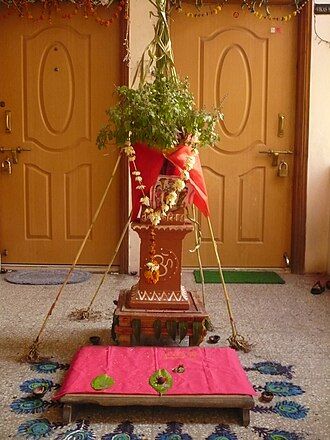
In homes, the tulsi pedestal, the tulsi vrindavan, is cleaned and decorated. The plant is adorned like a bride with a small sari, bangles and a bindi. A shaligram or an image of Vishnu or Krishna is placed beside her as the groom.
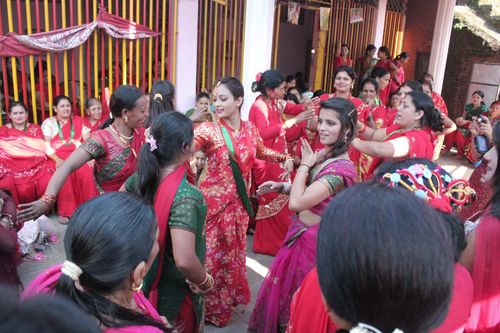
The wedding is then performed much as a human one would be, with a mandap built around the plant, often of sugarcane stalks, with the recitation of vows, the tying of a sacred thread, and the offering of the wedding's traditional items. Sweets are shared, and the household celebrates as it would at any wedding in the family.
What the festival honours
Tulsi Vivah holds several things at once, gently. It honours the tulsi plant, revered in Sanatan dharma not only as sacred but as deeply beneficial, kept at the centre of the home and tended daily. It honours Vrinda's devotion, raising faithfulness and purity of heart to something the divine itself bows to. And it marks the return of light and beginnings after the inward months.
There is also something quietly beautiful in marrying a plant to God. It says that the sacred is present in the living things around us, that the tulsi by the door is not decoration but a member of the household worthy of being given as a bride to the Lord himself.
Keeping it simply
If you have a tulsi plant, this is its day. Clean and decorate it, place an image of Krishna or Vishnu beside it, and perform a simple wedding with whatever sincerity and joy you can bring. Light the lamp, share something sweet, and welcome back the season of beginnings. If you have no plant, Tulsi Vivah is a fitting day to bring one home and give it the place of honour it has always held.