Twelve postures, four thousand years
Surya Namaskar is, in most modern minds, an exercise. A morning workout. A flexibility routine. Twelve postures done in sequence, a few rounds, and you have stretched the body for the day.
This framing is not wrong. It is incomplete.
In its complete form, Surya Namaskar is a sadhana. The asanas are the surface. The breath synchronizes the asanas. The mantras synchronize the breath. The visualization synchronizes the mantras. When all four are present, what looks like a workout is a complete morning practice. The rishis did not design it as exercise. They designed it as worship that incidentally happens to also be exercise.
The structure
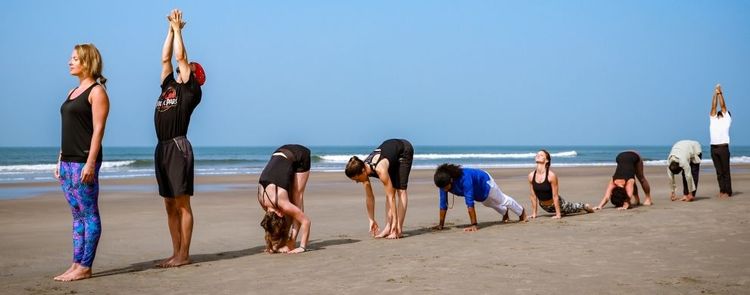
The classical Surya Namaskar has twelve asanas. Each is associated with a name of Surya and with a bija mantra. A complete round flows through all twelve postures, with each posture timed to one breath, with each breath accompanied by its mantra and the visualization of its corresponding name of the sun.
The twelve postures, in order:
- Pranamasana (prayer pose)
- Hasta Uttanasana (raised arms pose)
- Hastapadasana (forward bend)
- Ashwa Sanchalanasana (equestrian pose, right leg back)
- Dandasana (plank, or chaturanga, depending on tradition)
- Ashtanga Namaskara (eight-limbed salutation)
- Bhujangasana (cobra)
- Adho Mukha Svanasana (downward dog)
- Ashwa Sanchalanasana (equestrian pose, left leg forward)
- Hastapadasana (forward bend)
- Hasta Uttanasana (raised arms)
- Pranamasana (return to prayer)
One full round completes back to standing prayer. The next round begins.
The twelve names of Surya
Each posture corresponds to one name of Surya. These are not random epithets; each name describes a specific aspect of solar energy and is invoked at the relevant posture:
- Om Mitraya Namaha (to the friend)
- Om Ravaye Namaha (to the radiant)
- Om Suryaya Namaha (to the dispeller of darkness)
- Om Bhanave Namaha (to the shining)
- Om Khagaya Namaha (to the one who moves in the sky)
- Om Pushne Namaha (to the nourisher)
- Om Hiranyagarbhaya Namaha (to the golden womb of creation)
- Om Marichaye Namaha (to the ray)
- Om Adityaya Namaha (to the son of Aditi)
- Om Savitre Namaha (to the stimulator)
- Om Arkaya Namaha (to the worthy of praise)
- Om Bhaskaraya Namaha (to the giver of light)
In a complete practice, these are recited at the corresponding posture, either aloud or silently. The mind, instead of counting reps, is naming the sun in twelve forms.
The breath
Each posture has a designated breath: inhale or exhale. The pattern is:
- Prayer: neutral, settling
- Arms up: inhale
- Forward bend: exhale
- Right leg back: inhale
- Plank: hold or exhale
- Eight-limbed: exhale (often with breath held briefly)
- Cobra: inhale
- Down dog: exhale
- Left leg forward: inhale
- Forward bend: exhale
- Arms up: inhale
- Prayer: exhale, return
The body moves on the breath, not on the count. A round takes as long as the breath takes. Twelve breaths, twelve asanas, twelve mantras, twelve names of the sun. The mathematics of the practice is its own teaching.
How many rounds
The classical recommendation is twelve rounds per session: one full cycle of Surya Namaskar for each name of the sun, then twelve cycles for one full sadhana.
For a beginner, three to six rounds is sufficient. The body needs time to adapt to the chest-to-floor and back-bend transitions. Forcing rounds without preparation injures the lower back and shoulders.
A serious practitioner, after a few months, can do twelve rounds in roughly fifteen minutes. This is the traditional target.
The advanced practice goes to 108 rounds. This takes a couple of hours and is done as a tapasya, often on Sundays or on Sankranti days. The body that can complete 108 rounds is doing something very different from the body that does three.
When and where
When: Sunrise. The traditional practice is done facing east, ideally with the rising sun directly visible. The body, the breath, the mantras, and the sun are all engaged in one circuit.
If sunrise is not possible, any time before noon is acceptable. Surya Namaskar is fundamentally a morning practice and loses much of its effect in the afternoon or evening.
Where: Outside, if possible. The sun's actual light on the body during the practice is part of the practice. The receptors in the skin and the pineal gland register sunlight differently than indoor light. The body's clock resets on direct exposure to morning sun.
If outside is impossible, in front of an east-facing window. Indoor practice without sunlight is still beneficial; it is just not the complete practice.
Surface: A yoga mat or a folded cotton sheet. Bare floor is too hard on the wrists in plank and the knees in the equestrian pose.
When to avoid Surya Namaskar
The practice is not universally recommended. Skip it if you have:
- High blood pressure (the inversions and back-bends spike it)
- Recent back, knee, or shoulder injury
- A hernia
- Active menstruation (most traditional teachers recommend pausing for these days)
- Pregnancy beyond the first trimester
- Severe heart conditions
If you have any of these, modify or substitute. A modified form sitting in a chair, doing the upper-body postures only, still gives some of the benefit.
What changes when you do it daily
The first week, the body protests. The wrists ache. The lower back tightens. The breath does not synchronize with the movement.
By the second week, the body adapts. The asanas flow more smoothly. The breath catches up.
By the second month, the practice shifts internally. The mantras, repeated daily, become a kind of background mental music. The mind that used to wander during the practice begins to settle. You start the day with twelve minutes of focused attention to the body, the breath, and the sun. Whatever else happens that day, that foundation is already laid.
After six months of daily practice, the cumulative effect is the kind of thing the texts describe: a body that recovers faster, a mind that is harder to disturb, a relationship to the sun that goes beyond looking at it through a window. The sun becomes a presence in the day rather than an external object.
A closing thought
The modern fitness industry has discovered Surya Namaskar and packaged it as cardiovascular exercise. This is fine. The exercise is real, and the marketing brings new practitioners to the practice. But the practice is older than fitness. It is older than yoga as a discipline distinct from spirituality. It is one of the oldest documented body-mind techniques in any tradition.
If you do Surya Namaskar already, try adding the mantras and the names for one round each morning. Notice what changes.
If you do not do it yet, three rounds tomorrow morning is enough to begin. Face east. Breathe. Move with the breath. Acknowledge the sun. Let everything else in the day come after that.
The rishis built this practice for ordinary householders. It has been waiting for you. It costs fifteen minutes a day. It pays back, the texts say, for a lifetime.