A temple on the Arabian Sea
On the western coast of Gujarat, where the land meets the Arabian Sea, stands a temple that has been destroyed seventeen times. Each time, in some form, it has been rebuilt.
The temple is Somnath. The lingam inside, by tradition, is the first of the twelve Jyotirlingas. The shrine is older than recorded Indian history and has, by the conservative count of historians, been a continuously living place of worship for over fifteen hundred years.
What makes Somnath remarkable is not just its antiquity. It is that this shrine has stood, fallen, stood again, fallen again, in a pattern of destruction and resurrection that no other temple in the world has matched.
This is the temple that refused to die.
The earliest history
The traditional account dates Somnath to the early Vedic period. The Skanda Purana describes the lingam as having been consecrated by Chandra Dev (the moon god) himself after Daksha's curse caused his diminishment. Worshipping the lingam restored Chandra to his full form. The shrine takes its name from this event: Soma (Chandra) plus natha (lord), the Lord of the Moon.
Archaeological evidence places a temple at the site by at least the 4th century CE. The Mahabharata and the early Puranas reference Somnath as an already-old shrine. A 5th-century stone-built temple is documented in inscriptions; this was likely a stone reconstruction of an older wooden or modest stone shrine.
By the 9th and 10th centuries CE, Somnath was wealthy. The temple complex covered tens of acres. The main shrine was overlaid with gold. Pilgrims from across the subcontinent visited; foreign visitors recorded astonishment at its scale and wealth. The Arab geographer Al-Biruni, who visited India in the early 11th century, described Somnath as one of the wonders of the East.
The first major destruction
In 1024 CE, Mahmud of Ghazni, the Turkic-Persian ruler of Ghazna in present-day Afghanistan, led his sixteenth (and most famous) raid into India. His target was Somnath.
The motivations were both religious and economic. Mahmud was a fervent iconoclast who saw the destruction of major non-Islamic shrines as a religious duty. But Somnath was also fabulously wealthy. The temple's accumulated treasures of fifteen hundred years of donations represented an irresistible target.
Mahmud reached Somnath in January 1025. The temple was defended by an estimated fifty thousand devotees who had gathered for the Shivaratri festival. The battle lasted three days. Mahmud's forces broke through the temple walls. The lingam was destroyed. The gold was carried back to Ghazna, where it adorned Mahmud's tomb. Tens of thousands of defenders were killed.
This was the first major destruction. It would not be the last.
The cycle of destruction and rebuilding
The destruction of 1025 was followed by a rebuilding. The Solanki king Bhima I of Anhilwara reconstructed the temple within a generation, by 1042. The reconstruction was lavish; the wealth had not been entirely lost, merely shifted from one form to another.
In 1297, Alauddin Khilji's forces destroyed the temple again. It was rebuilt by Mahipala I of the Chudasama dynasty in 1308.
In 1395, Muzaffar Shah of the Gujarat Sultanate destroyed it. Mahmud Begada destroyed it again in 1451.
In 1546, Mahmud Shah III destroyed parts of it.
In 1665, Aurangzeb ordered its destruction once more.
Each destruction was followed by a rebuilding, sometimes within years, sometimes after decades. The pattern was so persistent that by the seventeenth century, the temple's identity had become inseparable from its history of repeated destruction and renewal.
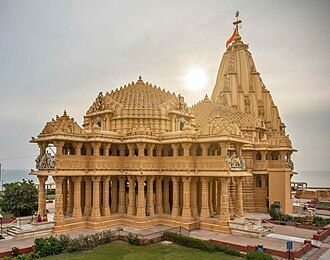
The seventh and current temple, in its present form, was built in 1951 by the Government of India, with Sardar Vallabhbhai Patel personally championing its reconstruction. Patel saw the rebuilding as an act of cultural healing. The lingam was reconsecrated on 1 May 1965 with President Rajendra Prasad performing the pratishtha ceremony. The temple is built of dressed stone in the Chalukya style, on the original site.
What makes Somnath different
Many Indian temples were destroyed in the medieval period. Many were rebuilt. What makes Somnath particular?
The geographic exposure. Somnath sits directly on the Arabian Sea coast, the natural landing point for invasions from Persia and Central Asia. Inland temples could be protected by distance, by forests, by mountain passes. Somnath could not. It was reachable.
The wealth concentration. The temple's continued wealth made it a target. Each rebuilding required substantial resources; once rebuilt, the temple again attracted donations that swelled its treasury. The wealth that funded reconstruction also marked the temple for the next attack.
The symbolic weight. Of the twelve Jyotirlingas, Somnath is the first by tradition. To destroy Somnath was, for iconoclastic invaders, to strike at the heart of Sanatani worship. The symbolism was understood on both sides. Each destruction was, in part, an attempt to break Sanatani morale. Each rebuilding was, in part, an affirmation that morale was not broken.
The community's persistence. The most striking feature is the steady persistence of the Sanatani community in rebuilding. Across nearly a thousand years, through dynastic collapses, through invasions, through periods of weakness, the temple was repeatedly raised again. This was not centrally directed. It was the result of countless local actors, kings and merchants and devotees, who refused to let the shrine remain destroyed.
The current temple
The temple as it stands today is a remarkable structure. Built of pink sandstone, it rises seventy-five metres above the sea. The main shikhara is topped by a kalash weighing ten tonnes. The lingam is inside the inner sanctum, lit by oil lamps that are kept burning continuously.
The temple complex includes a museum displaying fragments of the earlier temples recovered from archaeological excavations. The pieces tell their own story: the layered destruction, the styles changing across centuries, the same site holding different temples across time.
A visitor to Somnath today walks on ground that has held a continuously worshipped shrine for at least fifteen hundred years, possibly much longer. The lingam is new in the current temple, but the worship is continuous with the worship of the lingam destroyed in 1024.
What to do at Somnath
The temple is open for darshan daily from 6 AM to 9 PM. The morning Mangal Aarti at 7 AM and the evening Sandhya Aarti at 7 PM are the most powerful times to visit.
Bathe at the nearby Triveni Sangam, where three rivers meet the Arabian Sea, before darshan. This is the traditional pre-darshan ritual.
Visit the museum after darshan. The artifacts are extraordinary and contextualize what you have just seen.
In the evening, attend the Light and Sound show held at the temple. It narrates the temple's history, including the destructions and rebuildings, in dignified terms. It is not without controversy (some critics find it triumphalist) but it is well-produced and historically grounded.
If time permits, visit Triveni Ghat, the Gita Mandir near the temple (where Krishna is said to have given his final teachings before leaving his body), and the Bhalka Tirth where Krishna left his mortal form.
Why this temple matters now
In an era when much of the world treats its religious heritage as either museum piece or political weapon, Somnath occupies an unusual position. It is a living temple, daily worshipped, deeply connected to its history of destruction. But it is also a national monument that represents, in concrete form, a particular Sanatani response to historical violence: to acknowledge it, to remember it, and to rebuild.
The Somnath temple's response to a thousand years of destruction was not to forget, was not to retaliate, was not to nurse grievance. It was, repeatedly, to rebuild. The rebuilding is the answer. The continuity of worship is the answer. The same lingam offered the same prayers, in the same place, despite everything that came between, is the answer.
The temple does not declare victory over its destroyers. It simply outlasts them.
Standing at Somnath, watching the sea move slowly outside the shrine, you understand something about the Sanatani sense of time. The destroyers came and went. The dynasties came and went. The shrine remained. It will remain.