A river that ran for thousands of years, then stopped
The Rigveda, the oldest text in Sanatani tradition, mentions a river. It calls her the greatest of rivers (Naditame). It places her between the Yamuna and the Sutlej. It describes her as flowing from the mountains to the sea, broad and powerful, lined with cities and rituals. Her name is Saraswati.
Today, no river by that name flows where the Rigveda says she did. The space between the Yamuna and the Sutlej is largely dry plains, with seasonal streams that disappear by April. The Saraswati of the Rigveda is, by every appearance, gone.
For most of the modern era, scholars treated this as evidence that the Rigveda was mythologizing. Saraswati was a sacred concept, not a real river. The Sanatani tradition, which has continued to invoke Saraswati for three thousand years and to identify Allahabad as her invisible confluence with the Ganga and Yamuna, was assumed to be carrying a beautiful fiction.
Then, in the late twentieth century, satellite imagery began to suggest something different.
What the satellites saw
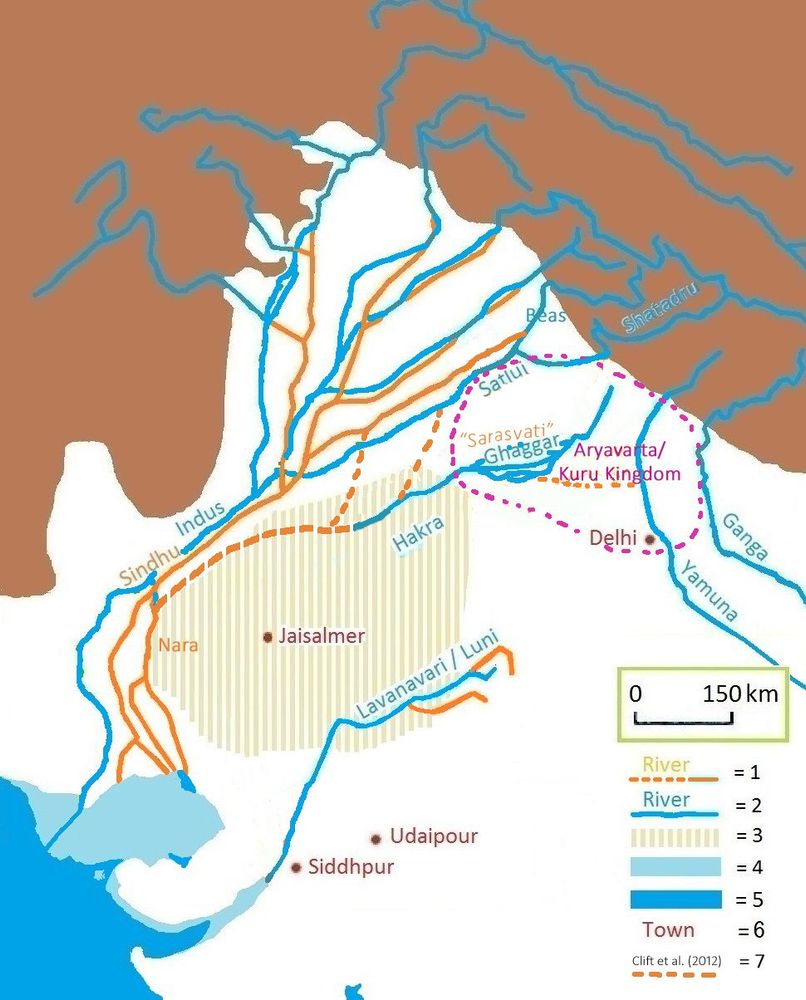
In 1980, the Indian Space Research Organisation began using infrared satellite imagery to map subsurface geology across northwest India. The images revealed something striking: a broad palaeochannel, traceable across hundreds of kilometres, running from the Himalayan foothills near present-day Yamuna Nagar southwest to the Rann of Kutch.
The channel showed up clearly in infrared because soil moisture in the buried former riverbed differs from surrounding terrain. Subsequent ground surveys, drilling, and isotope dating confirmed: water had flowed through this channel for tens of thousands of years, before it stopped.
The location of this palaeochannel matches the Rigveda's description of Saraswati with uncanny precision. The river ran between the Yamuna and the Sutlej. It originated in the high Himalayas. It flowed broad and powerful. It reached the sea in what is now the Rann of Kutch.
Hundreds of Harappan-era archaeological sites have been found along this dry channel. The civilizational density along the Saraswati's banks, in the third millennium BCE, exceeded that along the Indus. Cities like Rakhigarhi, Kalibangan, Bhirrana, and Banawali, all major Harappan sites, sit on what was once the Saraswati's course.
Why she dried up
Geological evidence from the last forty years has reconstructed the story.
The Saraswati was originally fed by two main tributaries: the Sutlej from the west, and the Yamuna from the east. Both flowed into a central river that crossed the plains southwestward.
Around 4,000 to 3,500 years ago, two tectonic events shifted the rivers. The Sutlej, due to uplift in the Himalayan foothills, changed course westward and began flowing into the Indus. The Yamuna, due to similar tectonic shifts, changed course eastward and began flowing into the Ganga.
The Saraswati, deprived of both its main tributaries within a relatively short geological window, began to dry up. The flow weakened. The river became seasonal. Eventually, except for monsoon channels and groundwater recharge in the buried palaeochannel, the surface river disappeared.
This was a slow event by human standards, lasting centuries, but a rapid one by geological standards. People living along the Saraswati would have witnessed the river dying within several generations. They migrated. The Harappan civilization, dependent on the Saraswati for irrigation and trade, declined and dispersed eastward and southward.
Why this matters
The Saraswati story is not just a curiosity. It changes our understanding of three things.
The dating of the Rigveda. The Rigveda describes the Saraswati in her full flowing form, between the Yamuna and the Sutlej. If she dried up around 3,500 years ago, the relevant verses must predate that drying. Either the Rigveda is older than the conventional scholarly dating of 1500 BCE, or it preserves a memory of an older time. Either possibility revises the timeline of Sanatani literary tradition.
The Harappan-Vedic question. Western scholarship long held that the Harappan and Vedic cultures were distinct, with the Vedic culture arriving after the Harappan decline. The Saraswati's identification as the Harappans' main river complicates this. If the Vedic people were aware of and named the Saraswati, they were likely contemporaneous with at least the late Harappan period, not arriving after it.
The reliability of oral tradition. A river that died 3,500 years ago is remembered, named, and located accurately by texts that have been transmitted orally and in writing across that gap. This is a non-trivial datum about the durability of Sanatani textual memory.
What of the modern observance
For Sanatanis, the Saraswati never disappeared. She went underground, by tradition, and continues to flow invisibly. The Triveni Sangam at Allahabad (Prayagraj), where the Ganga and Yamuna meet visibly, is held to be the place where Saraswati joins them as the invisible third river.
Hydrology has recently lent some weight to this. The groundwater under Allahabad has been shown to have a distinct isotopic signature consistent with Himalayan glacial origin, different from the Ganga and Yamuna water chemistry. Some geologists now describe the Allahabad groundwater as a subsurface palaeochannel continuation of the dried Saraswati.
Whether one accepts this interpretation literally or not, the Sanatani assertion of three rivers at Allahabad turns out not to be poetic license. There is something there.
The puja for Saraswati is still performed across India on Vasant Panchami. The goddess associated with the river, Saraswati, remains one of the most widely worshipped deities. The connection between the river and the goddess of learning is itself a Sanatani insight: rivers in the tradition are routinely identified as conduits of culture and knowledge, not just water. The Saraswati's drying up was, in the tradition, accompanied by a loss of Vedic learning in that region. The two losses moved together.
What recent research has found
In the last twenty years, several research initiatives have continued to map and characterize the Saraswati:
The Geological Survey of India and the Central Ground Water Board have conducted extensive subsurface mapping. The palaeochannel is now well-documented from satellite imagery to ground borings.
Several state governments along the river's old path (Haryana, Rajasthan, Gujarat) have established Saraswati Heritage projects, partially reconstructing seasonal flow in stretches and developing the archaeological sites along the way.
Carbon dating at Bhirrana in Haryana, a Harappan-era site on the Saraswati's banks, has produced dates as early as 7570 BCE, making it one of the oldest known agricultural settlements in the subcontinent.
These findings remain subject to ongoing scholarly debate. Some details, particularly the relative roles of the Sutlej and Yamuna in feeding the Saraswati, are still being refined. But the basic existence of the river, her drying around 3,500 years ago, and her correspondence with the Rigvedic descriptions, are now broadly accepted across Indian geology, archaeology, and Vedic studies.
A closing observation
The Saraswati is one of the cleaner test cases for taking Sanatani tradition seriously without taking it credulously. The tradition said: a great river once flowed there. The tradition was treated as poetic for two hundred years. Then the satellites looked, and the river was there, just where the tradition had placed her.
This does not, by itself, vindicate every Sanatani claim. But it suggests a useful default: when the tradition's specific empirical claims can be checked, check them carefully before concluding they are imaginary. Tradition is often a long memory, encoded in ritual, that is more durable than written record. Sometimes the verses are doing geography, not just poetry.
The Saraswati is dry. The Saraswati is remembered. Both are now established facts. The river goddess in your house, the puja you may have done on Vasant Panchami, the verses your grandmother recited, refer to something that was actually there. It is gone, but its absence is shaped exactly like its presence used to be. That is, in its own way, a kind of permanence.