The forgotten daily duty
Three times a day, traditionally, every Sanatani was expected to stop whatever he was doing, face the sun, and offer worship. At sunrise, at noon, at sunset. The practice was called Sandhya Vandana, and it was considered as essential as eating.
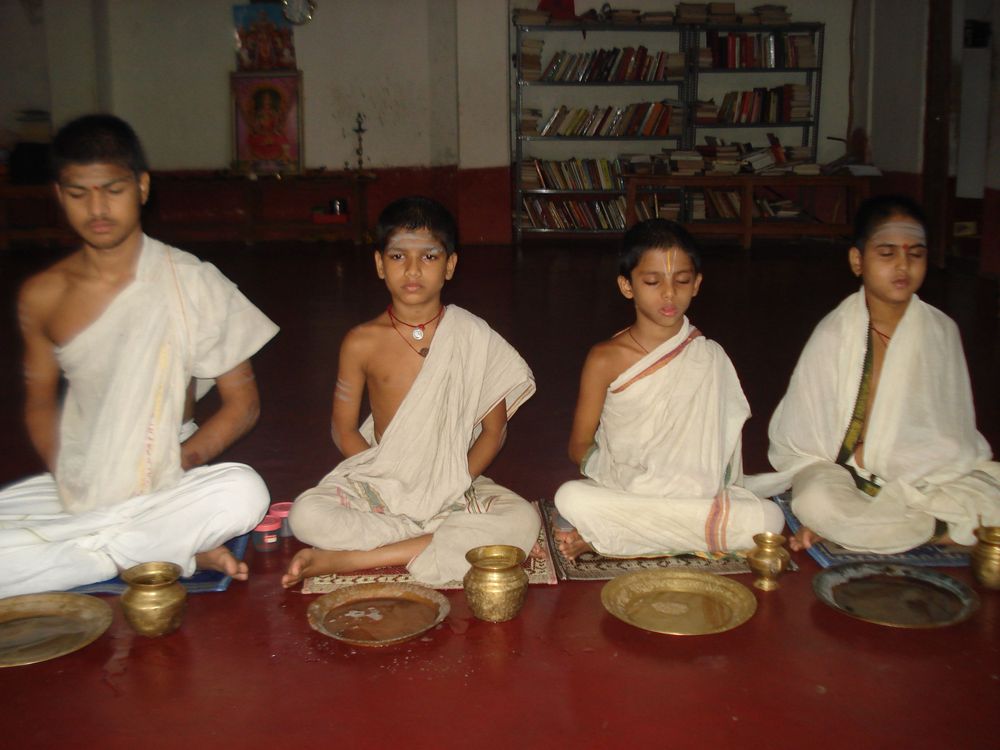
A boy who had received upanayana, the sacred thread ceremony, was obliged to do Sandhya Vandana from that day forward, for the rest of his life. Skipping it was a serious lapse. Doing it badly was less serious than not doing it at all.
This practice has largely disappeared. Most Sanatani households today do not perform it. The grandfather who did Sandhya every morning has passed away. The son who saw him do it stopped after upanayana. The grandson does not know it exists.
This article is a reintroduction. Not a complete vidhi (the complete vidhi requires guru initiation), but enough to understand what Sandhya is, what it does, and what we have lost.
What Sandhya means
Sandhya means "junction" or "joining." The three sandhyas are the junction-points of the day: where night becomes morning (pratah sandhya, sunrise), where morning becomes afternoon (madhyahnika sandhya, noon), where day becomes night (sayam sandhya, sunset).
These are the moments when the cosmic balance shifts. The shastras hold that at these junction-times, the boundary between the inner and outer worlds thins. The mind is more porous to subtler influences. Worship done at these times penetrates deeper than at other hours.
Modern observation confirms something parallel. The circadian rhythm responds most sensitively to light at sunrise and sunset. Cortisol spikes at dawn. Melatonin rises at dusk. The body itself, at these times, is in transition. The rishis built a practice around these transitions.
The three components
Sandhya Vandana, in its classical form, has three core components, repeated at all three sandhyas.
Achamana
A purification rite. Water is sipped three times from the palm, with mantras invoking Vishnu's names. The body is touched lightly at specific points with water-touched fingertips. The purpose is to bring the body, the breath, and the mind into a state ready for prayer.
Pranayama
A specific pranayama practice, traditionally three rounds of deep slow breathing with retention. The duration is calibrated to the mental state of the practitioner. The purpose is to calm the senses and bring the awareness inward.
Argya and Gayatri Japa
Argya is the offering of water to the sun. Standing facing the sun, the practitioner takes water in cupped palms and pours it slowly while reciting mantras. The water held briefly in the air refracts sunlight, creating a small spectrum the eyes register. This is intentional: the sun's light is being received and returned.
After argya, the Gayatri Mantra is recited. The traditional minimum is ten times. Twenty-eight is better. One hundred and eight is best. The Gayatri is recited silently or in a low murmur, never loudly. The point is internal absorption, not external display.
The Gayatri, for those who do not know it, is the central mantra of Sandhya:
Om Bhur Bhuvah Svah Tat Savitur Varenyam Bhargo Devasya Dheemahi Dhiyo Yo Nah Prachodayat
We meditate on the radiant glory of the divine Savitr (the sun, in its inner aspect). May that light illuminate our intellect.
This is not a prayer for things. It is a request for clarity of mind. The Gayatri does not ask the sun for prosperity or protection. It asks the inner sun to light up the inner faculty.
What Sandhya was for
The practice has multiple layers of purpose.
Discipline. Three times a day, for the rest of your life, you stop everything else for fifteen minutes. The discipline shapes the day around the practice, not the practice around the day. People who did Sandhya their whole lives often described it less as worship and more as the structure of their existence.
Cleansing. The practice cleanses, in the traditional understanding, the accumulated mental residue of the previous interval. Morning Sandhya cleanses the night's unconscious activity. Noon Sandhya cleanses the morning's actions. Evening Sandhya cleanses the day's reactions and prepares the mind for rest.
Alignment with light. The body has evolved with the sun. The eye's rods and cones, the pineal gland, the chemistry of sleep and waking, all keyed to the sun's daily arc. Sandhya is a deliberate participation in that arc, three times a day. People who do it consistently report deeper sleep, steadier moods, and a kind of internal rhythm that does not depend on caffeine or routine.
Continuity with tradition. Every Sanatani who has done Sandhya has used the same mantras, faced the same sun, held the same water. There is a thread, unbroken, that connects the rishi who composed the Gayatri three thousand years ago to anyone who recites it correctly today. This continuity is, for many, the practice's deepest meaning.
Why it died
The disappearance of Sandhya in modern Sanatani households is one of the quieter losses of the last hundred years. Several causes:
Industrial work schedules did not accommodate the noon practice. The afternoon Sandhya, requiring fifteen minutes away from the desk or the field at midday, was the first to go.
Urban life made the sunrise and sunset sandhyas difficult. The grandfather in the village got up with the light. The grandson in the apartment block sleeps past sunrise and works past sunset.
Upanayana itself became symbolic. The thread ceremony was once the gateway to a lifelong daily practice. Now it is often a single ceremony, performed for tradition, with no follow-through.
And, simply, no one taught the next generation. The grandfather who performed Sandhya every day did not always teach his son the vidhi. The son did not always teach his son. The practice fell out of one generation's hands.
How to begin again
If you want to revive Sandhya in your own life, you do not need to commit to all three sandhyas immediately.
Start with one. Morning Sandhya is the easiest to begin. Wake fifteen minutes before sunrise. Bathe or wash. Find a quiet place facing east. Sit cross-legged or stand. Take water in your right hand, sip three times. Breathe slowly for one minute. Offer water to the rising sun while reciting the Gayatri silently or softly.
Get the vidhi right. This article is not the complete procedure. For full Sandhya Vandana, the traditional path is to find a guru or family pandit who can teach the precise sequence: achamana mantras, asana mantras, sankalpa, marjana, prashanam, arghya, surya upasthana, and Gayatri japa. Many Sanatani trusts and ashrams now teach this freely. Online resources exist but are best confirmed with a knowledgeable person.
Be patient with yourself. The first month will feel awkward. The mantras will not flow. The mind will wander. The body will fidget. The whole practice will feel like an obligation. This is the same experience the rishis describe. Continue anyway.
Do not skip when you cannot do the full thing. If you have three minutes, sip water, recite the Gayatri three times, and bow to the sun. The shastras explicitly permit a shortened practice. They do not permit skipping entirely.
Closing
Sandhya Vandana is one of the oldest continuously practiced rituals on earth. It predates every modern religion. It is older than most languages now spoken. It has survived because it works, when done, on the mind and body of the practitioner.
Tomorrow morning, before checking your phone, stand facing east for one minute. Breathe slowly. Recite the Gayatri once if you know it. Bow to the rising sun.
The practice has been waiting for you. Your grandfather, somewhere, did this every day. So can you.