A seed that grows on a tree, and a bead that grows in a tradition
In a forest somewhere in the Himalayan foothills or the slopes of Java, a tall evergreen tree drops a small fruit, blue-black when ripe. Inside is a stone with five natural grooves, sometimes more, occasionally fewer. The forest people gather these seeds, clean them, dry them in the sun for weeks. Then the seeds travel: to Nepal, to Haridwar, to the workshops in Delhi and Mumbai where they are sorted, drilled, threaded, and sold as malas.
That seed is the rudraksha. The tree is Elaeocarpus ganitrus. The tradition that uses it is older than recorded history.
The story underneath the bead
The shastras say that Bhagwan Shiva once entered a meditation so deep and so long that when his eyes finally opened, tears fell from them to the earth. Where the tears landed, the rudraksha tree grew. The name itself comes from this: Rudra (Shiva) and aksha (eye, or tear). The eyes of Rudra. The tears of the great one.
This is the spiritual claim, beautiful and old. The botanical claim is that the rudraksha is the seed of a specific tree, mostly grown in Nepal and Indonesia, with a hard ridged pit that has been used as a meditation aid for at least three thousand years.
Both claims sit comfortably together for those who wear it. The seed is real. The story gives it meaning. The meaning shapes how the seed is treated.
Mukhis: the number of faces
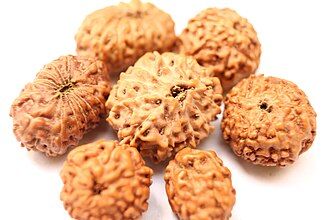
Each rudraksha has natural vertical grooves running from top to bottom. These are called mukhis (faces). A rudraksha is identified by the number of mukhis it carries.
Most rudrakshas are panch-mukhi (five-faced). These account for over 90% of the supply, are the most affordable, and are considered universally beneficial. The traditional Sanatani household keeps a panch-mukhi mala for daily japa.
The other mukhis are rarer and considered to have specific qualities:
- Ek-mukhi (1-face): The rarest and most powerful. Said to grant moksha. Genuine ek-mukhi rudrakshas are extremely rare and expensive; many sold as such are not authentic.
- Do-mukhi (2-face): Associated with Ardhanarishwara. Worn for harmony in relationships.
- Tri-mukhi (3-face): Associated with Agni. Worn for purification and recovery from illness.
- Char-mukhi (4-face): Associated with Brahma and Saraswati. Worn for knowledge and clarity.
- Panch-mukhi (5-face): Universal. Associated with Shiva himself. Worn by everyone.
- Shat-mukhi (6-face): Associated with Kartikeya. Worn for confidence and courage.
- Sapt-mukhi (7-face): Associated with Saptarishi. Worn for prosperity.
- Asht-mukhi (8-face): Associated with Ganesh. Worn for removal of obstacles.
- Nav-mukhi (9-face): Associated with Durga. Worn for shakti and protection.
- Das-mukhi (10-face): Associated with Vishnu. Worn for peace.
- Eleven to fourteen mukhi: Increasingly rare, each with specific associations.
- Gauri-Shankar: Two rudrakshas naturally joined. Associated with Shiva-Parvati. Worn for marriage and family harmony.
A note of caution. The high-mukhi rudrakshas (10+) and the gauri-shankar are commonly faked. A genuine 12-mukhi rudraksha is botanically rare; one sold cheaply is almost certainly artificially carved. If the price feels too low, it is not real.
What the bead is said to do
The classical claims for rudraksha are three:
Spiritual: Wearing or holding a rudraksha during meditation is said to deepen the practice. The mind settles faster. This is testable in your own experience.
Energetic: The bead is said to balance the wearer's energy, particularly to cool an agitated mind. Modern research at IIT Delhi and elsewhere has documented small but measurable effects on heart rate variability and skin conductance when subjects wear rudraksha malas, suggesting a real biophysical interaction worth further study.
Astrological: Specific mukhis are prescribed for specific planetary afflictions in jyotish, the way gemstones are. A jyotishi might prescribe a 7-mukhi for Saturn troubles, an 8-mukhi for Rahu, a 14-mukhi for Mars. The mala is the practice, not the cure.
What rudraksha is not said to do: make you rich quickly, cure serious illness, fix relationships through wearing alone. These are claims of vendors, not of the tradition.
How to wear and care for one
A mala traditionally has 108 beads plus one bigger "guru" bead. The number 108 is significant in jyotish (12 rashis × 9 navagrahas), in yoga (108 marma points), and in cosmology (the sun's diameter is approximately 108 times the earth's). The guru bead marks the completion of one round.
The traditional way to wear:
Cleanse it first. Soak the mala in water with a few tulsi leaves overnight before the first wear. Some traditions recommend ghee or panchamrit.
Wear it after a bath. Not before. The bead is treated as sacred and is kept clean.
Avoid it during impurity periods. Traditional injunctions: not during menstruation, not during the immediate aftermath of a death in the family, not while consuming meat or alcohol. The rationale, in the tradition, is that the bead's energy is sensitive and reciprocal.
Care daily. Oil it lightly with mustard oil or sandalwood oil every few weeks to prevent cracking. Beads that go dry develop fissures and lose their integrity.
Replace if broken. A cracked bead is traditionally considered to have absorbed something heavy and is replaced. Do not feel guilty about this. It has done its work.
Authentication
The rudraksha market in India is heavily counterfeit. Plastic, wood, and bodhi seeds are routinely sold as rudraksha. To check a bead:
Water test: Drop it in a glass of water. A genuine rudraksha sinks. A fake bead floats. (Not perfectly reliable; some genuine beads with internal air pockets also float.)
Copper coin test: Place the rudraksha between two copper coins. A genuine bead, due to its electromagnetic properties, will rotate or shift slightly. This test takes practice to read.
Inspect the mukhis. Natural grooves run clean from top to bottom and have a slight irregularity. Carved grooves are too symmetric and often interrupted.
Buy from a trusted source. The most reliable test is provenance. Buy from a known shrine source (Pashupatinath in Nepal, traditional Banaras vendors with multi-generation reputations) or a reputable online platform that certifies origin.
A note of practical realism: even genuine panch-mukhi rudrakshas vary in quality. A larger, denser, more clearly-faced bead is better than a small soft one. Pay for quality within your range.
A closing observation
The rudraksha is one of the cleaner objects in the Sanatani tradition. It is a seed, not a manufactured idol. It comes from a tree that has been cultivated for this purpose for thousands of years. It does its work through quiet daily contact, not through dramatic intervention.
If you have never worn one, a basic panch-mukhi mala from a reliable source is a small investment with a large invitation. It does not require belief. It requires only that you sit with it and notice. The bead has been waiting on a tree somewhere. The tradition has been waiting in your family. Both have time.