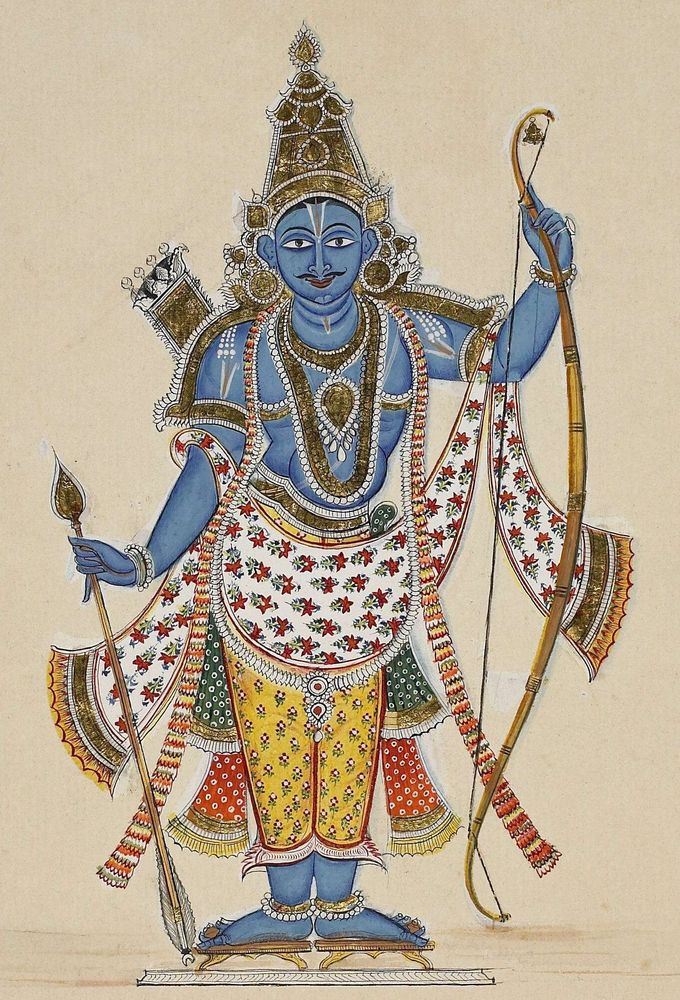
If Krishna is the divine at its most playful, Rama is the divine at its most disciplined. Where Krishna breaks rules to serve a higher purpose, Rama holds to them at enormous personal cost. He is the seventh avatara of Vishnu, the hero of the Ramayana, and the figure Sanatan dharma has held up for millennia as the answer to a single question: what does a life lived rightly look like?
Maryada Purushottam
Rama's defining title is Maryada Purushottam, the supreme upholder of maryada, the bounds of right conduct. This is the key to him. He is not revered for power or miracles, of which the epics give him fewer than Krishna. He is revered for conduct, for choosing the harder right over the easier wrong, again and again, whatever it costs him.
The Ramayana, attributed to the sage Valmiki and retold most lovingly in Tulsidas's Ramcharitmanas, is essentially a long examination of dharma under pressure. At every turn Rama is given a choice between his own comfort and his duty, and he chooses duty.
A life of hard choices
The arc is well known. On the eve of his coronation, Rama is sent into fourteen years of forest exile to honour a promise his father Dasharatha had made to Queen Kaikeyi. Rama does not argue or resent. He goes, calmly, because his father's word must be kept, and a son's duty is to uphold it.
In the forest, the demon king Ravana abducts his wife Sita. Rama, with his brother Lakshmana and an army of vanaras led by Hanuman and Sugriva, wages a long and costly war to recover her, culminating in Ravana's defeat. He returns to Ayodhya, and the people light rows of lamps to welcome their king, the night we keep as Diwali.
The story does not end in simple triumph. Rama's later life carries sorrow, including the painful episodes around Sita, which the tradition has debated with great seriousness for centuries. The epic does not pretend that a life of duty is a life without grief. That honesty is part of its power.
Ram Rajya
Rama's reign became the tradition's very ideal of good government. Ram Rajya, the rule of Rama, is remembered as a time of justice, prosperity, security and contentment, when the ruler placed the welfare of his people above all else, even his own happiness. To this day, across the political and cultural spectrum, Ram Rajya remains the byword for an ideal society.
This is the civilisational weight Rama carries. He is not only a god to be worshipped but a standard against which rulers, and ordinary people, are measured. The ideal of the dutiful king who serves rather than rules has shaped Indian thought about authority for two thousand years.
How he is worshipped
Rama is worshipped across India, with his birth celebrated at Ram Navami and his story enacted each year in the Ramlila culminating at Dussehra. He is most often worshipped together with Sita, Lakshmana and Hanuman, the four figures of the Ramayana's heart. The simple taraka mantra, Shri Rama Jaya Rama Jaya Jaya Rama, and the name Ram itself, repeated, are among the most widely chanted in the tradition. The consecration of the Ram Mandir in Ayodhya placed his birthplace once more at the centre of the devotional landscape.
His worship is, fittingly, less about asking and more about aspiring. To remember Rama is to be reminded of the standard, to ask not for favours but for the strength to hold to one's own duty when it is hard.
Jai Shri Ram.