A year inside the temple
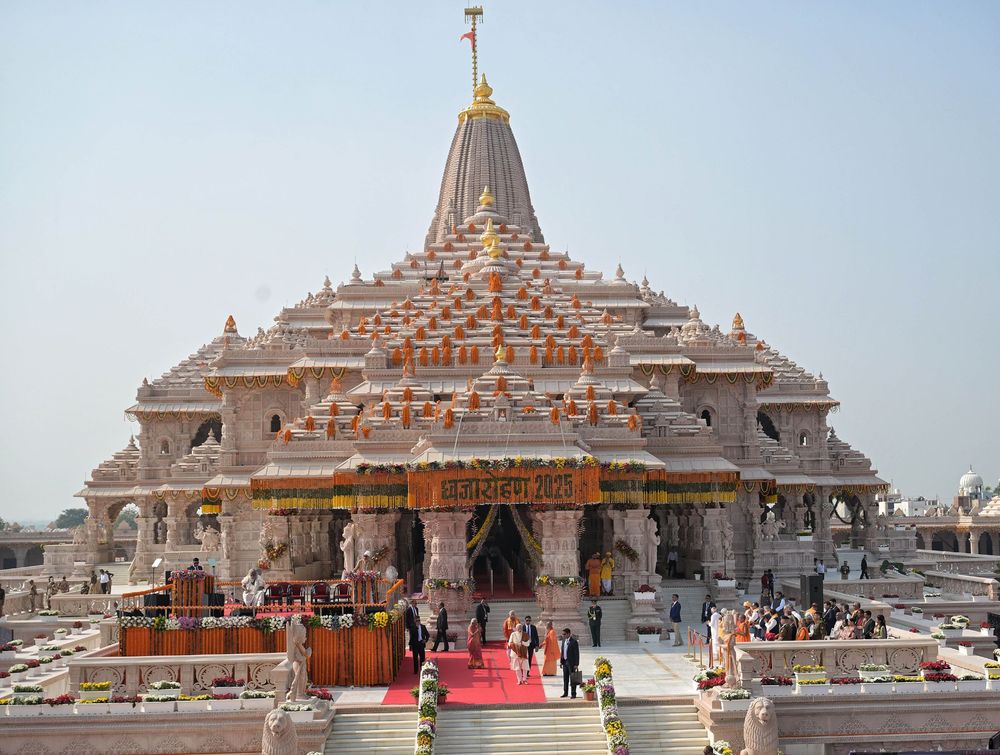
On 22 January 2024, the Ram Mandir in Ayodhya was formally consecrated. The pran pratishtha ceremony, attended by the Prime Minister and watched live by hundreds of millions of Indians, marked the formal installation of the deity in the new temple. The Ram Lalla murti, a 51-inch black stone idol of the divine child Rama by sculptor Arun Yogiraj, was placed in the garbha griha.
Two years on, the temple has become India's most-visited religious site. Footfall in 2025 exceeded 50 million pilgrims, more than the Vatican, Mecca, and Tirupati combined for the same year. The town of Ayodhya, which had a population of approximately 250,000 before the temple opened, has transformed into a city of two million pilgrims at any given time.
This is a look at what has happened in the two years since pran pratishtha. What the temple has built, what the town has become, and what the cultural significance of the moment has begun to settle into.
What was completed
When pran pratishtha was held in January 2024, only the ground floor of the main temple was operationally complete. The first floor and the upper sanctum were structurally underway. The Parikrama Path (the circumambulation path), the outer wall of seven major shrines, and most of the temple complex's ancillary structures were still under construction.
Over the next two years, the work has progressed steadily.
The first floor, housing the Ram Darbar (Rama with Sita, Lakshmana, Bharata, Shatrughna, and Hanuman), was completed and consecrated in March 2025. The Ram Darbar darshan is now part of the standard pilgrim circuit.
The seven outer shrines, dedicated to Ganesh, Shiva, Bhagwan Surya, Devi Bhagwati, Maa Annapurna, Hanuman, and Maharishi Vishwamitra, have all been completed and consecrated. These line the eastern wall of the complex and form the secondary darshan circuit.
The Parikrama Path, 800 metres long, has been completed and opened to pilgrims. The traditional circumambulation is now possible.
The Shiv Mandir, originally part of the temple complex's secondary structures, was inaugurated in late 2025.
The temple complex as a whole is now approximately 75% complete by the original plan. Full completion, including remaining outer shrines and detailed ornamentation work, is expected by end of 2027.
The Ayodhya transformation
The temple is the most visible change, but the city itself has been remade.
Infrastructure: Ayodhya now has a renovated railway station (Ayodhya Dham Junction), a new international airport (Maharishi Valmiki International Airport, operational since January 2024), and over 100 kilometres of widened roads. The airport handled 2.4 million passengers in 2025, up from zero two years earlier.
Accommodation: The hotel capacity in Ayodhya has grown from approximately 8,000 rooms in early 2024 to over 35,000 rooms by end of 2025. The Tata, ITC, and Oberoi groups have all opened five-star properties. Mid-market and budget chains have proliferated. The traditional dharamshalas have been preserved and renovated.
Hospitality industry: Restaurant capacity has tripled. Specialized vegetarian and Jain food establishments serve pilgrims with strict dietary requirements. The traditional Awadhi food culture of Ayodhya has been promoted alongside imported chain establishments.
The Saryu Ghat development: The Saryu river ghat has been expanded, the evening Saryu Aarti formalized into a daily event resembling Varanasi's Ganga Aarti, and a Light and Sound show launched on the river itself.
Cultural infrastructure: The Ramayana Heritage Centre, a museum-cum-cultural complex, opened in late 2025. It curates artifacts, texts, and dramatic performances related to the Ramayana tradition.
The transformation has not been uncontroversial. Critics have noted the displacement of older Ayodhya residents, the conversion of family lands into hotels, and the commercialization of pilgrimage. Supporters point to the unprecedented economic activity (Ayodhya's per-capita income has nearly tripled since 2023) and the cultural recovery of a city that had been forgotten by national consciousness for decades.
Both observations have merit. The transformation is real. Its costs and benefits are real.
The pran pratishtha day, in retrospect
22 January 2024 was a day of unusual unity in Indian public life. The ceremony was watched by 100 million viewers on live television in India alone. International coverage extended to Mauritius, Trinidad, Fiji, Surinam, Nepal, and across the Indian diaspora.
The ceremony itself was performed by 121 priests over several hours. The Prime Minister participated in the central pran pratishtha ritual alongside the priests. The murti was unveiled, the eyes formally opened, and the Ram Lalla was installed in the garbha griha.
In the year that followed, much was made of the political significance of the ceremony. Equally much, less commented on, was the cultural significance: the day marked the public, institutional return of a temple to a site that had been contested for five hundred years. Whatever one's views of the political dimensions, the cultural dimension was undeniable. A long-standing Sanatani grievance had been formally addressed.
What pilgrims report
Two years on, the experience of visiting the temple has settled into a recognizable pattern.
Pilgrims report arriving with high expectations and finding them mostly met. The darshan queue, even on regular days, is two to four hours; on festivals and weekends, eight hours. The infrastructure to handle this volume has improved across the two years, with covered queue corridors, water stations, and seating areas. The ordeal, while real, is less brutal than the early-2024 weeks when the system was still settling.
The actual darshan is brief. Most pilgrims report 30 to 60 seconds in front of the deity. The garbha griha is small, and the throughput demands keep movement constant. Those wanting a longer darshan come early in the morning before the crowds, or pay for VIP access (Rs. 500 to 5,000 depending on access tier), or attend special aartis.
The aartis are widely considered the highlight of the temple experience. The Mangal Aarti at 4:30 AM, the Shringar Aarti at 6:30 AM, and the Sandhya Aarti at sunset draw smaller, more devotional crowds, and the experience is closer to traditional temple worship than the daytime darshan.
The complex around the temple also makes the trip worthwhile. Most pilgrims report that the Parikrama path, the seven outer shrines, the Saryu Ghat aarti in the evening, and the Hanuman Garhi temple a few kilometres away combine into a full day's experience.
The questions that remain
A few open questions have emerged in the two years since pran pratishtha.
Crowd management at festivals. Diwali at Ayodhya in 2024 and 2025 drew unprecedented crowds. The 2025 Deepotsav, where over a million diyas were lit on the Saryu ghats, was a logistical strain that exposed the limits of even the upgraded infrastructure. Plans for further crowd-handling capacity are underway for 2026.
Long-term economic sustainability. The current boom in Ayodhya's economy is partly construction-driven. As construction completes, will the pilgrim economy be sufficient to sustain the city's expanded infrastructure? The early indicators are positive, but the question is genuinely open.
Preservation of older Ayodhya. The older temples and traditional dharamshalas of Ayodhya have been preserved in name but their social character has changed considerably. The Ayodhya of 1995 is no longer recoverable. Whether what has replaced it is better or worse depends on what one valued.
The completion of the surrounding kshetra. The Ram Mandir is the centerpiece of a larger temple kshetra (sacred area) that, when fully developed, will encompass several square kilometres including the Kanak Bhavan, the Hanuman Garhi, the Sita Rasoi, and a dozen other smaller temples. The integration of these into a coherent pilgrim experience is still in progress.
What the temple has come to mean
In 2024, the temple meant many different things to different people. To devotees, it was the long-awaited return of Ram Lalla to his janmasthan. To political observers, it was a milestone in Indian political and cultural history. To the diaspora, it was a moment of pride. To critics, it was a moment of concern about majoritarianism.
In 2026, two years on, the meanings have started to settle. The temple is now, simply, a temple. People go there to pray. People come away with whatever they came hoping for, or do not. The political weight that the moment carried has begun to ease as the temple becomes part of ordinary religious life.
This is, in a way, the deepest test of the project. A temple that was politically charged at its consecration becomes more meaningful as it becomes less political and more religious. The pilgrim queue at 4 AM, full of grandmothers and grandfathers who have travelled for days, is what a temple is for. The temple is doing its work.
A closing observation
The reconstruction of the Ram Mandir is one of the larger civilizational projects of contemporary India. Its completion will mark the end of a five-hundred-year process. What follows the end of that process, what Sanatani society does with its restored shrine, is the question of the next several decades.
For now, two years on, the temple is open, the deity is installed, the pilgrims are arriving in unprecedented numbers, and the city has begun to settle into its new identity. The work, in one sense, is done. The work, in another sense, has only begun.
The aarti is performed every morning. The pilgrim queue starts forming before dawn. Ram Lalla, in stone and presence, is back where he was always said to belong. The shastras consider this kind of return its own form of justice. Whatever else one makes of the moment, the deity is home.