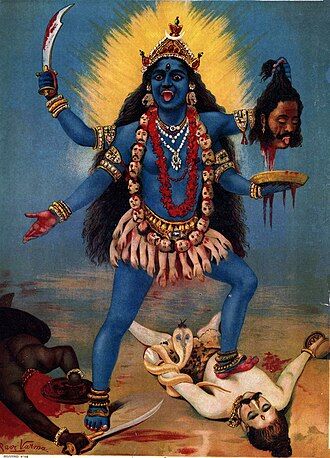
Of all the images in Sanatan dharma, none unsettles the newcomer like Kali. She is dark, almost black. Her tongue is out. She wears a garland of severed heads and a skirt of arms, and she stands on the body of her own husband, Shiva. To eyes trained on gentle, smiling deities, she can look like a goddess of horror. She is, in truth, one of the most profound and most tender figures in the whole tradition, and the fear she provokes is exactly what she is meant to dissolve.
The fierce mother
Kali is a form of the Divine Mother, of Shakti, in her most fierce and unconditioned aspect. Her name comes from kala, meaning both time and darkness, for she is the power of time itself, that devours all things, and the darkness that exists before and beyond all form.
She emerges in the Devi Mahatmya from the brow of the goddess Durga in the heat of battle, born of divine wrath to destroy demons that could not otherwise be killed. In one famous account she becomes so consumed by the fury of battle that the world itself is endangered, and only when she steps upon the prone body of Shiva, and recognises him, does she stop, her tongue out in astonishment. That image, so often misread, is the moment of the fierce mother recognising the stillness beneath her own storm.
Reading what frightens us
Every fearsome feature of Kali is a teaching, and understood rightly the fear turns to reverence.
Her dark, formless blackness is the infinite, that which is beyond all colour and all form, the womb from which everything arises and into which everything returns. Her nakedness is freedom from all illusion and pretence; she is reality with nothing hidden. The garland of severed heads is often read as the letters of the Sanskrit alphabet, the powers of speech and the ego-identities she frees us from, fifty heads for the fifty sounds. The skirt of arms is the release from the bondage of past action, of karma. The sword she holds cuts away ignorance; the severed head in her other hand is the ego she has slain. And the two remaining hands are raised in blessing and in fearlessness: do not be afraid.
This is the heart of her. Kali destroys, yes, but what she destroys is everything that binds us: ego, illusion, attachment, the fear of death itself. She is terrifying only to the ego, which she has come to free us from. To her devotees she is simply Maa, the mother who loves most fiercely.
Time and death faced directly
Kali's deepest gift is that she lets us look at time and death without flinching. Most of life is spent avoiding the fact of mortality. Kali stands in the cremation ground, garlanded with the emblems of death, and says: this too is the Mother. Face it, and the fear that has ruled you loses its power.
This is why her greatest devotees, like the saint Ramakrishna of Dakshineswar, approached her with such overwhelming love. Behind the fearsome form they found the most accepting of mothers, one who takes her children exactly as they are, who can be approached in any state, and who, having swallowed the fear of death, has nothing left to frighten anyone with.
How she is approached
Kali is worshipped especially in Bengal and the east, where Kali Puja is observed on the new moon night of Diwali, and at great shrines like Dakshineswar and Kalighat. Her simple mantra is Om Krim Kalikayai Namah. She is approached not with the polite formality offered to gentler deities but with raw, direct love, as a child runs to its mother.
To worship Kali is to ask to be freed: from ego, from illusion, and above all from fear. The goddess who looks like terror itself is, for those who come to her, the end of being afraid.