The first practice
Long before asana, before mantra, before the elaborate rituals of any tradition, the rishis sat and watched their breath. They noticed something simple. When the breath changed, the mind changed. When the mind became quiet, the breath became quiet. The two moved together.
From this single observation, an entire science was built. It is called pranayama. Prana, the life force. Ayama, extension or restraint. The extension of life through the discipline of breath.
This article is the beginning. You do not need a yoga mat. You do not need a guru, at least for these basics. You need a quiet place, fifteen minutes, and the willingness to sit still long enough to notice what is already happening.
What pranayama actually is
In the Yoga Sutras of Patanjali, pranayama is the fourth limb of the eightfold path. It comes after yamas (ethical restraints), niyamas (observances), and asana (steadiness of body). The placement is not accidental. You cannot do pranayama in a body that cannot sit still. You cannot do pranayama in a mind heavy with unethical action. The preparation is the practice.
Patanjali defines pranayama in three components: inhalation (puraka), exhalation (rechaka), and retention (kumbhaka). The classical practice is the conscious manipulation of all three.
Modern science calls this controlled breathing. The terms are different. The thing they describe is the same.
Why it works
The breath is the only autonomic function that can also be brought under conscious control. The heart beats on its own. The kidneys filter on their own. But the breath can be either automatic or deliberate. This makes it a doorway. Through the breath, the meditator reaches what is normally outside conscious access: the autonomic nervous system, the stress response, the deep regulation of the body's chemistry.
When you breathe slowly and deeply, the parasympathetic nervous system activates. Heart rate drops. Blood pressure drops. Cortisol levels fall. The mind, which has been narrating the day, slows its narration. This is not mystical. It is verifiable in any lab.
When you breathe in specific patterns, more specific effects follow. Alternate nostril breathing balances the activity of the two cerebral hemispheres. Slow exhalations longer than inhalations deepen the vagal response. Retention practices, done correctly, increase tolerance for CO2 and shift the chemistry of the blood.
The rishis discovered this empirically. Modern researchers confirm it instrumentally. Both arrive at the same conclusion: the breath is a control panel for the mind.
Three practices for a beginner
These three are enough. Master these before adding others.
1. Anulom Vilom (alternate nostril breathing)
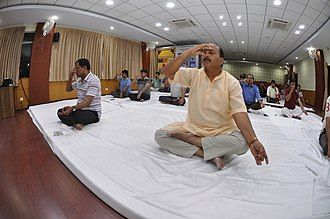
Sit upright. Rest the left hand on the left knee. With the right hand, fold the index and middle fingers into the palm. The thumb and ring finger remain extended.
Close the right nostril with the thumb. Breathe in slowly through the left nostril for a count of four.
Close the left nostril with the ring finger. Release the thumb from the right nostril. Breathe out through the right for a count of six.
Breathe in through the right for a count of four. Close the right. Release the left. Breathe out through the left for a count of six.
This is one round. Do twelve rounds.
The exhale is longer than the inhale. This is deliberate. The longer exhale activates the parasympathetic system more strongly. After twelve rounds, the mind will be noticeably steadier.
2. Bhramari (humming breath)
Sit upright. Close the eyes. Place the index fingers gently on the cartilage of each ear, closing them softly. The thumb and other fingers rest on the face.
Breathe in slowly through the nose.
On the exhale, hum a low steady "mmm" sound, with the lips closed. The sound vibrates in the skull. Continue until the breath naturally completes.
Inhale again. Hum again. Do nine rounds.
The vibration of bhramari quiets the brain through bone conduction. It is one of the simplest practices and one of the most immediately effective. Try it during a stressful moment and notice the shift.
3. Kapalabhati (skull-shining breath)
Sit upright. Take a normal breath in.
Exhale sharply through the nose by contracting the abdomen, as if blowing out a candle that is far away. The inhale happens passively, by itself. The work is only in the exhale.
Do thirty sharp exhales in succession, at a pace of about one per second. Then breathe normally for a few breaths.
Do three rounds of thirty.
Kapalabhati is more activating than the previous two. It is excellent in the morning, less suitable in the evening. Do not do this if pregnant, if you have high blood pressure, or if you have any abdominal injury.
When to practice
The traditional time is early morning, before sunrise, on an empty stomach. The body is rested, the mind is uncluttered, the air is freshest.
If early morning is not possible, before bed is the next best time, at least three hours after the last meal. Practice in the same place, on the same seat, at the same time. Pranayama responds to consistency more than to intensity.
Five minutes daily is better than thirty minutes once a week. The rishis did not measure by quantity. They measured by regularity.
What to expect
In the first week, you will notice that the mind wanders constantly. This is normal. The wandering mind is not a failure of the practice; it is what the practice begins to reveal. Keep counting.
In the second week, you may notice small physical changes. Better sleep. Less reactivity to small irritations. The space between a trigger and a response widening slightly.
In the first month, the breath itself becomes longer and deeper without effort. You will catch yourself, mid-day, breathing more slowly than you used to.
Beyond that, the territory belongs to your own practice. The texts describe the deeper states: pratyahara (withdrawal of senses), dharana (concentration), dhyana (meditation), samadhi (absorption). These are not destinations to chase. They are descriptions of what unfolds when the foundation is steady.
A note of caution
Pranayama is safe when done gently. It can be harmful when forced.
Do not hold the breath beyond comfort. Do not push through dizziness. Do not increase counts faster than the body adapts. The classical texts warn explicitly that wrongly practiced pranayama disturbs the nervous system. They are not exaggerating.
Find a teacher when you are ready to go beyond the three practices above. The traditional model is in-person guidance for a reason: pranayama is taught by adjustment, not by description.
Closing
The rishis did not invent the breath. They observed what was already there. They sat for a long time, watched carefully, and described what they found. We have the same breath they did. We have the same minds. We have, if we choose to use them, the same fifteen minutes a day.
Start tomorrow morning. Sit upright. Close the eyes. Watch the breath for one minute before you do anything else. The practice has been waiting for you for three thousand years. It is in no hurry.