Nine planets, one chart
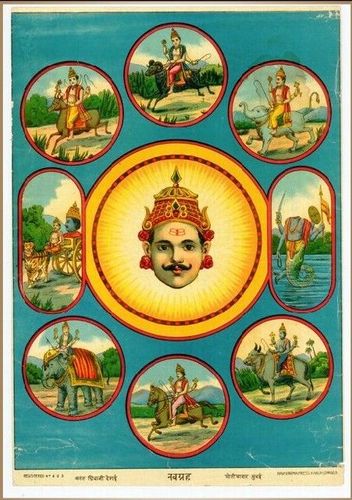
When a Sanatani jyotishi looks at a kundli, he is looking at nine planets and their positions. He calls them grahas. The Sanskrit word means "the one that seizes," and it is precise. These nine bodies are said, in the tradition, to seize different aspects of the native's life and hold them in their gravitational field.
These nine are not nine planets in the astronomical sense. Two of them, Rahu and Ketu, are not planets at all but mathematical points where the moon's orbit crosses the sun's. The other seven are: Surya (sun), Chandra (moon), Mangal (Mars), Budha (Mercury), Brihaspati (Jupiter), Shukra (Venus), and Shani (Saturn). Together they form the Navagraha, the nine grahas of Vedic astrology.
This article walks through who they are, what they govern, and why your relationship with each one matters.
Surya: the sun
The king of the grahas. Surya represents the soul (atma), the father, authority, vitality, health, leadership, the ability to be seen.
In jyotish, Surya's placement in a chart determines the strength of your sense of self. A strong Surya gives confidence, purpose, and the capacity to lead. A weak or afflicted Surya gives self-doubt, troubled relationships with authority, and chronic vitality issues.
Day: Sunday. Direction: East. Color: Red or copper. Stone: Ruby.
Worship: Surya Namaskar at sunrise. Offering arghya (water) to the rising sun. The Aditya Hridaya Stotram is the classical hymn.
Chandra: the moon
The mind. Where Surya is the soul, Chandra is the manas (the thinking, feeling, oscillating mind). Chandra represents the mother, emotions, the home, intuition, peace of mind.
Your moon sign in jyotish is, in many ways, more important than your sun sign for understanding daily life. Sade Sati is calculated from the moon. Your emotional reactions to the world map closely to Chandra's position.
A strong Chandra gives equanimity, sensitivity to others, and a settled inner life. A weak Chandra gives mood swings, restlessness, and difficulty with the mother or with home.
Day: Monday. Direction: Northwest. Color: White or silver. Stone: Pearl.
Worship: Shiva worship (Chandra adorns Shiva's head). Chanting Om Chandraya Namaha. Drinking water during moonrise, especially on Purnima.
Mangal: Mars
The warrior. Mangal represents courage, energy, brothers, land, conflict, and the willingness to act decisively.
Mangal is also Kuja, the planet of Mangal Dosha, which affects marriage in the traditional reading. Mangal placed in certain houses creates aggressive tendencies that need a partner who can match or balance them.
A strong Mangal gives drive, athletic capacity, leadership in difficult situations. A weak Mangal gives passivity, indecision, lack of courage, or its opposite extreme of unfocused anger.
Day: Tuesday. Direction: South. Color: Red. Stone: Red coral.
Worship: Hanuman worship (Hanuman pacifies Mangal). Tuesday fasts. Mangal Beej Mantra.
Budha: Mercury
The intellect. Budha represents thinking, learning, speech, commerce, communication, and the capacity to make connections between disparate things.
A strong Budha gives a quick mind, fluent speech, skill in business or scholarship. A weak Budha gives confusion, speech impediments, learning difficulties, or compulsive talking without substance.
Budha is also the karaka (significator) of education in a chart. Whether a child will study well depends largely on Budha's strength.
Day: Wednesday. Direction: North. Color: Green. Stone: Emerald.
Worship: Vishnu worship (Budha is Vishnu's son in some accounts). Vishnu Sahasranama. Wearing green on Wednesdays.
Brihaspati: Jupiter
The guru. Brihaspati is the teacher of the devas, the planet of wisdom, dharma, expansion, fortune, and the father in many traditional readings.
Brihaspati is widely considered the most auspicious graha in the chart. Its aspects bring blessings. Its dasha periods, if Brihaspati is well-placed, are golden.
A strong Brihaspati gives wisdom, moral clarity, prosperity, and good children. A weak Brihaspati gives bad judgment, lapsed dharma, troubled relationship with teachers or with God.
Day: Thursday. Direction: Northeast. Color: Yellow. Stone: Yellow sapphire.
Worship: Vishnu worship. Thursday fasts. Sri Sukta recitation. Donations to teachers and to learned persons.
Shukra: Venus
The teacher of the asuras. Shukra is the planet of love, beauty, marriage, comfort, the arts, refinement, and material pleasure.
In jyotish, Shukra governs the spouse, particularly for men (Mangal governs the spouse for women in the traditional reading). The placement of Shukra indicates the character of the marriage partner and the nature of the marital relationship.
A strong Shukra gives romantic happiness, artistic ability, financial comfort, and refined taste. A weak Shukra gives relationship difficulties, vulgar taste, financial extravagance without satisfaction.
Day: Friday. Direction: Southeast. Color: White, silver, or pale pink. Stone: Diamond.
Worship: Lakshmi worship. Friday fasts. Sri Sukta. Wearing white on Fridays.
Shani: Saturn
The disciplinarian. Shani is the planet of karma, discipline, longevity, service, hard work, restriction, and time itself. Shani is the slowest-moving graha. He sees everything; he forgets nothing.
Shani has the worst reputation among the grahas and the most undeservedly so. Shani is not evil. He is precise. He is the Karmaphaladata, the one who delivers the fruits of action. Those whose actions have been clean find Shani's transits productive. Those whose actions have been unclean find his transits hard.
A strong Shani gives endurance, integrity, the capacity for delayed gratification, and longevity. A weak or afflicted Shani gives chronic illness, persistent obstacles, and the surfacing of debts (karmic and literal).
Day: Saturday. Direction: West. Color: Black or dark blue. Stone: Blue sapphire.
Worship: Hanuman worship (Hanuman protects from Shani). Visiting Shani temples on Saturdays. Lighting mustard-oil lamps. Donations to the marginalized.
Rahu: the north node
Rahu is not a body. It is the point where the moon's orbit crosses the ecliptic from south to north. But in jyotish it is treated as fully a graha, with its own deity, its own dashas, and its own profound effects.
Rahu represents desire, ambition, obsession, foreigners, technology, the unconventional, and that which lies outside the dharmic order. Where Rahu sits in a chart is where the native is hungry, often with imperfect judgment.
Rahu's effects in dasha periods are dramatic. He can give sudden material rise. He can also give equally sudden falls. The shastras describe Rahu as the planet of maya, of illusion that is mistaken for truth.
Day: Saturday (shares with Shani). Color: Smoky. Stone: Hessonite (gomedh).
Worship: Durga worship. Hanuman worship. Specific Rahu shanti pujas. The mantra "Om Rang Rahave Namaha."
Ketu: the south node
The opposite point of Rahu. Where Rahu seeks, Ketu releases. Ketu represents detachment, spirituality, past-life accumulation, sudden insight, hidden knowledge, and the dissolution of forms.
Ketu in a strong position can produce intense spiritual progress, sometimes against the native's will. Ketu in a weak position produces feelings of meaninglessness, sudden losses, and disconnection.
Day: Tuesday (shares with Mangal). Color: Variegated. Stone: Cat's eye (lehsuniya).
Worship: Ganesh worship. Specific Ketu shanti pujas. The mantra "Om Krang Ketave Namaha."
How they work together
A kundli is not nine isolated readings. It is the interaction of nine grahas across twelve houses and twenty-seven nakshatras. A strong Brihaspati in the wrong house can do less than a moderate Budha in the right one. A debilitated Shukra under the gaze of a friendly Brihaspati can still give good results. The chart is read as a whole.
This is why the standard advice, "your sun sign is Aries, so you are confident and impulsive," is useless. The sun sign in jyotish is the moon sign, and it does not represent confidence in isolation. It represents one factor among nine, modified by all the others.
If you want to understand your Navagraha placement, generate your kundli on this platform or consult a jyotishi. The shorthand version of your astrological identity, the one most people carry in their head, is almost always wrong. The full version requires looking at the whole chart.
Closing
The Navagraha is one of the cleanest contributions of Sanatani thought to global astrology. The system is internally coherent, observationally testable over time, and ethically grounded (each graha is paired with a deity, a virtue, and a discipline). It is not a system of fate. It is a system of forces. What you do with them is, in the tradition's framing, the actual subject of your life.
Look at your chart. Find the strong grahas; thank them. Find the weak grahas; do their disciplines. The system has been waiting for you to use it for three thousand years.