A temple in the south whose corridors do not end
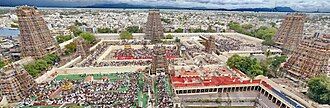
In Tamil Nadu, in the temple town of Madurai, sits one of the largest and most architecturally extraordinary temples in India. The Meenakshi Amman Temple. The principal shrine is to Goddess Meenakshi, an aspect of Parvati, and to her consort Sundareshwarar, an aspect of Shiva. The temple covers 45 acres in the heart of the old city, surrounded by 14 enormous gopurams (gateway towers), the tallest reaching 52 metres.
This temple is one of the most visited shrines in India, drawing approximately 25,000 pilgrims daily on regular days and up to 1 lakh during festivals. Its architecture is among the most elaborate in any Sanatani temple. Its murals, sculptures, and pillared halls are catalogued as some of the finest examples of South Indian temple art.
But what makes Meenakshi distinctive is not just its scale. It is its devotion to a goddess as the principal deity, with the consort Shiva treated as secondary. This is rare in Sanatani temple culture, where the male deity is usually the central figure with the goddess in supporting role. At Meenakshi, the roles are reversed.
This article walks through what the temple is, the story of Meenakshi, and what to do on a visit.
The story of Meenakshi
The classical story is in the Tiruvilaiyatal Puranam, a Tamil-language text dating from the 16th century but incorporating older traditions.
A king of the Pandyan dynasty, Malayadhwaja, was childless. He performed elaborate sacrifices, asking the gods for a son. From the sacrificial fire, instead of a son, a three-year-old girl emerged with three breasts. The king was distraught but took her as his daughter, naming her Tatatakai (later Meenakshi, "fish-eyed").
The girl grew into a warrior princess and eventually inherited the kingdom. She was, in this version of the story, an undefeated warrior. She conquered all the kingdoms of the world, eventually challenging the gods themselves.
When she met Shiva in battle, her third breast disappeared. This was the sign, prophesied at her birth, that she would meet her future husband. Meenakshi recognized Shiva, surrendered to him, and they were married in a grand wedding at Madurai. This is the story of the temple's central deities.
The Meenakshi-Sundareshwarar wedding is the central festival of the temple, observed annually as the Chithirai festival.
What makes the temple architecturally extraordinary
Several features of the Meenakshi temple are unique.
Fourteen gopurams. The temple complex has 14 large gateway towers, ranging in height from 45 to 52 metres. Each is covered in thousands of carved figures of deities, animals, and humans, painted in bright colors. The figures are restored and repainted approximately every 12 years. The total number of carved figures on the gopurams exceeds 33,000.
The four outer gopurams (one on each side of the temple) are particularly tall. They dominate the Madurai skyline visible from kilometres away.
The Thousand Pillar Hall (Ayiramkaal Mandapam). A vast hall with 985 carved stone pillars (the count varies by source; the traditional figure is 1,000). Each pillar is differently carved. The hall is now used as a museum displaying religious artifacts.
The Musical Pillars. A smaller hall in the temple contains pillars that produce different musical notes when struck. The exact metallurgy and shape combinations that produce these tones are unknown; they have not been successfully replicated in modern construction. The pillars produce the seven notes of the South Indian Carnatic music scale.
The Golden Lotus Tank. A large rectangular tank in the heart of the temple. Devotees bathe here before darshan. The tank is associated with the legend that anyone whose work was thrown into it would, if of true literary merit, float; lesser work would sink. This was used historically as a test for poetry.
The corridor system. The temple is built as a series of nested corridors, each more sacred than the previous. The outer corridors are open to all. The inner corridors progressively restrict access. The innermost shrines are accessible only to the priests.
The two principal shrines
Within the complex are two main shrines, one for Meenakshi and one for Sundareshwarar.
Meenakshi shrine. Located in the western part of the complex. The deity is a black stone image of the goddess, ornately decorated with jewelry that is changed daily according to a fixed schedule. The icon is approximately one metre tall.
Sundareshwarar shrine. Located adjacent to the Meenakshi shrine but separated by a corridor. The deity is in the form of a Shiva lingam.
The ritual structure of the temple treats Meenakshi as the principal deity, with Sundareshwarar as her consort. Many pilgrims visit Meenakshi first, then Sundareshwarar. This ordering is unusual for a Shiva temple, where Shiva is typically primary.
The daily ritual
The temple operates on an elaborate daily ritual schedule that has remained essentially unchanged for centuries.
Palli Arai (the sleeping chamber). At about 9 PM each night, the deities are symbolically united for the night. The Sundareshwarar image is taken in procession from his shrine to a small chamber where Meenakshi's image already waits. The two deities are placed in proximity for the night. The chamber is sealed.
Mangal Aarti at dawn. The earliest puja, performed before sunrise. The deities are "awakened" with prayers, bathed, dressed in fresh clothes, and offered food.
Multiple aartis through the day. Eight specific aartis are performed each day, at fixed times. The intermediate hours are open for general darshan.
The Friday alankaram. Every Friday, Meenakshi is dressed in an elaborate special form (often as a queen, a warrior, or a wife). Devotees come specifically to see the Friday darshan.
Annual cycle. The temple's elaborate annual schedule includes the Chithirai festival (March-April, the wedding celebration), the Avani Moolam festival (August-September), and many others. The festival calendar is dense; some festival is occurring nearly every month.
The Chithirai festival
The temple's most important annual festival is the Meenakshi Tirukalyanam, the wedding of Meenakshi and Sundareshwarar. Held in the Tamil month of Chithirai (April-May), it lasts 12 days. The festival includes:
The coronation of Meenakshi as queen. Performed early in the festival.
The Pattabhishekam (royal anointment). Confirming Meenakshi as the supreme deity.
The Meenakshi Kalyanam (wedding). The central event, performed on the tenth day. Meenakshi is dressed as a bride; Sundareshwarar arrives in procession. The wedding rituals are performed with full traditional elaborateness. Hundreds of thousands of devotees attend.
The procession. After the wedding, the deities are taken in procession through the streets of Madurai. The procession involves enormous chariots, similar in scale to those at Puri (though not as large).
The Chithirai festival is one of the largest single-festival celebrations in South India. Pilgrims arrive in millions. The city of Madurai is transformed for the entire 12-day duration.
How to reach Madurai
Air: Madurai International Airport, with regular flights from major Indian cities.
Rail: Madurai Junction is a major railway hub, with direct trains from Chennai, Bangalore, Delhi, Mumbai, and other cities.
Road: Madurai is connected to Chennai by good highway (about 460 km, 7-8 hours). To Bangalore (440 km, 8-9 hours). To Trivandrum (300 km, 6 hours).
When to visit
Best months: December to February. Pleasant cool weather, manageable crowds.
For Chithirai festival: April-May. Plan well in advance; accommodation books out months ahead.
Avoid: April to June (extreme heat reaching 40+ Celsius) except for the festival period. Monsoon months (October-November) can have rain but are otherwise pleasant.
What to do during a visit
Begin at the Pottramarai Tank. The golden lotus tank. A ritual washing of hands and face before darshan.
Visit Meenakshi shrine first. Following the temple's traditional ordering.
Then Sundareshwarar. The Shiva lingam shrine.
Walk the Thousand Pillar Hall. Examine the variety of sculptural details. Each pillar is different.
Visit the Museum. Located in the Thousand Pillar Hall. Contains historical artifacts and explanations.
Hear the musical pillars. Located in a smaller hall. A small fee is sometimes charged for a demonstration.
Climb to the rooftop (if access permitted). The view of the gopurams from above is exceptional.
Visit during an aarti. The evening Sandhya Aarti is particularly atmospheric.
Walk around the temple's outer corridor. Several smaller shrines line the outer corridor. Pilgrims often visit a complete pradakshina (circumambulation) through this outer path.
Visit the temple at night. The illuminated gopurams against the dark sky are one of Madurai's signature sights.
A complete temple visit takes at least 4-5 hours. Many serious pilgrims spend a full day at the temple.
Around Madurai
Several other significant sites near Madurai are worth visiting:
Thirumalai Nayak Palace. A 17th-century palace built by the Nayak king who heavily patronized the Meenakshi temple. Located about 2 km from the temple.
Gandhi Memorial Museum. Located in the former Tamukkam Palace. The room where Mahatma Gandhi's bloodstained dhoti is displayed.
Rameshwaram (about 170 km). One of the four dhams. Can be combined with Madurai for a 2-3 day pilgrimage.
Tirunelveli and surrounding temples. Several other major shrines in the surrounding region.
A reflection
The Meenakshi temple is one of the great Sanatani religious monuments. The scale is overwhelming on first visit. The density of sculptural detail is staggering. The continuity of worship, with the same daily ritual schedule maintained for over 400 years (the present temple structure dates from the 16th and 17th centuries, but the site has been worshipped for far longer), is remarkable.
What stays with most visitors is the temple's particular atmosphere. The interior is dim, lit by oil lamps and small electric lights. The smell of incense permeates everything. The sound of bells, chanting, and the priests' instructions fills the corridors. The crowds move continuously through the spaces, but somehow the temple does not feel chaotic; the structure absorbs the movement.
Meenakshi herself, the fish-eyed goddess at the center of all this, has been receiving devotees in this temple for centuries. The Pandyan kingdom built it; the Nayak rulers expanded it; the Madurai municipality maintains it; the priests continue the unbroken daily ritual. The deity has been served by generation upon generation of human hands. She is, in a real sense, the long-running collective project of an entire region.
If you visit, give the temple its full time. The architecture rewards close attention. The deities reward patient darshan. The annual cycle, if you can time your visit to one of the major festivals, reveals dimensions that ordinary visits cannot show.
The temple has been here. It will continue. The goddess presides, fish-eyed, three thousand years of South Indian devotional tradition concentrated in her stone form.