The temple at the edge of the world
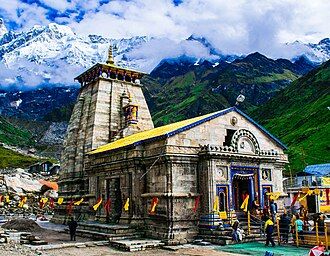
In the high Himalayas, at 3,583 metres above sea level, in a narrow valley surrounded by snow-capped peaks, stands a small stone shrine. It is built of large slabs of grey stone, fitted together without mortar, weathered by centuries of wind and snow. From a distance, it looks almost organic, like an outcrop of the mountain itself.
This is Kedarnath. One of the twelve Jyotirlingas. The temple where Bhagwan Shiva, fleeing the Pandavas, is said to have dived into the ground, leaving only the hump of a buffalo exposed above the earth. That hump, in the tradition, became the lingam.
The temple sits in one of the most dramatic settings of any major Sanatani shrine. Behind it rises the Kedarnath peak (6,940 metres). To its sides, towering ridges. Below, the Mandakini river. Access is by foot, mule, helicopter, or palanquin. There is no road that reaches the temple itself.
This article walks through what Kedarnath is, the story behind it, what to expect on pilgrimage, and what happened in 2013 when the floods came.
The story
The story of Kedarnath's founding is in the Mahabharata and the Skanda Purana.
After the Kurukshetra war, the Pandavas sought to atone for the killing of their kinsmen and the brahmin warriors who had fought against them. They were told that only Shiva could grant them release from this grave sin. They went searching for him.
Shiva, however, did not want to grant easy release. The sin was severe. He took the form of a bull (Nandi) and hid in the Himalayas. The Pandavas, guided by sage Vyasa, eventually tracked him to the Garhwal region.
When the Pandavas approached, Shiva tried to dive into the ground to escape them. Bhima, the second Pandava, recognized him and grasped the bull's hump just as it was disappearing into the earth. The body of the bull broke into five parts, each emerging in a different location of the upper Himalayas. These are the Panch Kedar:
- Kedarnath: The hump emerged here
- Tungnath: The arms
- Madhmaheshwar: The navel and stomach
- Rudranath: The face
- Kalpeshwar: The hair (jata)
Of the five, Kedarnath is the most accessible and the most famous. The other four are also pilgrimage sites but require more difficult treks. The full Panch Kedar yatra is one of the most demanding pilgrimages in the Sanatani tradition.
The lingam at Kedarnath is irregularly shaped, conical-pyramidal, resembling indeed a buffalo's hump. It is one of the very few lingams in the country that is not the standard cylindrical shape; this is part of why Kedarnath is considered particularly powerful.
The history of the structure
The current temple was built, by traditional account, by Adi Shankaracharya in the 8th century CE. Shankaracharya included Kedarnath in his establishment of major Shiva temples across India. He is also traditionally said to have entered mahasamadhi just behind the Kedarnath temple, at the age of 32.
Before Shankaracharya, a temple is mentioned in the Skanda Purana, which suggests a structure existed at the site by at least the 4th to 6th century CE. The exact form of pre-Shankara temple is uncertain.
The current temple has stood, in roughly its current form, for over 1,200 years. It has survived numerous floods, avalanches, and earthquakes. The 2013 flash flood, which devastated the surrounding town, left the temple itself largely intact, protected by a single massive boulder that diverted the flood waters around the structure.
This boulder, called the "Bhim Shila," is now visible behind the temple. Local tradition treats its appearance during the flood as direct divine protection. Geologists have a less metaphysical explanation but agree that the boulder's placement was essential to the temple's survival.
The 2013 floods
In June 2013, after extraordinary monsoon rains, a glacial lake breach combined with melted snow produced a catastrophic flash flood through the Mandakini valley. The town of Kedarnath, full of pilgrims for the season, was devastated.
The official death toll was over 5,000, but the true count is likely much higher. Many pilgrims, their bodies never recovered, are still listed as missing. The infrastructure of the entire pilgrimage circuit was destroyed: bridges, accommodations, the helicopter landing pad, the supply chain.
The Indian government, the Indo-Tibetan Border Police, and the Indian Army conducted one of the largest rescue operations in Indian history. Thousands of pilgrims were airlifted out. The full evacuation took weeks.
Reconstruction began immediately. By 2014 monsoon season, basic pilgrimage was again possible. By 2019, the infrastructure had been substantially rebuilt with improved flood resilience.
The 2013 floods remain a sobering reminder of the natural risks of high-Himalayan pilgrimage. Pilgrims today are reminded of weather forecasts, of evacuation protocols, and of the importance of not extending stays beyond planned dates.
The pilgrimage
Kedarnath is open for darshan only from late April or early May to late October or early November. The exact opening and closing dates are determined annually by traditional calculations, typically announced on Maha Shivratri. The closing of the temple in October is itself a ceremony: the deity is symbolically moved to Ukhimath at lower elevation for the winter, and the Kedarnath site is left to the snow.
Getting there
Air access: The nearest airport is Jolly Grant Airport in Dehradun (236 km from Gaurikund, the road-head to Kedarnath). From Dehradun, the road to Gaurikund takes 8-10 hours.
Rail access: The nearest railway station is Rishikesh (228 km from Gaurikund). From Rishikesh, the journey to Gaurikund is by road.
Road to Gaurikund: The journey from Rishikesh to Gaurikund passes through some of the most dramatic mountain scenery in India. Stops typically include Rudraprayag (confluence of Mandakini and Alaknanda) and Sonprayag (last major town before Gaurikund). The road is mountainous and the journey takes 8-10 hours from Rishikesh.
Foot trek from Gaurikund: The temple is 16 km from Gaurikund, accessible only on foot, by pony, by helicopter, or by palanquin. The trek takes 5-7 hours on foot. Most pilgrims combine walking with pony riding for the steeper sections.
Helicopter service: Helicopter services from Sersi and Phata helipads (near Gaurikund) reach Kedarnath in 7-10 minutes. The convenience is offset by cost (Rs. 8,000 to 12,000 per person round-trip) and unpredictable availability due to weather. Helicopter services often cancel last-minute due to clouds.
The trek
For those who walk, the trek is one of the most rewarding in Indian pilgrimage. The path follows the Mandakini valley, gradually climbing. Forest gives way to alpine meadow. The peaks emerge into view. The temple appears in the distance, small against the immensity of the surrounding mountains.
Most pilgrims walk in stages. The first day, Rishikesh to Sonprayag. The second day, Sonprayag to Gaurikund. The third day, Gaurikund to Kedarnath (the 16 km trek). The return follows the same path.
The total minimum time for a Kedarnath pilgrimage is 4-5 days. A more relaxed pilgrimage takes 7-10 days, allowing for weather delays and acclimatization.
Altitude and preparation
Kedarnath at 3,583 metres is genuinely high altitude. The trek itself involves significant elevation gain. Pilgrims who arrive directly from sea level often experience altitude effects: shortness of breath, headache, fatigue.
The traditional preparation: spend at least one night at Sonprayag or Gaurikund (around 1,800-1,900 metres) to begin acclimatization. Walk slowly. Drink water. Avoid alcohol the day before and during the trek.
Those with heart conditions, severe asthma, or general weakness should consult a doctor before undertaking Kedarnath. The trek is demanding even for fit individuals.
What to do at Kedarnath
Darshan and abhishekam: The main puja is performed three times daily. The morning aarti at sunrise, the midday puja, and the evening sandhya aarti. The morning aarti is particularly powerful at this altitude.
The lingam abhishekam: Devotees can perform their own abhishekam (pouring of water, milk, and other offerings on the lingam). Tickets and time slots are issued; the system has become organized in recent years.
Visit Shankaracharya samadhi: Just behind the main temple. The site where Adi Shankaracharya, by tradition, entered mahasamadhi.
The Bhim Shila: The boulder that protected the temple during the 2013 floods. Visible from behind the temple complex.
Bhairavnath temple: A small shrine at the higher end of the Kedarnath plateau, accessible by a short trek. Bhairavnath is the guardian deity of Kedarnath.
Vasuki Tal: A high-altitude glacial lake about 8 km from Kedarnath, requiring a 5-hour additional trek. Stunning views; not for the casually fit.
The river Mandakini: Cold, fast-flowing, glacial. A pre-darshan dip is traditional but not essential.
When to go
The best months for Kedarnath pilgrimage are May, June, and September. July and August are monsoon and carry flood risk. October is cold but generally clear.
Most crowded: May and June. Schools out, traditional pilgrimage season, peak helicopter service.
Less crowded: September. The post-monsoon clarity is exceptional. Better for photographers and for serious pilgrims.
Crowded but doable: First half of October. Cold but the views are at their best.
Closed: Late October to late April. The temple is closed and the area is snow-bound.
A closing observation
Kedarnath is, of all the major Sanatani pilgrimage sites, the one most exposed to the natural world. The temple sits in a high valley that is genuinely wild. The journey there requires effort that other pilgrimages have softened. The risks (altitude, weather, flooding) are real.
This is part of what makes Kedarnath what it is. The temple is hard to reach. The deity is therefore approached with the body's effort, not just the mind's intention. The pilgrim who has walked the 16 km from Gaurikund and stands in front of the lingam has done something with their body that gives the darshan a quality that no helicopter ride can replicate.
If you have the physical capacity, walk it. If you do not, take the helicopter without shame; the deity does not measure by mode of arrival. But know that the temple has been waiting at the edge of the world for a thousand years, and the path to it is part of what it offers.
Shiva, in this place, chose to hide. He still does, in a sense. Only those who make the effort find him. That is the test and the gift of Kedarnath.