The temple of light
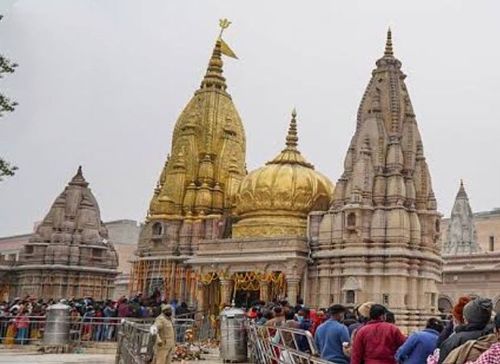
Stand at the Manikarnika Ghat at dawn. The Ganga moves slow and cold below you. Smoke from the cremation pyres drifts across the water. Behind you rises a maze of narrow lanes, twisting upward and inward toward a low golden dome that catches the first light of the sun. This is the Kashi Vishwanath temple, and the city around it has not stopped functioning, in roughly its current shape, for over three thousand years.
Kashi, also called Varanasi or Banaras, is the oldest continuously inhabited city in the world. Mark Twain visited in 1896 and wrote that it was older than history, older than tradition, older even than legend, and looked twice as old as all of them put together. He was not exaggerating.
What the city is
Kashi is, by tradition, the city of Shiva. The shastras describe it as resting on the trishul of Mahadev himself, meaning the cosmic destruction that ends every kalpa does not touch it. When the universe dissolves, Kashi remains. This is the theological claim. The geographical claim is more modest: a strip of land on the western bank of the Ganga, about five kilometres long, where the river bends in a slow crescent.
The Kashi Vishwanath temple at the city's heart enshrines one of the twelve Jyotirlingas, the self-manifest lingas of Shiva considered most sacred in all of Sanatani worship. Pilgrimage to this single shrine has been a continuous practice for at least two and a half thousand years. The Skanda Purana, composed sometime between the 8th and 10th centuries CE, describes the temple as if it were already ancient.
The history that the temple carries
The structure standing today is the seventh on this site. The previous six were destroyed.
The earliest references to a temple at this location appear in texts from the 5th century CE. We do not know what those structures looked like. The first destruction we have firm record of was by Qutb-ud-din Aibak's forces in 1194. The temple was rebuilt by a Gujarati merchant named Vishal in the 13th century. It was destroyed again, by Hussain Shah Sharqi in 1447, and rebuilt by Raja Todar Mal, Akbar's revenue minister, in the late 16th century with explicit imperial sanction.
It was destroyed once more in 1669 by order of Aurangzeb. The Gyanvapi Mosque, which still stands adjacent to the current temple, was built on its foundations. Parts of the original temple wall remain visible in the mosque's western facade. This is not contested history. It is etched into the stones.
The temple in its present form was built in 1780 by Ahilyabai Holkar, the Maratha queen of Indore. Maharaja Ranjit Singh of the Sikh empire later donated 800 kilograms of gold to plate its spire and dome, which is what catches the morning sun.
Why the city has held
A pilgrimage city's existence depends entirely on the continuity of its pilgrims. Kashi has had every reason to discontinue. Plague, famine, invasion, demolition, riot. Each generation has had its excuse to let the practice lapse. None has.
The reason, when you ask people in Kashi, is mukti. Dying in Kashi is held to dissolve the cycle of birth and death. The Kashi Khanda of the Skanda Purana describes Shiva himself whispering the Taraka mantra into the ear of the dying so they cross over without further rebirth. This is not a metaphor for Banarasis. Old people from across India travel here to die, sometimes years in advance, taking rooms in the muktibhavans along the ghats and waiting.
A city built around the practice of dying well has a different relationship with time than a city built around producing or consuming. Banarasis say that life in Kashi is slow because Kashi is the only place where you are not running from death. You are settling into the conversation.
What you see when you go
Most visitors come for the Ganga aarti at Dashashwamedh Ghat at sunset. This is the postcard version. It is genuinely beautiful, but it is a performance for visitors that began in its current form in the 1990s.
The older Kashi reveals itself in the early morning. Walk down to the ghats before 5 AM. The river is still. Boats are pushing off into the mist. Sadhus are doing their pranayama on the steps. People are scrubbing themselves with cold river water, then standing facing east for surya namaskar.
Visit Manikarnika Ghat, the main cremation ground. The doms who tend the funeral fires have done this work for as long as anyone can trace, by hereditary right. They are descended from Kashyapa, by their own account. The fire at Manikarnika has not been allowed to extinguish, by tradition, in over three thousand years.
Walk the alleys of the old city. The lanes are too narrow for cars, sometimes too narrow for two people side by side. The buildings lean toward each other overhead. Pandits sit in tiny shrines selling tulsi malas, paan vendors hand-fold leaves with quick precise fingers, sweet shops sell malaiyo in winter and rabri in summer. The structure of the lanes has not changed in centuries.
Find the Adi Vishweshwar shrine in a forgotten corner. Smaller and older than the main Vishwanath temple, this is the original lingam location according to local tradition. Most visitors miss it entirely.
Why this city matters now
In an era when Indian cities are rebuilding themselves every twenty years, Kashi has built itself once and then stopped. The Kashi Vishwanath Corridor opened in 2021 cleaned up the temple approach considerably, but the city behind it is what it has always been: dense, layered, breathing slowly, alive in its smell and its sound and its weight.
To visit Kashi is to feel what continuity costs and what it preserves. Most of human history has been like this: small, dense, durable, layered. Modern cities are the exception. Kashi is one of the few remaining places on earth where you can walk through three thousand years of unbroken practice in an afternoon.
Bhagwan Shiva, the texts say, never leaves Kashi. After three thousand years of repeated destruction and rebuilding, it is hard to argue with the evidence.