A temple where the deity has limbs
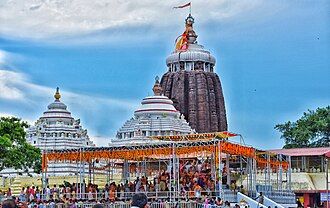
On the Bay of Bengal coast in Odisha, in the small city of Puri, sits a temple unlike any other in India. The Jagannath temple. The deity inside is unlike any other in any Sanatani temple: a wooden figure with no clear arms, no clear feet, enormous painted eyes, and a head that seems oversized for the body. Beside him are similar figures of his elder brother Balabhadra and his sister Subhadra. The three together are the Jagannath triad: Lord of the Universe, his brother, and his sister.
This is one of the four dhams (covered in our Char Dham article). It is among the most ancient continuously functioning shrines in the world. The temple's construction, in its current form, dates to the 12th century, but the worship at the site is considerably older.
The deity's distinctive form is the subject of multiple traditions. The strangest, and most beloved, is that no human ever finished the carving of these images. They are deliberately incomplete. The reason is part of the tradition's deepest teaching.
This article walks through the temple, the deity, the Rath Yatra (one of the largest religious processions in the world), and what makes Puri Jagannath unique among Sanatani shrines.
The story of the incomplete deities
The classical story is in the Skanda Purana and several other texts.
King Indradyumna of Puri had a vision of Bhagwan Jagannath and was instructed to build a temple. He prepared everything but did not have the right wood for the murti. Then Vishnu himself, in the form of a wooden log, arrived on the shore of Puri. The king was overjoyed but did not know how to carve the image.
The divine architect Vishwakarma offered to carve the murtis but on one condition: he would carve in a sealed room, and no one was to enter or disturb him until he was finished. The king agreed.
Days passed. The king heard the sounds of carving from inside the sealed room. Weeks passed. The king's wife became anxious. After 21 days, she could wait no longer; she insisted that the king check whether Vishwakarma was alive or had died at the work.
The king opened the door. Vishwakarma vanished. The murtis were unfinished: heads carved, large eyes, but arms barely begun, feet not carved at all.
The king was distraught. Vishnu appeared to console him: "These are the forms I have chosen. Worship them as they are. I will dwell in them in this incomplete form, which is itself the teaching that the divine cannot be fully grasped by the senses."
This is the story. The deities have been worshipped in this form for at least 1,200 years.
What the form means
Whether or not one takes the story literally, the form of the Jagannath deities carries specific meanings.
The unfinished nature. The deity is, in a profound sense, beyond complete representation. Any image we make of the divine is incomplete by definition. The Jagannath murtis make this explicit by being explicitly unfinished. The worshipper is reminded, every time they see the deity, that what they see is not the full reality.
The large eyes. The eyes are disproportionately large, often half the size of the face. These eyes look directly at the devotee. The tradition holds that the divine sees everything; the eyes are the principal sense organ for divinity. The eyes' size is not a flaw; it is the point.
The wood. The deities are carved from a specific sacred wood (neem). They are replaced every 12 to 19 years in a ceremony called Nabakalebara (new body), in which the old murtis are buried and new ones are carved from a new sacred tree. The Brahma Padartha (a sacred substance inside the murti) is transferred from the old to the new without anyone ever seeing it. The priests who perform this transfer are blindfolded.
This Nabakalebara ceremony is one of the most secret rituals in Sanatani tradition. Only specific priests, members of certain hereditary families, are allowed to handle the transfer. The Brahma Padartha is held to be the deity's actual essence, not a symbolic object. Its handling is treated with the highest possible sanctity.
The last Nabakalebara was performed in 2015. The next is expected in 2034 or thereafter.
The Mahaprasad tradition
Puri Jagannath is famous for one of the most distinctive food traditions in any Sanatani temple. The Mahaprasad.
In most temples, the prasad consists of a small piece of food given to devotees as a blessing. At Puri, the Mahaprasad is an entire meal, cooked in vast quantities in the temple's kitchen.
The temple kitchen (Anand Bazaar) is one of the largest religious kitchens in the world. Hundreds of priests and cooks work in it daily. Cooking is done in massive earthen pots stacked on woodfires. The food is prepared without modern conveniences, in the traditional manner that has not changed in centuries.
The Mahaprasad consists of 56 different food items (the chappan bhog), including rice, dal, vegetables, and various sweets. The food is offered first to the deities, then distributed to the public.
The most distinctive feature of Mahaprasad: it transcends all social distinctions. Once the food has been offered to Jagannath, all who eat it are considered equal, regardless of caste, region, religion, or class. People of all backgrounds sit together in the Ananda Bazaar dining hall, eating from the same earthen plates. This is one of the most powerful equalizing rituals in any tradition.
Pilgrims often emphasize that no proper Puri visit is complete without sharing the Mahaprasad with strangers. The act of eating with people you would not normally eat with is the central teaching of the meal.
The Rath Yatra
The largest single annual event at Puri is the Rath Yatra (chariot festival), held in June or July. In 2026, the Rath Yatra falls on 17 June.
On this day, the three deities are taken out of the main temple and placed in massive wooden chariots. Each chariot is enormous: 45 feet tall, weighing about 200 tons, with 16 large wooden wheels.
The deities ride the chariots from the main temple to the Gundicha Temple, a smaller shrine about 3 kilometres away. The journey is the procession. Hundreds of thousands of devotees pull the chariots by ropes through the streets of Puri.
The procession takes 7 to 10 hours. The chariots are decorated with bright cloth. Drums beat. Devotees throw flowers. The atmosphere is unlike anything else in Sanatani religious practice.
The deities remain at the Gundicha Temple for nine days, then return to the main temple in a reverse procession. The full Rath Yatra cycle extends over more than two weeks.
Several features make the Rath Yatra unique:
The deity is accessible. During the Rath Yatra, the deity is taken outside the temple where any human can touch the chariot ropes and pull. This is one of the few times in the year when the Jagannath form is available to direct human interaction without temple intermediation.
The chariots are rebuilt annually. The 200-ton chariots are not stored between festivals. They are dismantled after each Rath Yatra, the wood reused (sometimes given as prasad to devotees), and new chariots are built each year. This requires an enormous community effort that continues year-round.
The sea visits. During certain phases of the Rath Yatra, the deity is brought to the seashore for darshan with the ocean. This is one of the few rituals where the deity is taken to a body of water rather than the devotees coming to the deity.
The Rath Yatra has been held at Puri for at least 1,200 years. The exact form of the chariots, the routes, and the rituals has been preserved with remarkable continuity.
Restrictions and protocols
Some specific restrictions at Puri:
Non-Hindus are not permitted inside the main temple. This is one of the strictest such restrictions at any major Sanatani site. The restriction is enforced by guards at the temple gates. Non-Hindus can view the temple from the outside and from a vantage point at the Raghunandan Library.
This restriction has been criticized in modern times and is the subject of ongoing debate. The current position is that the tradition has been maintained for centuries and changes to it require careful deliberation.
Specific photography restrictions. Photography is not permitted inside the main temple or close to the deities during certain rituals. Smartphones must often be deposited at the temple entrance.
Strict cloth requirements. Devotees are expected to dress respectfully. Some specific dress codes apply during major rituals.
Mahaprasad protocols. Despite the food's openness across castes once offered to the deity, the cooking and the temple kitchen access remain restricted to certain priest families.
When to visit
Best months: October to March. Pleasant weather, manageable crowds.
For Rath Yatra: Plan a year in advance. Accommodation in Puri during the Rath Yatra fills up six months ahead. The Rath Yatra dates shift with the lunar calendar; check the panchang for your year.
Most pleasant: December and January. Cool sea breeze, less humidity than other months.
Avoid: April to June (heat, humidity). Monsoon season except for the Rath Yatra itself (the city is overwhelmed but the experience is unforgettable for those who can manage it).
A reflection
Puri Jagannath is one of the more philosophically interesting Sanatani shrines. The deity is unfinished. The food crosses all social distinctions. The chariots are rebuilt every year. The body of the deity is replaced every decade or two. The entire complex is, in its design, a meditation on impermanence and on the limits of any representation of the divine.
In an era when many religious traditions emphasize the eternal fixity of their truths, Puri offers a different model: the divine is here, but it is here only in forms that we acknowledge as incomplete, and the forms themselves are renewable, replaceable, and continuously refreshed.
If you have the opportunity to visit, do so. The Mahaprasad alone is worth the trip. The Rath Yatra, if you can time it, is one of the most extraordinary single-day events on earth. And the deity, with the great eyes that look directly at you, has been receiving devotees in this exact form for over a thousand years.
The Lord of the Universe, in Puri, is not what you expect. That is part of the teaching.