The temple at the source
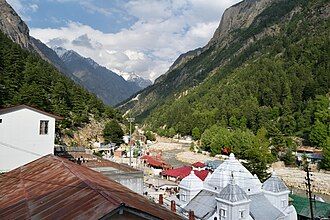
In Uttarakhand, in the high Himalayas, at 3,133 metres above sea level, near the spot where the Bhagirathi river emerges from the Gomukh glacier, sits a small temple. Built of white granite, modest in scale, surrounded by snow-capped peaks. This is Gangotri.
This is the temple of Ganga, the goddess who is also the river. The shrine marks the symbolic source of the Ganges, the most sacred river in the Sanatani tradition. The actual source, where the glacier ends and the river begins, is at Gomukh, 18 km further into the mountains. But the temple at Gangotri is where the goddess is worshipped.
Gangotri is one of the four sites of the Chota Char Dham (the Himalayan circuit), along with Yamunotri, Kedarnath, and Badrinath. It is among the most sacred and most demanding pilgrimage sites in India.
This article walks through what Gangotri is, the story of how Ganga came to earth, and what to expect on pilgrimage.
The descent of Ganga
The classical story of Ganga's arrival on earth is in the Ramayana, the Mahabharata, and several Puranas.
King Sagara of Ayodhya performed the Ashwamedha (horse sacrifice). His 60,000 sons followed the sacrificial horse on its journey. The horse was stolen by Indra (who was anxious about Sagara's power) and hidden in the underworld at the ashram of sage Kapila.
The 60,000 sons reached Kapila's ashram in pursuit, accusing him of the theft. Kapila, opening his eyes from meditation, burned them all to ash with his gaze. They had insulted a great sage; the consequence was their incineration. Their souls were trapped, unable to reach the next world, because their bodies had not received proper funeral rites.
Sagara's great-grandson, King Bhagiratha, undertook severe tapasya to bring Ganga from the heavens to earth, so that her waters could touch the ashes of his ancestors and grant them release. After thousands of years of penance, Brahma agreed.
But Ganga's descent posed a problem. The force of her fall from heaven to earth would crush the earth itself. Only Shiva could absorb her impact.
Bhagiratha undertook further tapasya, now propitiating Shiva. Shiva agreed to receive Ganga in his matted hair (jata). When she descended, Shiva caught her in his hair, slowing her tremendous force.
Ganga then flowed from Shiva's hair, in seven streams, to earth. The principal stream is the Ganges. The other six are the Yamuna, the Godavari, the Saraswati (now subterranean), the Narmada, the Sindhu, and the Kaveri.
This is the descent. Ganga is therefore called Bhagirathi (born of Bhagiratha's effort). Her source in the mountains is named Gangotri.
The Bhagirathi river, which flows from Gomukh and joins the Alaknanda at Devprayag to form the Ganga proper, takes its name from the king whose penance brought her.
What the river is
Ganga, in the Sanatani tradition, is not a river that resembles a goddess. She is a goddess who has taken the form of a river. The two are not separate; they are aspects of the same reality.
This understanding shapes how the river is treated. Devotees bathing in the Ganga are bathing in Ganga, the divine being. The water is not merely water; it is the body of the goddess. Diving into her, in this view, is the same act as touching the foot of a deity in a temple.
The river is held to have specific spiritual properties that ordinary water does not:
Purifying. A bath in Ganga's water is held to wash away sins accumulated over many lifetimes. This is the central theological claim. Bathing rituals at Ganga ghats across India are based on this claim.
Liberating. Death in the presence of Ganga, or having one's ashes immersed in her, is held to grant moksha or substantial spiritual progress. This is why old Sanatanis travel to Kashi (on the Ganga) to die, and why ashes from cremations across India are sometimes carried to be immersed in the Ganga.
Sacred at the source. The water at Gangotri itself, being closest to the goddess's source, is considered the most spiritually potent. Pilgrims carry small quantities home in special vessels.
The river is also, importantly, real. The Ganges flows from the Himalayas through the Indian plains to the Bay of Bengal, a journey of 2,525 kilometres. Its hydrological significance is enormous. Its cultural significance is older than recorded history.
The temple structure
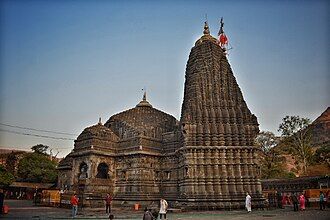
The current Gangotri temple was built in the early 18th century by the Gorkha general Amar Singh Thapa. The temple is modest in scale, about 6 metres tall, with white granite walls and a small shikhara. It sits on the banks of the Bhagirathi river, with the snow-capped peaks of Sudarshan, Bhrigupanth, Shivling, and Bhagirathi behind it.
The temple is open from late April or early May to early November. The exact dates are determined annually. In winter, the temple is closed; the deity is symbolically moved to Mukhba village (at lower elevation) for the winter months.
The deity inside is Goddess Ganga in personified form, with four arms, holding a kalash and other symbolic items. Her vahana is the makara (a mythical sea-creature that is part crocodile, part fish, part elephant).
The puja ritual is performed by priests of a specific hereditary lineage. The morning aarti at sunrise and the evening aarti at sunset are the most attended.
The Gomukh trek
Pilgrims who want to reach the actual source of the Ganga must trek 18 kilometres from Gangotri to Gomukh. This trek is one of the most spiritually significant journeys in Sanatani tradition.
The trail follows the Bhagirathi river upstream. The terrain is alpine, with mixed forest giving way to grassland and finally to barren glacial moraine. The elevation gain is from 3,100 metres at Gangotri to 4,000 metres at Gomukh.
The trek requires acclimatization. Most pilgrims spend at least one night at Gangotri before attempting it. Permits are required (issued by the forest department) and the number of pilgrims per day is regulated to protect the fragile glacial ecosystem.
At Gomukh, the trail ends at the snout of the Gangotri glacier. From a cave-like opening at the glacier's base, the Bhagirathi river emerges. This is the symbolic source of the Ganges.
The water at Gomukh is intensely cold (often below 5 degrees Celsius) and intensely clear. Many pilgrims take a ritual bath, despite the temperature. Others fill containers with the source water to carry home.
A few notes on the Gomukh trek:
Physical demand. The 18 km one-way trek (36 km round trip) at altitude is genuinely demanding. Not everyone can do it. Plan honestly.
Time required. Most pilgrims complete it as a 2-night, 3-day excursion from Gangotri, with one night at Bhojbasa (a small camp 14 km from Gangotri). Same-day return is possible but exhausting.
Permits. Required from the Forest Department in Uttarakhand. Apply in advance.
Weather. The trek is possible only from May to early October. Earlier or later, snow blocks the trail.
Pollution. Increasing pilgrim numbers have damaged the Gomukh ecosystem. Recent regulations restrict daily access to 150 pilgrims. Apply for permits early; quotas fill quickly.
When to visit Gangotri
Opening dates: Generally late April to early May, depending on the panchang for that year.
Closing dates: Generally early November.
Best months: May, June, September, October. July and August are monsoon and pose flood risk on the access road.
For Gomukh: Late May to early June, or mid-September to early October. The shoulder seasons offer the best balance of clear weather and manageable crowds.
How to reach Gangotri
Air: Jolly Grant Airport (Dehradun), 233 km from Gangotri.
Rail: Rishikesh railway station, 250 km from Gangotri.
Road: From Rishikesh, the journey to Gangotri takes 8-10 hours, passing through Uttarkashi (the main administrative center of the upper Bhagirathi valley). The road becomes increasingly mountainous and the last few kilometres before Gangotri offer dramatic views of the Bhagirathi peaks.
The road to Gangotri itself ends at the temple. Vehicles cannot proceed further. The trek to Gomukh begins from there.
What to do at Gangotri
Darshan at the main temple. Both the morning and evening aartis.
Bathe in the Bhagirathi. Cold but the most direct act of devotion at Gangotri. Most pilgrims take a small dip and apply some river water to the head.
Visit the small Bhairon temple. A guardian shrine just adjacent to the main temple.
The Surya Kund. A natural rock formation near the temple where the river plunges through a narrow channel, creating a small whirlpool. Considered especially sacred.
The Gauri Kund. A small temple of Parvati on the way to the river bank.
Sit at the river. This is, in many ways, the central practice. The temple is approachable in minutes. The river is the deity. Spending time at the river bank, in silent presence, is what most serious pilgrims do for several hours of their visit.
A reflection
Gangotri is one of the most spiritually evocative sites in India. The setting is dramatic: high mountains, glacial river, thin clear air. The temple is modest, not dominating the landscape. The river is the focus.
For pilgrims who reach Gomukh, the experience adds another layer. The point at which a river of such enormous significance begins is identifiable: a cave in a glacier, water emerging into the open air for the first time. Standing at that point, holding water that minutes earlier was glacial ice and that will, in two months, flow past Varanasi and onward to the Bay of Bengal, is one of the rare experiences in any pilgrim's life.
The Ganges has carried Sanatani civilization for three thousand years. Cities have grown along her banks. Cremations have been performed at her edge. Festivals have been timed to her seasonal rises. The descent that Bhagiratha brought about, however one understands the story, is now a flowing river that defines a civilization.
Gangotri, for those who can reach it, lets one stand at the symbolic beginning of this. The temple is small. The mountains are large. The river, at this altitude, is still narrow enough that one can step across it in places. In the next thousand kilometres, it will widen and become what India has long known.
The journey is worth making. The river has been waiting since before any of us was born. She is still flowing.