The city Krishna built and the sea took back
On the western tip of Gujarat, where the Arabian Sea meets the Gulf of Kutch, sits a small town built around an ancient temple. The town is Dwarka. The temple, Dwarkadhish, houses the murti of Bhagwan Krishna in his form as Lord of Dwarka.
By tradition, this site was, five thousand years ago, the capital of Krishna's kingdom. The Mahabharata describes Dwarka in detail: a magnificent city built by the divine architect Vishwakarma on the orders of Krishna, with golden walls, jeweled gates, palaces, gardens, fountains. Krishna ruled here for 36 years after leaving Mathura, until the events that ended the Yadava dynasty and led to his own departure from earthly life.
After Krishna's death, the texts say, the city sank into the sea, fulfilling Krishna's prophecy that nothing of his earthly establishment would remain. The sea closed over the city's walls. The Yadava people scattered. The kingdom that had been ruled by the divine was dissolved.
This is the story. The interesting question, which we will address, is whether there is any archaeological evidence for it. The short answer: yes, more than you might expect.
The temple as it stands
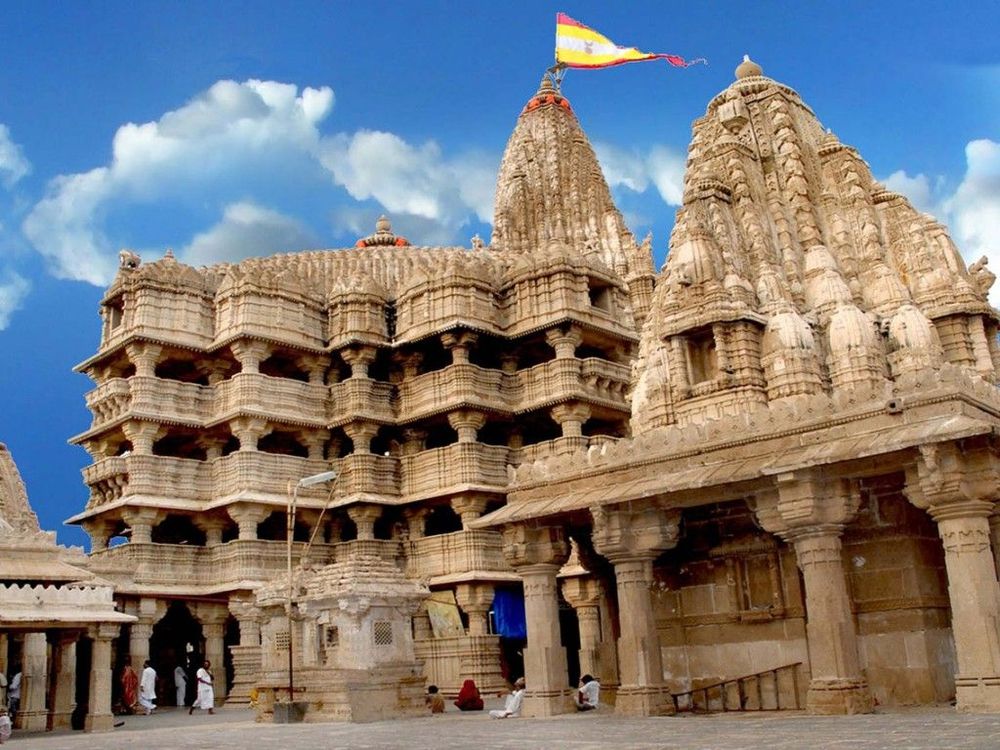
The current Dwarkadhish temple is a multi-tiered shikhara temple of yellow limestone, built in the Chalukya style. Its tower rises 78 metres above sea level. The flag atop the temple is changed five times daily; this is itself one of the rituals devotees come to witness.
The current structure dates from approximately the 16th century, built on the foundations of older structures going back to at least the 2nd century BCE. Some scholarly accounts place the original temple at this site as far back as 400 BCE, with continuous worship for over 2,500 years.
The murti inside is of Krishna in standing form, dark-stone, four-armed, wearing royal regalia. He is treated, in the daily worship, as a living king. The morning rituals include waking him, bathing him, dressing him in fresh clothes, and offering him breakfast. The evening rituals include singing him to sleep. The temple is, in this sense, not a place of worship; it is the king's residence.
This treatment of Krishna as king, rather than as a remote deity, is one of the distinctive features of Dwarka. The temple is the most "royal" of all Krishna temples.
The submerged city
The Mahabharata's description of Dwarka is detailed. The city had eight roads with shops and markets. It had palaces and gardens. It had walls and gates. It was, according to the texts, surrounded by water on three sides.
This last detail, surrounded by water on three sides, has been one of the central clues in modern archaeological investigation. The geography of present-day Dwarka matches this description: the town sits at the tip of a peninsula, with water on three sides.
In the 1980s and 1990s, Dr. S.R. Rao of the National Institute of Oceanography (NIO) began systematic underwater archaeological surveys off the Dwarka coast. The team used scuba diving, sonar imaging, and submersible vehicles to map the seafloor.
What they found was substantial.
A series of submerged structures was identified extending several kilometres offshore. The structures included walls, roads, what appeared to be bastions, and a port area with stone anchors. The materials were of dressed limestone, similar in style to the foundations of the current temple. Dating the finds was complicated by the marine environment, but the consensus estimate placed them at 3,000 to 4,000 years old, with the oldest possibly considerably older.
Subsequent surveys in the 2000s and 2010s have continued to find additional structures. The full extent of the submerged area is still being mapped. Major sites identified include:
- A submerged township off the coast of Bet Dwarka (an offshore island)
- Stone foundations off the main Dwarka coast
- Numerous stone anchors of various sizes, suggesting a major ancient port
- Walls and what appear to be city gates
This is not proof that the city is Krishna's Dwarka of the Mahabharata. It is, however, evidence of a substantial ancient civilization at this site that submerged at some point in antiquity. The match with the textual tradition is striking even if not conclusive.
The Archaeological Survey of India has continued investigation. The current scholarly position is that the submerged structures represent a real ancient port city, dating perhaps to 1500-2000 BCE, that aligns with the legendary Dwarka of tradition. Whether the historical Dwarka and the legendary Dwarka are precisely the same is left as an open question.
The pilgrimage circuit
Dwarka is one of the four dhams of the classical Char Dham (covered in our Char Dham article). A complete Dwarka pilgrimage involves several sites:
Dwarkadhish temple: The central shrine. Morning darshan from 6:30 AM, with multiple aartis through the day. The afternoon shringar aarti (around 4 PM) and the evening sandhya aarti (around 7 PM) are the most attended.
Rukmini temple: Approximately 2 km from the main temple, the shrine of Krishna's wife Rukmini. By tradition, Rukmini was cursed by sage Durvasa to live apart from Krishna; her temple is therefore separate from his. Visiting both temples is part of the complete darshan.
Bet Dwarka: A small island about 30 km off the mainland Dwarka, accessible by boat. The island contains a temple at the site where Krishna is said to have resided. The boat journey is itself part of the experience.
Nageshwar Jyotirlinga: About 25 km from Dwarka, one of the twelve Jyotirlingas (covered in our Twelve Jyotirlingas article).
Gomti Ghat: The point where the river Gomti meets the sea. Pilgrims traditionally take a bath here before darshan.
Bhadkeshwar Mahadev temple: A small Shiva temple at the seashore, partially submerged at high tide, fully visible at low tide. The temple is structurally remarkable and one of the few in India that goes underwater twice daily.
A complete Dwarka pilgrimage takes 2-3 days minimum, ideally 4-5 days to see everything at reasonable pace.
The flag changing ritual
A unique tradition: the temple flag (the dhwaja) is changed five times every day. Devotees can sponsor this ritual; the cost is high (currently several thousand rupees per change), and the wait list extends years for the more auspicious time slots.
Why five times daily? Several reasons given in the tradition.
The flag, when raised, is said to be touching the divine realm. The energy that flows through the flag must be renewed regularly. Each new flag carries the prayers of the sponsoring family for the duration it flies.
The flag is approximately 50 feet long and made of fine cloth. Watching it change is impressive: a small team scales the temple's spire, lowers the previous flag, attaches the new one, raises it, ties it. The wind catches it; it unfurls. This single ritual is one of Dwarka's signature sights.
Festivals
Krishna Janmashtami: The biggest festival at Dwarka. The temple holds elaborate celebrations on Krishna's birthday in August-September. Pilgrims arrive in tens of thousands.
Janmashtami Sham e Murli: A particularly distinctive Dwarka tradition. After the midnight celebration, in the early hours before dawn, devotees gather to hear the murli (flute) played in honor of Krishna. The sound, in the still pre-dawn darkness, is held to be especially powerful.
Holi: Celebrated with traditional vigor, particularly the colour play in the temple courtyards.
Annakut after Diwali: A massive feast offering, with hundreds of dishes prepared and offered to Krishna.
Dol Yatra (Holi-adjacent): A special swing ceremony in the temple, where Krishna's image is placed on a decorated swing.
When to go
Best months: October to March. The temperature is comfortable, the sea is calm enough for boat trips to Bet Dwarka, and the air is clear for the temple's exterior views.
Most crowded: During Janmashtami and Diwali. The pilgrim influx is enormous.
Most pleasant: December and January. Pleasant cool weather, manageable crowds (compared to peak festival periods), good for photography.
Avoid: May and June (extreme heat). The monsoon months of July and August (rough seas, occasional cyclones).
A reflection on the place
Dwarka has a particular character among Sanatani pilgrimage sites. It is not as ancient-feeling as Kashi. It is not as remote as Kedarnath. It is not as architectural as Mahakal or Rameshwaram. What it offers is something different: a place where the question "what was here five thousand years ago" is actively being investigated, where the textual tradition and the archaeological record are slowly coming into dialogue.
A visit to Dwarka, especially one that includes a glimpse of the underwater archaeological work, is a reminder that the texts the Sanatani tradition has preserved are not mere stories. Some of them may be historical accounts whose accuracy is becoming verifiable as archaeology improves.
Whether the underwater structures off Dwarka are the literal remains of Krishna's city is a matter for scholarly debate. What is clear is that something substantial existed there, that the tradition has remembered, and that the sea has held in trust for several thousand years.
The current temple, the bustling pilgrim circuit, the daily flag changes, the elaborate worship of Krishna as king, all continue. Underneath the sea a few kilometres out, an older city sleeps. Both are part of what Dwarka is.
If you have not visited, this is one of the four dhams; visiting it is, by tradition, one of the major pilgrimages of any Sanatani life. The temple has been waiting. The sea has been holding. Five thousand years on, the king is still receiving his subjects.