The other Navratri
Most Sanatanis know Shardiya Navratri, the autumn Navratri in October that culminates in Vijayadashami. That is the loud one. The garba, the dandiya, the public celebration, the Durga pandals across Bengal.
The other Navratri, in spring, is quieter. Chaitra Navratri begins on the first day of the lunar month of Chaitra, in March or April. In 2027, the dates are 17 March to 25 March. The festival ends with Rama Navami, the celebration of Bhagwan Ram's birth, on the ninth day.
This is the older Navratri. It is the one tied to the cosmic calendar, to the start of the new year, and to the foundational stories of Sanatani spring.
This article walks through what Chaitra Navratri is, how it differs from Shardiya, and how to observe it.
The Sanatani new year
In most regions of India, the first day of Chaitra Shukla Paksha is celebrated as the new year. The names differ by region:
- Gudi Padwa in Maharashtra
- Ugadi in Karnataka and Andhra Pradesh
- Cheti Chand in Sindhi tradition
- Navreh in Kashmir
- Chaitra Sukladi in much of north India
This is the day the Vikram Samvat year changes. In 2027, the calendar shifts from Vikram Samvat 2083 to 2084 on the same day Chaitra Navratri begins.
The new year, in this tradition, is not arbitrary. It is anchored astronomically to the spring equinox, the day when the sun's apparent path crosses the equator moving northward. Daylight begins to lengthen. The cosmos itself, in this view, is starting a new cycle. The Sanatani new year is timed to match.
Chaitra Navratri begins with this day. The nine-day Devi worship is, in this framing, the new year's foundational practice. Setting the year right with the goddess.
The stories anchoring Chaitra Navratri
Several traditions converge in the spring Navratri.
The cosmic creation. Brahma, by tradition, began the creation of the universe on Chaitra shukla pratipada. The first day of the festival commemorates the start of the cosmos itself.
Ram's birth. Bhagwan Ram was born on the ninth day of Chaitra shukla paksha. Rama Navami, the closing day of Chaitra Navratri, is therefore both the festival's culmination and one of the year's major birthdays.
The earlier Navadurga worship. Some traditional accounts hold that Chaitra Navratri is the older of the two Navratris. The autumn Shardiya Navratri, in this view, became prominent only later, in the period after Ram's victory over Ravana (which traditionally happened in autumn).
The Sita-Rama connection. Spring is the season of the Ramayana. Ram's birth, his early years, his wedding to Sita (which happened in Chaitra by tradition), are all marked by Chaitra Navratri's nine days.
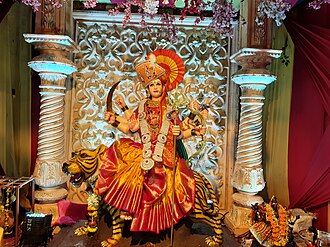
The festival, like Shardiya Navratri, worships the nine forms of Devi. But the parallel celebration of Rama gives it a distinctly different texture from the autumn festival.
How it differs from Shardiya Navratri
Both festivals worship the same nine forms across nine days, in the same order:
- Shailputri
- Brahmacharini
- Chandraghanta
- Kushmanda
- Skandamata
- Katyayani
- Kalaratri
- Mahagauri
- Siddhidatri
But the experiential character of the two festivals is different.
Shardiya Navratri is celebratory and public. It coincides with the post-monsoon harvest period. The community gathers in pandals, performs garba and dandiya, organizes processions, builds Durga idols. The atmosphere is loud and abundant.
Chaitra Navratri is contemplative and private. It coincides with the start of spring's productive season, when the rabi harvest has been gathered and the kharif planting is about to begin. The atmosphere is one of inward preparation rather than outward celebration. Families typically observe it at home, with fewer public events.
The vrats differ in intensity. Shardiya Navratri vrats are often complete, with strict adherence across all nine days. Chaitra Navratri vrats are often modified, with people fasting on the first day, last day, and Ashtami or Navami only.
The closing day is different. Shardiya ends with Vijayadashami, the victory of Durga over Mahishasura. Chaitra ends with Rama Navami, the birth of Ram. The first is martial; the second is generative.
Geographic emphasis varies. Shardiya is celebrated more strongly in Bengal, Gujarat, and Maharashtra. Chaitra is celebrated more strongly in the Hindi belt, in Bihar, and in south India (especially as part of the broader Telugu and Kannadiga new year traditions).
How to observe Chaitra Navratri
The traditional framework, similar to Shardiya but lighter:
Day 1 (Chaitra Shukla Pratipada). New year day. Many households perform a small puja in the morning, plant a sapling (especially neem, traditionally associated with the new year), and exchange new year greetings. Ghatasthapana (kalash installation) for the nine-day period is performed.
Days 2 to 8. Daily worship of the corresponding Devi form. Recitation of the day's mantra. Light fasting. Many families keep the akhand jyot (continuously burning lamp) before the Devi image for all nine days. The Durga Saptashati is recited across the days or in single sittings.
Day 9 (Rama Navami). The festival's culmination. Worship of Devi Siddhidatri in the morning. The Ram puja begins around noon, the traditional time of Ram's birth. The full nine-day fast is broken with Ram darshan and the sharing of prasad. Many households read sections of the Ramayana through the day.
The vrat foods are the same as Shardiya Navratri: phalahar, no grains, no onion or garlic, rock salt only. The intensity of the fast varies by household and individual capacity.
The connection to spring
One of the deeper meanings of Chaitra Navratri is its alignment with the spring equinox and the body's transition into a new season.
Ayurveda teaches that the transition between seasons (ritu sandhi) is when the body is most vulnerable. The old season's accumulated doshic patterns need to be released. The new season's patterns are being formed. A poorly managed transition produces illness and lasting imbalance.
Chaitra Navratri, falling at the exact moment of seasonal transition into spring, is in part a structured detox. The light vrat foods, the abstention from heavy grains, the elimination of onion and garlic, the increased fluid intake, all align with what the body needs at this specific time of year.
By the end of nine days of lighter eating, the body has cleared the heaviness of winter and is primed for the active spring season ahead. The festival's spiritual framework is also a seasonal recalibration.
A small ritual: planting on Chaitra Shukla Pratipada
A traditional Chaitra Shukla Pratipada practice that has nearly disappeared: planting a sapling on new year's day.
The traditional choice is neem (associated with health and new beginnings) or peepal (associated with longevity). The tree planted on this day, by tradition, carries the household's intentions for the year ahead.
If you have any outdoor space, even a balcony, this is a simple practice worth reviving. A small neem sapling, planted in the morning of new year day, watered through the nine days of Navratri, becomes a living marker of the year.
By next Chaitra, the tree will be different. So will you. The two parallel growths are, in the Sanatani understanding, related.
Closing
Chaitra Navratri is the quieter of the two Navratris. It is also, by some traditional accounts, the older one. It marks the new year, the start of spring, the birth of Ram, and the foundational worship of Devi all in nine days.
In 2027, the festival runs from 17 March to 25 March. The dates shift each year by the lunar calendar.
If you have not observed Chaitra Navratri before, this is a good year to begin. The intensity required is moderate. The discipline rewards consistency. The festival, like all good festivals, does not require complete observance to begin doing its work. A small daily diya, a light vrat, a few minutes of Durga recitation, and an early-morning new year practice are enough to mark the festival meaningfully.
The Devi visits both Navratris. Both deserve to be observed. The autumn one is louder. The spring one is older. Each has its place in the Sanatani year.