A conversation on a battlefield
Two armies face each other. The horns have sounded. The conches have been blown. The warriors are in formation. In a few minutes, the largest battle in the history of Bharatvarsha will begin. Brothers will kill brothers. Teachers will be killed by their own students. The ground is about to soak in blood that will not dry for eighteen days.
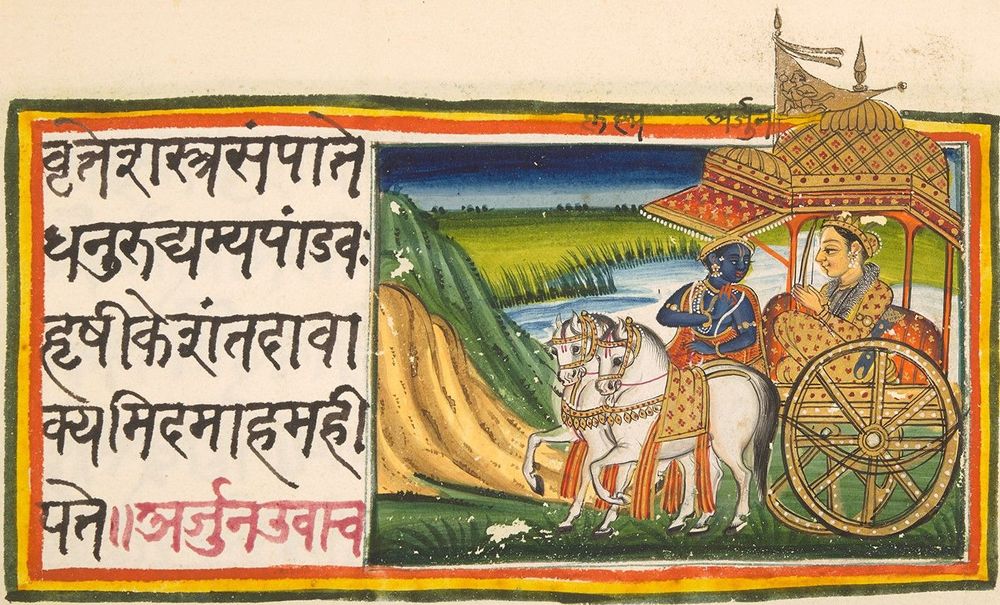
In the middle of this, between the two armies, a chariot stops. The warrior in it looks across at the men he is about to kill and discovers that he cannot do it. His arms shake. His bow slips from his hand. He tells his charioteer: I cannot fight this war.
The charioteer's response, given over the next several hours while the armies wait, is the Bhagavad Gita.
The warrior is Arjuna. The charioteer is Krishna. The conversation is the most influential single text in the philosophical history of Sanatan dharma. And the second chapter, called Sankhya Yoga, is where the practical teaching begins.
What chapter 2 sets out to do
Chapter 1 is Arjuna's collapse. He describes who is in the opposing army (his cousins, his uncles, his teachers), what their deaths will mean, why this war is intolerable to him. He concludes by dropping his weapons and saying he will not fight.
Chapter 2 is Krishna's response. It is the longest single chapter in the Gita and contains the seed of every teaching that follows. Almost every philosophical position the rest of the Gita develops is introduced, in compressed form, in chapter 2.
For someone who has never read the Gita, chapter 2 is the chapter to start with. Read in good translation, it takes about forty minutes. It will change how you think about action, about identity, and about the structure of the human predicament.
The opening: why Arjuna is wrong
Krishna's first response, in verses 2 to 9, is surprisingly harsh. He calls Arjuna's compassion misplaced. He calls his hesitation unworthy of his lineage. He uses the word "klaibyam" (impotence, weakness), which would have stung any Kshatriya. He does not validate the emotion; he names it as cowardice dressed in the clothes of moral seriousness.
This is the Gita's first move. The text takes seriously that what feels like compassion can be confused thinking. Not all hesitation is wisdom. Not all reluctance is virtue. Sometimes the moral feeling is itself the obstacle.
Modern readers often struggle with this passage. It seems to dismiss legitimate ethical doubt. But the context matters: this is not generic ethical doubt. Arjuna has agreed to fight the war. He has marched the army. He has stood at the front line. His collapse now, at the moment of action, is not principled refusal; it is failure of nerve. Krishna names this with precision.
The teaching of the imperishable self
After the opening rebuke, Krishna begins the actual teaching at verse 11. This is where the philosophical content begins, and where the Gita's distinctive vision emerges.
"You grieve for those who should not be grieved for. The wise grieve neither for the living nor the dead."
The reason: the self that is the true subject of these warriors is not the body that will die. It is the atman, the consciousness, which has no birth and no death. The body falls; the wearer of the body continues.
"Never was there a time when I did not exist, nor you, nor these kings, nor will any of us ever cease to be."
This is one of the most famous passages in world philosophy. It is also easy to misunderstand. The Gita is not saying that death does not matter. It is saying that death is not the deepest fact about the human person. The body's death is real. The self's death is not.
"Just as a person discards worn-out clothes and puts on new ones, the embodied self discards worn-out bodies and enters new ones."
This is the doctrine of reincarnation, but the framing is unusual. The Gita does not emphasize the moral mechanics of karma in this passage. It emphasizes the continuity of the self. Death is not annihilation; it is transition. Grief that mistakes death for annihilation is grief built on a false picture of reality.
The argument for action
Verses 31 to 38 turn from metaphysics to ethics. If the self is imperishable, why fight at all? Krishna's answer is dharma.
"Considering your own dharma, you should not hesitate. There is nothing more auspicious for a Kshatriya than a righteous war."
The argument is structural. Arjuna is a Kshatriya, a warrior. His dharma is to fight, when the war is just. To refuse this is not virtue; it is dereliction of duty. The cause is righteous (the Kauravas have committed extensive injustices). The position is legitimate (Arjuna fights on the side that has tried every peaceful alternative). The act is required.
Then comes the famous instruction:
"Considering equally pleasure and pain, gain and loss, victory and defeat, prepare yourself for battle. In this way you will not incur sin."
This is the Gita's central practical teaching. Act. Act according to your dharma. But do not act for the outcome. Do not be attached to victory or to defeat. The action is yours; the result is not.
The doctrine of action without attachment
This is where chapter 2 makes its most lasting contribution to Sanatani thought. Verses 47 and 48:
"You have the right to action, but never to the fruits of action. Never let the fruits of action be your motive, nor let your inclination be to inaction."
"Be steadfast in yoga, O Arjuna. Perform your duty, abandoning attachment, being indifferent to success and failure. This equanimity is called yoga."
This is the heart of karma yoga: action performed without grasping for its outcome. The principle is not passivity. The principle is full engagement combined with full release. Do everything that is yours to do, with complete attention. But do not be owned by what the doing produces.
This teaching, simple to state, takes a lifetime to practice. We act because we want results. The Gita is asking us to act because action is what dharma requires, not because of what action will produce.
The reward, if reward is the wrong word for it, is freedom from the cycle of elation and despair that ordinary motivation produces. The person who acts without attachment to outcome is not depressed by failure or inflated by success. He is steady. The Gita calls this state sthitaprajna, settled in wisdom.
The portrait of the steady mind
The chapter closes with one of the most beautiful passages in the Gita: the description of the sthitaprajna, the person of steady wisdom. Verses 54 to 72.
Arjuna asks Krishna directly: what does such a person look like? How does he sit? How does he speak? How does he walk?
Krishna's answer is detailed:
He has abandoned the cravings of the mind. He finds his satisfaction within himself. He is unmoved by sorrow. He does not chase pleasure. He has no fear and no anger. Like a tortoise drawing in its limbs, he withdraws his senses from their objects at will.
He is awake when others sleep, and he sleeps when others are awake. The "sleep" and "waking" here are spiritual states. He is alert to the deeper reality; he rests with regard to the surface attachments others spend their nights on.
The chapter ends with a single image: the river flowing into the sea. The waters that pour in do not disturb the sea; the sea remains itself. So with the wise person and the desires of the world. They flow into him; they do not move him.
What chapter 2 leaves you with
Anyone who reads chapter 2 carefully, even once, comes away with the structural insight: action, performed correctly, is not a problem. Identification with the results of action is a problem. The way out is not less action but less identification.
This is a practical teaching, not a mystical one. Try it in small things. Wash a dish without thinking about getting it done. Write an email without checking how it lands. Have a conversation without performing it. Notice the difference between acting and acting-for-an-outcome. The Gita's insight starts becoming visible the moment you try.
For the larger questions, marriage, career, parenting, health, the same principle applies. Do what dharma asks. Do it with full attention. Do not own the result.
A closing observation
The Gita is delivered between two armies in eighteen chapters. By the end, Arjuna picks up his bow and fights. The war is fought. People die. History continues.
The Gita does not promise that following its teaching makes the world easy. It does not promise that Arjuna will win, or that his victory will heal what the war has cost. It promises only that the warrior who fights with the steady mind of chapter 2 will fight rightly, will be unbroken by the consequences, and will, at the end, return to himself rather than to grief.
This is the offer. Not the removal of life's difficulty. The capacity to walk through it without being destroyed by it.
If you have not read the Gita, start with chapter 2. The first sixty verses are the foundation. Everything that follows in the rest of the text builds on what is laid out there. Read it slowly. Read it more than once. The passages you remember are the passages doing their work.