A temple in the high Himalayas
In Uttarakhand, at 3,300 metres, in a narrow valley dominated by the snow-capped Neelkanth peak, sits one of the four classical dhams: Badrinath. The temple sits at the confluence of the Alaknanda river and a hot spring called Tapt Kund. The deity inside is Bhagwan Vishnu in his form as Badrinarayan: seated in deep meditation under a wild jujube (badri) tree, the tree that Lakshmi, in plant form, became to shelter him from the snow.
Of the four dhams, Badrinath is the northernmost. Of the principal Vishnu shrines in the Himalayas, it is the most important. The temple is open only six months of the year; the rest is buried in snow.
This article walks through Badrinath, the story of Vishnu's tapasya at this spot, what to do during a visit, and what the place represents in the larger geography of Sanatani pilgrimage.
The story
Vishnu, by the classical tradition, performed centuries of tapasya at this spot in the Himalayas. He sat in meditation, immobile, through summers and winters. The snow gathered on him. The wind blew through him. He did not move.
Lakshmi, his consort, was concerned. To protect him from the worst of the snow, she took the form of a badri (wild jujube) tree and grew over him, sheltering him with her branches.
The combination, Vishnu meditating under Lakshmi's tree form, gave the place its name: Badrinath, the Lord of the Badri.
This is the founding story. The site marks the spot where Vishnu performed his tapasya. The temple, built later, encloses this sacred point.
A second story: Bhagwan Krishna, in the Mahabharata, described Badrinath as one of the most powerful spots on earth for spiritual practice. The Nara-Narayana, two great rishis who are forms of Vishnu, are said to be still doing tapasya in the mountains surrounding Badrinath. Some pilgrims who undertake serious sadhana at Badrinath report sensing their presence in the surrounding peaks.
The temple
The current temple was built in its present form in the 8th century by Adi Shankaracharya, who restored worship at this site after a period of dormancy. The structure has been renovated several times since. The current building dates substantially from the 19th century.
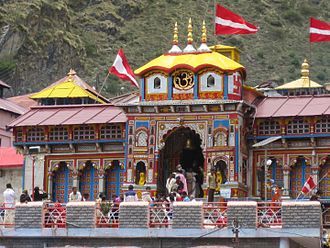
The temple is colorful, painted in bright yellow and other colors that contrast vividly with the gray-and-white surroundings. The shikhara is conical, rising to about 15 metres. The main entrance is the Singh Dwara (Lion Gate), at the front.
The deity inside is a one-metre-tall black stone (shaligram) image of Vishnu, seated in padmasana with his hands in dhyana mudra. He is decorated with elaborate gold ornaments and clothing. Beside him are smaller images of his attendants and consorts.
The puja is performed by priests of a particular lineage called the Rawals, traditionally from Kerala (a long-distance tradition that Shankaracharya established to maintain pan-Indian connections). The principal priest, the Rawal, is the only person permitted to touch the main deity image.
The morning aarti (Mangal Aarti) at 4 AM and the evening aarti (Sandhya Aarti) at 7 PM are the two main daily worship times. The temple is open from 4:30 AM to 1 PM and again from 4 PM to 9 PM.
The site
Several features make Badrinath unique even among major Sanatani shrines.
The Tapt Kund. Immediately below the temple is a natural hot spring called the Tapt Kund (hot pool). The water emerges from the rocks at about 45 degrees Celsius year-round, even when the surrounding air is well below freezing. Pilgrims bathe in this kund before darshan; it is one of the most distinctive pre-darshan rituals at any Indian temple.
The Brahma Kapal. A few hundred metres from the temple, on the bank of the Alaknanda, is the Brahma Kapal. This is the site for pinda daan (offerings to ancestors). Bhagwan Brahma himself is said to have performed pinda daan here. The offerings made at Brahma Kapal are considered to grant release to ancestors whose souls have been wandering.
The Sheshnetra. A small natural rock formation that resembles the eye of the serpent Shesh. Located near the temple.
Charanpaduka. A rock that bears, according to the tradition, the footprints of Vishnu. Located about 3 km uphill from the temple; reaching it requires a short trek.
Vyas Cave and Ganesh Cave. Located in Mana village, the last Indian village before the Tibetan border, about 4 km from Badrinath. By tradition, sage Vyasa dictated the Mahabharata here while Ganesh wrote it down. The caves are small and accessible.
Saraswati river. Near Mana village, the Saraswati emerges as a small visible stream (then disappears underground, in keeping with the tradition that the Saraswati is mostly hidden). Brief but striking to see her in surface form.
How to reach Badrinath
Air: Jolly Grant Airport (Dehradun), 308 km from Badrinath.
Rail: Rishikesh railway station, 295 km from Badrinath.
Road: From Rishikesh, the journey takes 10-12 hours. The route passes through Devprayag (confluence of Bhagirathi and Alaknanda, forming the Ganga), Rudraprayag (confluence of Mandakini and Alaknanda), Karnaprayag, Nandaprayag, and Joshimath.
The road from Joshimath to Badrinath is one of the more dramatic mountain roads in India. The valley narrows. The peaks tower. The Alaknanda runs alongside, fast and gray with glacial silt.
Direct road access to the temple is available, unlike at Kedarnath. Vehicles park near the temple complex.
When to visit
Opening dates: Generally late April or early May, with exact dates announced annually on Basant Panchami.
Closing dates: Generally late October or early November, after a closing ceremony on Vijayadashami or shortly thereafter. The deity is symbolically moved to Joshimath for the winter.
Best months: May, June, and September. July and August are monsoon and can have landslides. October can be cold but offers exceptional clarity.
Avoid: The first week and the last week of the season. The opening and closing dates draw enormous crowds. The middle months are quieter.
The Badrinath experience
For pilgrims who reach Badrinath, the experience has several distinctive elements.
The Tapt Kund bath. The hot spring bath before darshan is among the most memorable experiences. The contrast of the freezing mountain air with the hot water is striking. The kund is small but well-maintained. Separate bathing facilities exist for men and women.
The darshan itself. The deity is seated in deep meditation. The image is calming, profoundly still. Many pilgrims describe a particular quality of presence at Badrinath that is different from other Vishnu temples.
Pinda daan at Brahma Kapal. For those carrying intentions for departed ancestors, this is one of the most spiritually significant rituals available anywhere. The priest will guide the ceremony. Most pilgrims who perform it report a sense of release afterward.
Mana village. A short visit to the last Indian village before the Tibetan border is a memorable experience. The village retains a quality of frontier life. Several small shops, the Vyas and Ganesh caves, and views of the route that continues into Tibet (now closed to civilian travel).
Sit at the Alaknanda. As at Gangotri, the river is one of the deepest experiences. The water at Badrinath is gray-blue, fast-flowing, intensely cold. Sitting on a rock at the river's edge for a long time, in the cold mountain air, is itself a form of practice.
A reflection
Of the four classical dhams, Badrinath has a particular character. The temple is approachable. The site is dramatic but not overwhelming. The rituals are accessible.
What Badrinath offers, more than other major shrines, is a sense of the divine in stillness. Vishnu in meditation is the central image. The temple is a place not of action but of receptivity. Pilgrims who come here often describe the visit as quieting in a way that other pilgrimages are not.
The story of Vishnu performing centuries of tapasya at this spot is also worth taking seriously, whatever one's views on the literal claims. The site has been a place of practice for at least 2,000 years. The accumulated meditation of countless practitioners across that time leaves a quality in the place that is detectable, even by skeptical visitors.
If you are planning a Char Dham yatra, Badrinath is the climactic shrine. If you are planning a single pilgrimage to the Himalayan dhams, Badrinath is among the most accessible. The temple is, of all the Himalayan major shrines, the easiest to reach (road access to the door) and the easiest to integrate into a varied pilgrimage.
The deity has been sitting in meditation, in this place, since before any of us was born. He is still there. The badri tree still shelters him. The hot spring still flows. Lakshmi is still doing her work, in a sense, every winter when she covers the temple in snow.
Pilgrim, the road is open six months a year. The deity is open all day during those months. The work he is doing, in his deep stillness, is available to whoever sits at his feet.