Why one diet does not fit everyone
If you have ever read modern nutrition advice, you have probably noticed something strange. Two articles, both citing research, will tell you opposite things. One says eat more raw vegetables. Another says cooked vegetables are better. One says intermittent fasting is good. Another says fasting harms metabolism. One says cold water is healthy. Another says only warm water.
The reason the advice contradicts itself is that the human bodies it is being given to are different. What works for one body harms another. The Western nutritional sciences have struggled with this problem for a hundred years. They have started to address it with concepts like "metabolic type" and "personalized nutrition."
Ayurveda has been addressing it for three thousand years. The framework is called dosha.
This article walks you through what dosha is, how to identify yours, and what to eat (and avoid) based on it. Not as folk wisdom. As a system that has been refined empirically across a hundred generations of clinical practice.
What dosha actually is
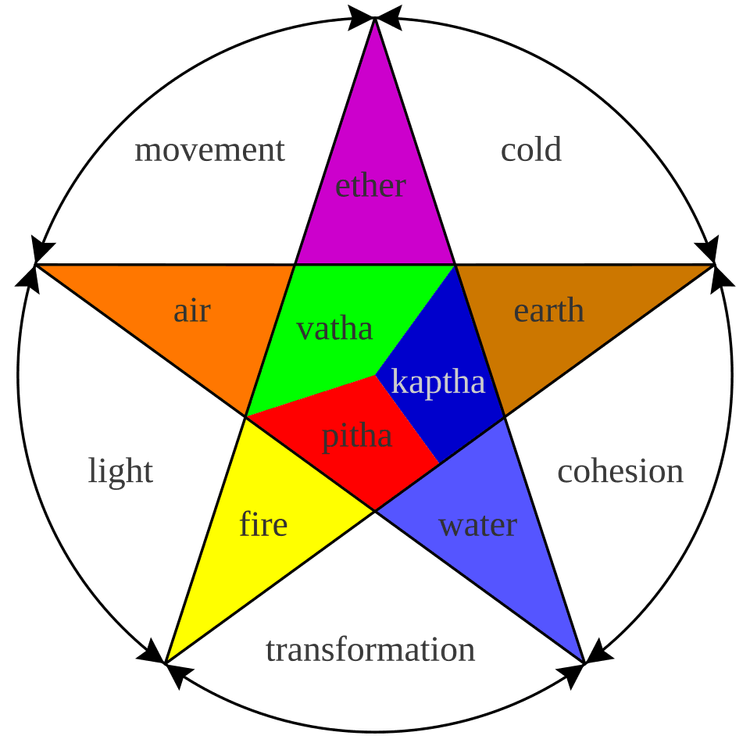
Ayurveda holds that the human body is constituted of three fundamental bio-energetic principles: Vata, Pitta, and Kapha. These are not types of people. They are forces that operate in everyone, in different proportions.
Vata governs movement: the breath, the nervous system, the elimination of waste, the circulation of blood. Vata is dry, light, cold, mobile, rough.
Pitta governs transformation: digestion, body temperature, metabolism, perception. Pitta is hot, sharp, oily, light, liquid.
Kapha governs structure: bone, muscle, fat, fluids, lubrication. Kapha is heavy, cold, moist, smooth, slow, stable.
Every human body contains all three. The proportions vary. Most people are dominant in one or two doshas. A few are tridoshic (roughly balanced).
The dominant dosha shapes the body, the mind, the metabolism, and crucially, the foods that suit and unsuit you.
How to identify your dosha
A precise dosha diagnosis requires consultation with a qualified vaidya, who looks at pulse, body type, mental constitution, and over thirty other markers. But a reasonable self-assessment is possible from a few questions.
Build: A thin, long-limbed body with prominent veins, struggles to gain weight: Vata. A medium build with moderate weight, gains and loses weight easily, gets warm fast: Pitta. A heavier, well-built body, gains weight easily, retains it stubbornly: Kapha.
Skin: Dry, rough, often cool: Vata. Warm, oily, prone to redness or rashes: Pitta. Cool, moist, smooth, prone to oiliness in spots: Kapha.
Hair: Dry, frizzy, often thin: Vata. Fine, straight, prone to early graying or thinning: Pitta. Thick, oily, wavy, abundant: Kapha.
Appetite: Variable, sometimes hungry sometimes not: Vata. Strong, regular, gets irritable when meals are skipped: Pitta. Moderate, can skip meals comfortably: Kapha.
Sleep: Light, easily disturbed: Vata. Sound but moderate duration: Pitta. Deep, prolonged, hard to wake: Kapha.
Mind: Quick, creative, prone to anxiety: Vata. Sharp, focused, prone to anger or impatience: Pitta. Slow, steady, prone to lethargy or attachment: Kapha.
Bowels: Irregular, often constipated: Vata. Regular, sometimes loose: Pitta. Regular, well-formed, heavy: Kapha.
A pattern in most of these answers points to your dominant dosha. Many people are dual: Vata-Pitta, Pitta-Kapha, Vata-Kapha. The dominant of the two carries most of the dietary implications.
The principle: like increases like
Ayurveda's central dietary principle is simple. Like increases like.
A cold, dry food eaten by a cold, dry Vata person will increase Vata in that person. The result: more dryness, more anxiety, more irregular digestion, more difficulty sleeping.
A hot, oily food eaten by a hot, oily Pitta person will increase Pitta. The result: more heat, more acidity, more anger, more inflammation.
A heavy, cold, oily food eaten by a heavy, cold Kapha person will increase Kapha. The result: more weight, more lethargy, more congestion, more sluggish digestion.
To stay balanced, you eat foods that have the opposite qualities to your dominant dosha. Vata-dominant: eat warm, moist, slightly heavy foods. Pitta-dominant: eat cool, mild, slightly dry foods. Kapha-dominant: eat warm, light, dry, spicy foods.
The system is simple in principle. The application across thousands of foods is what Ayurveda has refined for centuries.
What to eat: by dosha
For Vata
Favor: Warm, cooked, moist, slightly oily foods. Cooked grains (rice, wheat, oats). Cooked vegetables (sweet potatoes, carrots, beets, zucchini). Cooked legumes (especially mung dal). Dairy in moderation (warm milk with spices is excellent). Sweet fruits (mango, banana, dates). Nuts and seeds (in moderation, soaked or ground). Warming spices (ginger, cumin, cardamom, cinnamon).
Avoid: Raw cold foods. Salads in winter. Cold drinks. Crackers, dry breads, chips. Caffeine in excess. Astringent fruits (apples, pears, cranberries) unless cooked. Beans without proper preparation (cause gas in Vata).
Meal pattern: Regular, three meals at fixed times. Vata is the dosha most disturbed by irregular eating. Skipping meals is the worst thing Vata can do.
For Pitta
Favor: Cool, mildly cooked, slightly dry foods. Sweet and bitter tastes especially. Rice, wheat, barley. Most vegetables, especially cooling ones (cucumber, leafy greens, broccoli, asparagus). Sweet fruits (mango, melon, grapes, sweet apples). Cooling dairy (milk, ghee, fresh paneer). Coconut. Mild spices (coriander, fennel, mint, dill).
Avoid: Hot, spicy, oily, fried, fermented foods. Excess salt. Sour fruits (citrus, tamarind, sour curd). Tomatoes in excess. Vinegar. Alcohol. Coffee. Red meat. Hot spices (chili, mustard, hing) in excess.
Meal pattern: Three regular meals. Do not skip lunch, when pitta's digestive fire is strongest. Eating cold or skipping meals creates pitta imbalance.
For Kapha
Favor: Warm, light, dry, spicy foods. Pungent, bitter, and astringent tastes. Smaller grains (millet, barley, quinoa). Most vegetables, especially leafy and bitter ones. Cooked legumes (less dairy than Vata). Spices in abundance (ginger, black pepper, turmeric, mustard seed, cinnamon, cloves). Honey (the only sweetener Ayurveda recommends for Kapha).
Avoid: Heavy, oily, cold, sweet foods. Excess dairy (especially cold milk, cheese, yogurt, ice cream). Fried foods. Sweet desserts. Wheat in excess. Bananas, watermelon. Cold drinks.
Meal pattern: Smaller meals. Kapha is the only dosha that can comfortably skip breakfast. Larger lunch, lighter dinner. Avoid late-night eating.
Beyond dosha: timing
Ayurveda places almost as much weight on when you eat as on what you eat.
Breakfast: Light, warm. Vata and Pitta should eat breakfast; Kapha can sometimes skip.
Lunch: The main meal of the day for everyone. The body's digestive fire (agni) is strongest at midday, between 12 PM and 2 PM. This is when the heaviest meal should be eaten.
Dinner: Light, eaten before sunset ideally. Heavy food in the evening, when agni is weakest, is the most common cause of undigested food (ama) accumulating in the body. Ama, in Ayurveda, is the root cause of most chronic disease.
Between meals: No snacking unless necessary. Continuous eating prevents complete digestion of the previous meal.
Hydration: Sip warm or room-temperature water through the day. Cold water on an empty stomach extinguishes agni. Avoid drinking large quantities of water with meals, which dilutes digestive juices.
What changes when you do this
Eating according to your dosha is not a quick fix. It is a slow recalibration.
In the first week, you may not notice much. You will be paying more attention to what you eat, which itself has effects.
By the second week, digestion usually improves. Bloating decreases. Energy levels stabilize through the day.
By the first month, sleep often deepens. The mind feels less scattered (for Vata), less irritable (for Pitta), or less heavy (for Kapha).
After three months, the body's set-points often shift. Weight that was hard to lose comes off (if you are Kapha-dominant and were eating Kapha-aggravating foods). Weight that was hard to gain comes on (if you are Vata-dominant). Skin clears. The mind acquires a new steadiness.
The deeper changes take longer. The texts say a full constitutional reset, returning the body to its prakriti (natural balance), takes one or two years of consistent practice. This is the timeline of seasons, not weeks.
A note about modern medicine
Ayurvedic dietary principles do not replace medical treatment. If you have a diagnosed condition (diabetes, hypertension, autoimmune illness, anything chronic), the dietary changes here should complement, not substitute, the care your physician is providing.
The good news is that they almost always complement well. A Pitta-balanced diet generally aligns with anti-inflammatory dietary recommendations. A Kapha-balanced diet generally aligns with weight-loss recommendations. A Vata-balanced diet generally aligns with gut-health recommendations.
Consult a qualified Ayurvedic vaidya for a precise dosha assessment and a personalized plan. The self-assessment in this article is a starting point, not a final diagnosis.
Closing
Ayurveda is one of the oldest continuously practiced medical traditions in the world. It survived because its observations about the body, the food, and the relationship between them have proved durable across millennia. The science is empirical. The framework, dosha, has stood the test of time.
Your body has been waiting for someone to listen to it correctly. Eating by dosha is, in part, the practice of that listening. Try it for one month. The body will tell you what it thinks.