
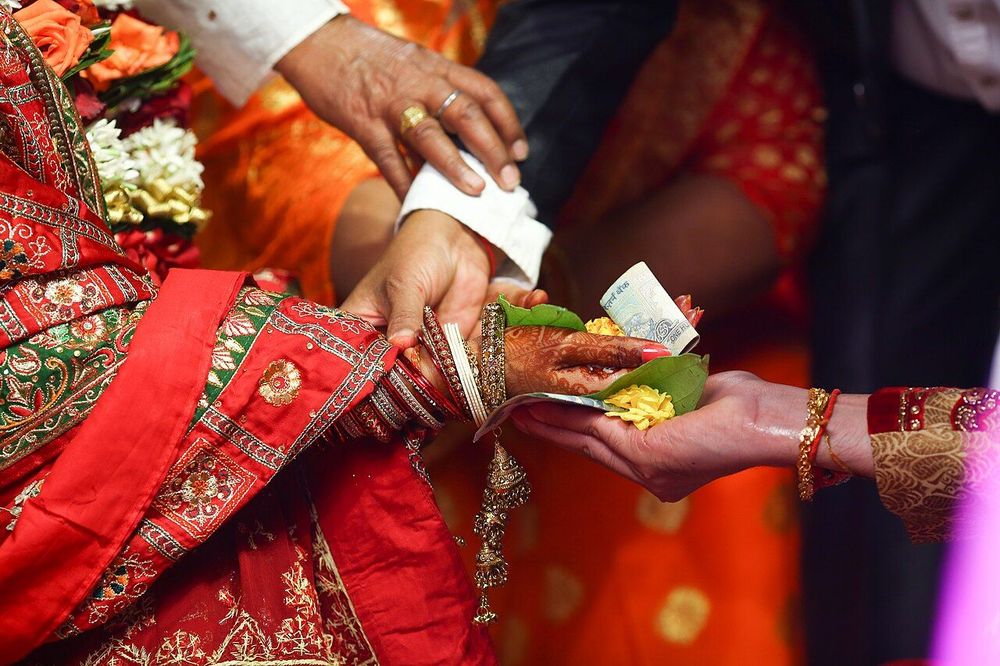
When the wedding pandit asks for both kundlis
In nearly every traditional Sanatani marriage, before dates are fixed or invitations printed, both families bring the kundlis of the bride and groom to a pandit. The pandit runs a comparison. He reports back a score out of 36. If the score is good, the families proceed. If it is poor, doubts surface, alternatives are considered, and sometimes the match is broken.
This is kundli matching. The Sanskrit term is guna milan, the matching of qualities. The system is called ashtakoota, the eight categories. Each category has its own weight, the total being 36 points.
This article walks through what the ashtakoota system actually measures, what scores mean what, and how to think about the matching process without superstition and without dismissing the wisdom in it.
What ashtakoota does
The ashtakoota system compares the bride's and groom's kundlis across eight specific categories. Each category captures a different aspect of marital compatibility:
- Varna (1 point): Spiritual maturity and class
- Vashya (2 points): Mutual influence
- Tara (3 points): Stars, fortune, and lineage
- Yoni (4 points): Sexual and physical compatibility
- Graha Maitri (5 points): Friendship of the ruling planets
- Gana (6 points): Temperament alignment
- Bhakoot (7 points): Wealth, family, and prosperity
- Nadi (8 points): Genetic compatibility and progeny
The total is 36 points. The scoring is weighted: nadi is worth eight times what varna is worth, reflecting how much each factor matters in practice.
The matching is done from the bride's and groom's nakshatras and rashis (specifically the moon's placement). The system has been refined across two thousand years and is one of the most carefully developed compatibility systems in any tradition.
Walking through the eight kootas
1. Varna (1 point)
Compares the spiritual class of the two charts. Four varnas (Brahmin, Kshatriya, Vaishya, Shudra) are assigned to each rashi based on traditional classification.
Scoring: If the groom's varna is equal to or higher than the bride's, full point. If lower, zero.
The varna here is astrological, not social. It refers to the spiritual orientation suggested by the rashi, not to caste. The traditional rule is that the husband should have equal or higher spiritual maturity than the wife (in this specific astrological sense), to support the marital relationship.
Most matches score on this category. It is the lowest-weighted koota for a reason: its predictive power is limited.
2. Vashya (2 points)
Compares whether the two people will naturally influence each other. Each rashi is classified as Manava (human), Chatushpada (four-footed), Jalachara (water-dwelling), Vanachara (forest-dwelling), or Keeta (insect-like).
Scoring: Specific compatible pairings give two points. Friendly pairings give one. Conflicting pairings give zero.
The vashya looks at whether one partner will dominate or whether mutual influence will flow naturally.
3. Tara (3 points)
Compares the nakshatras' relationship in terms of janma tara (birth star) sequence. The 27 nakshatras are divided into nine groups of three, with specific positive and negative classifications.
Scoring: Based on how the groom's nakshatra falls in relation to the bride's nakshatra (and vice versa). Compatible positions give three points. Less compatible positions give less.
Tara reflects general fortune in the marriage. A high tara score suggests the couple together will have an auspicious life.
4. Yoni (4 points)
Compares physical and sexual compatibility based on the animal symbol assigned to each nakshatra. The 27 nakshatras are paired with 14 animal symbols (some animals cover two nakshatras).
Scoring: Same animal: full four points. Friendly animals: three points. Neutral: two points. Enemy animals: one or zero points.
Yoni is more important than its raw point weight suggests. Physical and sexual compatibility is one of the foundations of a healthy marriage. Low yoni scores often correlate with persistent intimacy issues.
5. Graha Maitri (5 points)
Compares the friendship of the rashi lords (the planets ruling the moon signs of bride and groom).
Scoring: Mutual friendship of the two lords: full five points. One-way friendship: down to three or four. Mutual neutrality: two points. Mutual enmity: zero.
This is one of the most important kootas. The lords of the moon signs represent the mental tendencies of the partners. If the lords are friends, the partners' minds harmonize naturally. If enemies, the minds will struggle to align.
6. Gana (6 points)
Compares the gana (temperament) of the two charts. Three ganas exist: Deva (divine), Manushya (human), and Rakshasa (demonic). Each nakshatra is assigned a gana.
Scoring: Same gana: full six points. Deva-Manushya pairing: five or six points. Deva-Rakshasa or Manushya-Rakshasa pairings: zero or low.
Gana describes underlying temperament. Deva ganas are gentle and spiritual; Manushya ganas are practical and balanced; Rakshasa ganas are intense and assertive. The pairings that work are the ones where the underlying temperaments do not produce constant friction.
Note that Rakshasa is not "demonic" in any moral sense. It refers to a more intense, assertive temperament, which can be a positive quality in many contexts. The matching simply asks whether two such temperaments will harmonize.
7. Bhakoot (7 points)
Compares the relative positions of the two moon signs. The rashis are evaluated for how they sit relative to each other in the zodiac.
Scoring: Certain relative positions give seven points. Certain positions (called the 6-8 or 2-12 placements) give zero and are traditionally considered serious mismatches.
Bhakoot affects wealth, family harmony, and the household's general prosperity. A poor bhakoot score (especially the 6-8 placement) is traditionally taken seriously, though there are cancellations.
8. Nadi (8 points)
The most important koota by weight. Compares the nadi (pulse type, in Ayurvedic terminology) of the two charts. Three nadis exist: Adi (initial), Madhya (middle), and Antya (final). Each nakshatra is assigned a nadi.
Scoring: Different nadis: full eight points. Same nadi: zero points (this is the dreaded "nadi dosha").
The nadi system is connected to the underlying physiological constitution (similar to dosha in Ayurveda). The traditional understanding is that partners with the same nadi will have difficulty conceiving healthy children, since their genetic-energetic constitutions are too similar.
Nadi dosha is the single most consequential single-koota failure in the ashtakoota system. It is also the most surrounded by exemptions, qualifications, and modern reinterpretations.
What scores mean
The total ashtakoota score is out of 36.
0 to 17: Not recommended. Most jyotishis advise against the match.
18 to 24: Acceptable but with caution. The match can work, but specific issues need to be addressed.
25 to 31: Good. Most matches in this range proceed without difficulty.
32 to 36: Excellent. These matches are quite rare and traditionally considered exceptionally fortunate.
These ranges are guidelines, not absolutes. The specific kootas that fail matter as much as the overall score. A score of 24 with strong nadi and good gana is often better than a score of 28 with nadi dosha.
What ashtakoota does not measure
Several things matter for marriage that ashtakoota does not measure:
Mangal Dosha. A separate analysis, not part of the eight kootas.
The seventh house and seventh lord. Detailed analysis of marriage indicators in each partner's chart is a separate process.
The chart's overall fortune. A general kundli reading of both partners is essential. Ashtakoota alone misses major fortune patterns.
Current dashas. What planetary periods the partners are running through affects how the marriage's early years unfold.
The non-astrological factors. Education compatibility, family values, financial security, life goals. These matter for marriage in ways no koota can capture.
A complete pre-marital astrological consultation looks at all of these together. Ashtakoota is one component, not the whole.
When kundlis do not match
If the ashtakoota score is below the recommended threshold, families face a decision. Several approaches:
Reject the match. The traditional response. If the kundlis do not match, look for another match. This is still the most common path in traditional families.
Seek cancellation factors. Several traditional exemptions can cancel specific koota failures. Nadi dosha is canceled if both partners share the same rashi but different nakshatras (or vice versa, depending on tradition). Bhakoot dosha is canceled if both partners' moon signs are ruled by friendly planets. A skilled jyotishi can examine whether cancellations apply.
Perform remedies. Specific astrological remedies can reduce the impact of specific dosha failures. Mangal worship for Mangal Dosha. Specific homas for nadi dosha. Coral or other gemstones for relevant planetary weakness. These remedies are part of the traditional response.
Proceed despite the score. Some families, after considering everything, decide to proceed despite a low score. This is a valid choice, especially in modern contexts where other compatibility factors (education, values, mutual affection) may be considered as compensating.
A note on the modern context
Kundli matching faces several modern criticisms.
It is not predictive. Cases exist of matches with high scores failing badly and matches with low scores succeeding wonderfully. The system's predictive power, in modern controlled studies, is limited.
It encourages superstition. Families sometimes use the kundli score to justify decisions that have other motivations, or to break engagements over technicalities that could have been worked around.
It is gendered. Several of the kootas have asymmetries that traditionally favor the husband's chart (varna, the priority of the husband's bhakoot position). This reflects the era in which the system developed.
These criticisms have merit. The honest response is to use ashtakoota as one input among many in the marriage decision, not as a determining factor.
The wiser tradition has always been to combine ashtakoota with a complete astrological reading, with practical compatibility assessment, with mutual understanding between the partners themselves, and with the elders' judgment of the families. A single number out of 36 should never be the decisive factor.
Closing
Kundli matching is one of the oldest empirical attempts to predict marital compatibility from astrological factors. It has been refined across two thousand years. It captures real patterns in many cases. It misses important factors in others.
For families undertaking marriage discussions, the matching is worth doing. It surfaces conversations and considerations that might otherwise be missed. It gives a structured framework for evaluating compatibility. It provides, when interpreted skillfully, useful information.
Approach it with realism. A good ashtakoota score does not guarantee a happy marriage. A poor score does not condemn the marriage. The chart is a description, not a verdict. The marriage that follows is, in the end, made by the people who walk into it.