The speech that started a century
On 11 September 1893, at the Parliament of Religions in Chicago, a young monk from India rose to speak. He was twenty-nine years old. He had landed in the United States only a few weeks earlier, with no formal invitation, no organizational backing, and barely enough money to survive. He had slept in a railway carriage the previous night because he could not afford lodging.
He opened with five words.
"Sisters and brothers of America."
The audience of seven thousand people rose to their feet and applauded for nearly three minutes. The young monk had not yet spoken his second sentence.
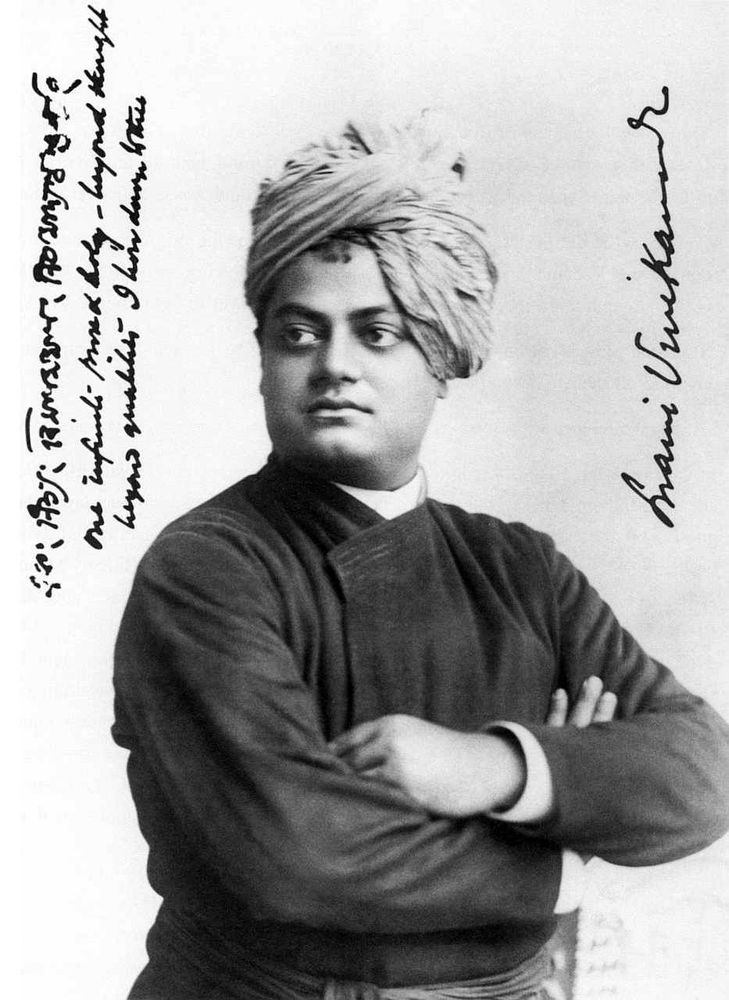
This is Swami Vivekananda at the Chicago Parliament of Religions. What he said next, and what followed it, marked the beginning of Sanatan dharma's modern global presence.
What he was doing there
The Parliament of Religions was organized as part of the 1893 World's Columbian Exposition celebrating the four-hundredth anniversary of Columbus's arrival. It was intended as the first global gathering of religious traditions, and despite its colonial framing, it became something genuinely interesting: an attempt to put representatives of every major faith in one room for two weeks.
Vivekananda was not invited as an official delegate. He had heard of the Parliament through a friend in Madras and decided, with characteristic confidence, that he should attend. He left Bombay in May 1893 with a one-way passage to America paid for by donations from his admirers.
His arrival in Chicago was disastrous. He had the wrong address. He had no introduction. He had no place to stay. He was wandering the streets of Chicago when a woman saw him in his orange robes from her doorstep and invited him in. Her name was Kate Sanborn. She arranged his stay with friends and made the introductions that eventually got him a place on the Parliament's speakers list.
That place on the list, granted reluctantly, became one of the more consequential speaking slots of the nineteenth century.
What he actually said
His opening on September 11 was brief. He thanked America for its hospitality, expressed gratitude to the assembly, and spoke for less than ten minutes. The famous opening line was its centerpiece. The substance was thin.
But across the two weeks of the Parliament, Vivekananda spoke several more times. These later addresses were where his real intellectual contribution emerged.
He addressed three core themes:
The unity of religions. Vivekananda argued that all religions, in their depth, point toward the same ultimate reality. The differences are differences of cultural expression and emphasis, not of fundamental claim. He quoted a verse from the Shiva Mahimna Stotram: "As the different streams, having their sources in different places, all mingle their waters in the sea, so do the different paths which men take through different tendencies, various though they appear, crooked or straight, all lead to Thee."
This was, in 1893, a radical claim made calmly. The Parliament was structured around the assumption that religions compete. Vivekananda told the audience they cooperated.
Hinduism as a philosophy of unity. He systematically presented Sanatan dharma not as a foreign exoticism but as a coherent philosophical tradition. The Vedanta, in his framing, was rigorous, ethical, and explicitly compatible with science. He cited the Upanishads, the Bhagavad Gita, and the Brahma Sutras, treating them as world philosophy rather than tribal scripture.
This was the first systematic introduction of Vedanta to American intellectual life. It would shape the next century of American interest in Indian thought.
A challenge to religious sectarianism. Vivekananda was explicit about the violence done in the name of religion. He spoke of the persecution of Zoroastrians by Muslims, of Christians by both, of Buddhists by Hindus. He named these failures by name. He did not present any tradition, including his own, as morally pure.
The audience, much of which had come expecting confirmation of Christian superiority, did not always respond well to these passages. But the press coverage, by the end of the Parliament, was overwhelmingly positive. The New York Herald called him "undoubtedly the greatest figure in the Parliament of Religions." The Boston Evening Transcript wrote that "America thanks India for sending this noble specimen of her culture."
The aftermath
Vivekananda stayed in the United States for nearly four years after the Parliament. He toured the country, lecturing in major cities, founding the first Vedanta Society in New York in 1894. He returned to India in 1897 to a hero's welcome and immediately began the work that would consume the remaining five years of his life.
He founded the Ramakrishna Mission in 1897, an institution that would grow into one of the largest socio-religious orders in India. It is still active today, running schools, hospitals, and relief operations across India and the world. The Mission's structure of monastic service to society was Vivekananda's own innovation, drawing on his guru Ramakrishna Paramahamsa's vision but giving it organizational form.
He died on 4 July 1902, in Belur Math, at the age of thirty-nine. The brevity of his life is jarring when set against the scale of what he initiated.
Why the speech still matters
Several reasons.
It is the moment Sanatani thought entered global discourse on its own terms. Before 1893, what the West knew of Hinduism came from colonial scholarship, Christian missionaries, and Orientalist scholarship, all of which framed it as primitive, exotic, or in need of correction. Vivekananda spoke as an equal among equals, in confident English, with sophisticated philosophical content. This was unprecedented.
It established Vedanta as a respectable global philosophy. Subsequent twentieth-century American interest in meditation, yoga, and Eastern thought was built on the foundation Vivekananda laid in 1893. From the Beats to the counterculture of the 1960s, from American transcendentalism's earlier interest in the Upanishads to today's global meditation movement, Vivekananda's framing is in the bloodstream.
It set the tone for Hindu reform movements in India. Vivekananda's confident, philosophically rigorous, ethically self-critical Sanatan dharma became the template for twentieth-century Hindu thought. He rejected caste discrimination, rejected the subordination of women, rejected ritual without understanding. His Sanatan dharma was both more confident and more self-critical than what came before.
It re-established Sanatani pride. Indians under British rule had been told for over a century that their tradition was inferior. Vivekananda's reception in Chicago was reported back in India and contributed to the early stirrings of cultural confidence that would, decades later, support the independence movement.
What to remember
When the speech is invoked today, it is usually for that opening line. "Sisters and brothers of America." A line that disarmed an audience and changed the room.
But the deeper content is in what followed. A young man, sleeping in train cars because he had no money, walked into the most prestigious religious gathering of his century and articulated his tradition with such precision and grace that the gathering changed shape around him.
The speech is worth reading in full. It is freely available, takes about twenty minutes, and is still readable as a model of how to introduce a tradition to people unfamiliar with it: with respect, with confidence, with humour, with humility, and with clear philosophical content.
Vivekananda was thirty when he gave it. He had no organizational backing. He had no introduction. He had only his tradition, his English, and his conviction that what he had to say was worth saying.
The world's largest religious assembly stood for him before he finished his opening sentence. The world has been listening, on and off, ever since.