The monk who walked from Kerala to Kashmir
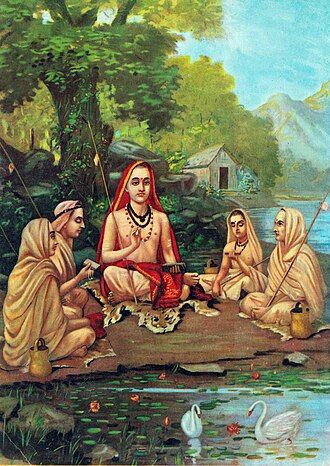
In the eighth century CE, a boy was born in a Brahmin household in a small village in central Kerala called Kaladi. His name was Shankara. He took sannyasa at the age of eight. By twelve, he had mastered the Vedas. By sixteen, he had written commentaries on the Brahma Sutras, the Upanishads, and the Bhagavad Gita that would shape Sanatani thought for the next twelve centuries. By thirty-two, he was dead.
Between his sannyasa at eight and his death at thirty-two, he walked the length and breadth of Bharatvarsha three times. He established four mathas at the four corners of the subcontinent. He defeated the leading scholars of every philosophical school in public debate. He systematized Advaita Vedanta into the form in which we still receive it.
This is Adi Shankaracharya. The brevity of his life is staggering when set against the scale of what he did with it.
What he found and what he changed
When Shankara was born, Sanatan dharma was in a particular state of disarray. Buddhism, after almost a thousand years of imperial patronage, had eroded the prestige of Vedic learning. The Vedas were still recited, but their interpretation had fractured into dozens of competing schools, each treating its preferred deity as supreme and its preferred ritual as essential. Tantra had spread widely, sometimes in disciplined lineages, sometimes in degraded forms. The basic question of Sanatani identity, what holds all this together, had no clear answer.
Shankara's contribution was philosophical, structural, and institutional, all at once.
Philosophically, he articulated Advaita Vedanta as the foundational metaphysics underneath the diversity of Sanatani practice. The Upanishads, he argued, taught one ultimate truth: Brahman is real, the world is appearance, and the individual self (atman) is not different from Brahman. All the deities, all the rituals, all the schools were valid as paths, provisional as truths. The single non-dual reality was what they pointed toward.
This was not new. The Upanishads had said it. But Shankara made it systematic, defensible, and accessible in commentary form. His Brahma Sutra Bhashya is still the foundational text of Advaita.
Structurally, he reconciled the apparent contradictions in the Sanatani corpus. The Vedas describe rituals; the Upanishads negate them. The Bhagavad Gita praises action; the Yoga Sutras praise withdrawal. The Vishnu Puranas exalt Vishnu; the Shiva Puranas exalt Shiva. Shankara's method was to assign each text its appropriate level: ritual for the householder, knowledge for the seeker, the highest realization for the renunciate. The texts did not contradict each other; they spoke to different stages of life.
Institutionally, he established the four mathas at Sringeri (south), Dvaraka (west), Puri (east), and Jyotirmath (north). Each was given charge of one of the four Vedas. The lineage of acharyas in each matha continues to this day, twelve centuries later, in unbroken succession.
He also reformed temple worship across India, regularizing rituals at Badrinath, Kedarnath, Jagannath Puri, and dozens of other shrines. The current form of worship at many of the most important Sanatani temples bears Shankara's revisions.
The debates
Shankara's most famous public encounter was with Mandana Misra, a great Mimamsa scholar in Mahishmati. The debate, by tradition, lasted weeks. Mandana's wife Ubhaya Bharati, herself a learned Mimamsa scholar, served as judge.
The debate ended with Mandana's defeat. Mandana, by his own terms, became Shankara's disciple, taking the name Sureshvara and later becoming one of the four principal disciples who would head the four mathas.
Ubhaya Bharati then challenged Shankara herself. She asked questions of kama shastra (the science of erotic love) that, as a sannyasi, Shankara had no experience of. To answer her honestly, Shankara entered the body of a recently dead king through the yogic siddhi of parakaya pravesha, lived the king's life for some months, and returned to defeat her in debate. (This is the traditional account. The skeptical reader may take it as allegory; the believer takes it as fact. Either way, the story has been told for twelve centuries.)
Other debates followed across the subcontinent. By the end of his life, Shankara had defeated every major scholar of the dualist, ritualist, Buddhist, and tantric schools in sequence. His philosophical position became, by default, the standard against which all subsequent Sanatani thought defined itself.
Why he matters now
Twelve centuries on, Shankara's influence is everywhere in living Sanatani practice, though it is no longer credited to him by name.
The four shrines at the four directions, Badrinath, Dvaraka, Jagannath, Rameshwaram (which Shankara also restored), are still on every Sanatani's pilgrimage list. The phrase "char dham" comes from his arrangement.
The Panchayatana puja, worship of five deities together (Vishnu, Shiva, Devi, Surya, Ganesha), which most traditional households still perform, was systematized by Shankara to reconcile the sectarian splits of his time.
The very idea that all paths within Sanatan dharma lead to one ultimate reality, an idea so naturalized to modern Sanatanis that it feels obvious, is largely Shankara's bequest.
His personal example also remains: the householder who renounces formally to take sannyasa, the wanderer who walks for years on foot, the scholar who debates without rancor and accepts disciples from former opponents. Each of these patterns of Sanatani religious life carries the Shankara archetype.
The death at Kedarnath
By tradition, Shankara died at Kedarnath at the age of thirty-two. The exact site is marked by a small samadhi behind the main temple. He walked there from his last matha visit, completed his fourth circuit of the subcontinent, and entered mahasamadhi.
Thirty-two years is not a long life. In thirty-two years, Shankara wrote enough commentary to fill multiple bookshelves, founded four institutions still living, restored dozens of temples, defeated every major opponent of his philosophy, and articulated the central metaphysics of his tradition.
What he did with thirty-two years is the kind of thing that, looking back, makes the human-divine distinction of the tradition feel less abstract. Whatever you make of his metaphysics, the historical fact of his life is one of the more remarkable in the recorded history of any tradition.
A closing thought
Most Sanatanis today, asked about Adi Shankaracharya, will say his name with reverence but cannot say precisely what he did. This is itself a measure of his success. His ideas have penetrated so deeply that they are no longer ideas; they are the air the tradition breathes.
If you have not read him, the Bhaja Govindam is the easiest entry. Fourteen short verses, attributed to Shankara, written for ordinary people, urging the contemplation of God in the midst of daily life. The verses can be read in fifteen minutes. They have been recited by Sanatanis for twelve hundred years. They are still alive.
The boy who walked out of Kaladi at eight years old is still walking, in a sense, through every Sanatani who continues the conversation he set in motion.