Some of the most powerful teachers in our tradition are children. Prahlad, who would not stop loving Vishnu though his father tried to kill him. Markandeya, who conquered death at sixteen. And Dhruva, a little boy of five whose stubborn determination carried him to a place in the sky that has not moved since. His is a story for anyone who has ever been made to feel small, and it is, at heart, about what a child's resolve can become.
The boy who was turned away
Dhruva was the son of King Uttanapada, but not of the king's favoured queen. He was the son of Suniti, the elder queen who had fallen out of favour, while the younger queen, Suruchi, held the king's heart and the throne's future for her own son.
One day the little boy climbed onto his father's lap, as small children do. Suruchi saw it and spoke to him with cold cruelty. That lap, she told him, was not for the likes of him. If he wished to sit there, he should have been born to her; he should go and pray to be reborn as her son, for he had no place here as he was. And the king, weak before the queen he favoured, said nothing.
Dhruva, only five, went to his mother in tears. Suniti, herself wronged and powerless, did not feed his anger. She told him the truth as she understood it: that the only lap that could never be denied him, the only refuge above all kings and queens, was that of Bhagavan Vishnu himself. If he wanted a place no one could take from him, he must seek the Lord.
A child's impossible resolve
The little boy took his mother literally. He left the palace and went into the forest, alone, to find God.
What follows is what makes the story extraordinary. Guided by the sage Narada, who tested his resolve and, finding it unshakeable, gave him the mantra Om Namo Bhagavate Vasudevaya, the child began a tapasya that astonished the heavens. He stood and meditated with a focus no adult could match, reducing his food and then giving it up, his concentration so complete and so pure that its heat began to disturb the worlds.
This is the heart of Dhruva's story: the single-pointedness of a child who has decided. He was not distracted, not discouraged, not turned aside. A grown person's mind wanders; Dhruva's did not. The very quality the world had used to wound him, his refusal to accept his place, became, turned toward the divine, an unbreakable devotion.
The Lord appears, and the boy is changed
Vishnu, moved by such devotion in one so small, appeared before him. And here the story turns again. Dhruva had gone to the forest carrying a child's hurt, wanting status, wanting the lap he had been denied, wanting to be greater than the queen's son. But standing in the presence of the Lord, all of that fell away. The small ambition that had sent him was burned up by what he found. He no longer wanted a throne. He had found something beside which thrones meant nothing.
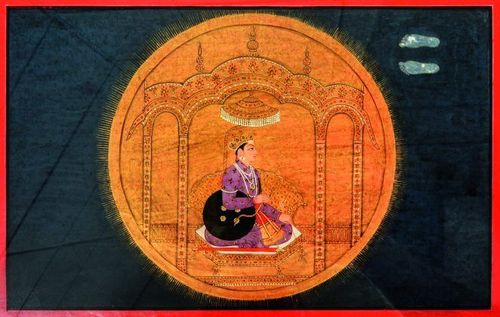
Vishnu blessed him with a place that no one could ever take: the Dhruva Nakshatra, the Pole Star, fixed and unmoving at the still point of the turning sky, around which all the other stars revolve. Dhruva did eventually return and rule as a wise king, but his name belongs to that fixed star, the one point in the night sky that never sets and never moves.
What the story holds
Dhruva's tale carries several gifts at once. It tells the wounded and the overlooked that the highest refuge is open to them, whatever their standing in the world. It shows that a child's whole-hearted determination, the very thing adults learn to soften, is precisely the quality that devotion asks for. And it teaches, gently, that what sends us toward God may be a small and even selfish wish, and that the seeking itself can purify the wish, so that we arrive wanting something far greater than what we set out for.
The Pole Star is still there. On a clear night you can find it, the one fixed point, and remember a five-year-old who would not accept that he was small.