The Ganga is not, in the tradition's telling, simply a river that happened to flow through northern India. She is a goddess who came down from heaven, and she came because one man would not give up across three lifetimes of effort. The story of her descent, Ganga Avataran, is one of the great narratives of Sanatan dharma, and it explains why the river is treated not as water but as a mother.
A debt across generations
The story begins with a curse and a catastrophe. King Sagara, an ancestor of Rama's line, had sixty thousand sons. In the course of a horse sacrifice, these sons, searching for the missing sacrificial horse, dug up the earth and burst into the underworld, where they found the horse near the sage Kapila, deep in meditation. Accusing the innocent sage of theft, they disturbed him, and the heat of his awakened gaze reduced all sixty thousand to ash on the spot.
This was no ordinary death. Their ashes lay unhallowed, and without the proper funerary rites their souls could not find rest. The only thing that could purify them and grant them release was the touch of the waters of the heavenly Ganga, which at that time flowed only in the heavens and had never come to earth.
So began the effort. Sagara's descendants, generation after generation, undertook severe austerities to bring the celestial river down. His grandson Anshuman tried and could not. Anshuman's son Dilipa tried and could not. The debt to the dead passed down the family like an inheritance.
Bhagiratha's resolve
It fell at last to Bhagiratha, the great-grandson, and his name has become a byword in Indian languages for an effort of immense, sustained determination. A bhagirath prayatna means a heroic, almost superhuman endeavour, and the phrase is still used today.
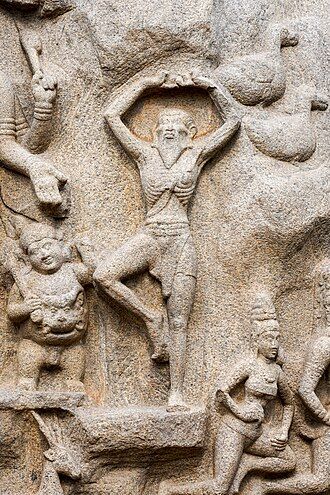
Bhagiratha renounced his kingdom and undertook tapasya of extraordinary intensity to win the descent of the Ganga, first pleasing Brahma, who granted that the river could come down. But there was a problem. The Ganga's fall from heaven was so powerful that the earth could not withstand it; her descent would shatter the ground and flood the world. Only one being could bear the force of that fall.
Shiva bears the river
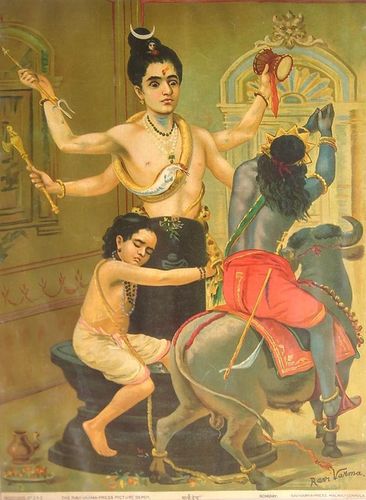
That being was Shiva. Bhagiratha turned his austerities to Mahadeva, and Shiva agreed to receive the river on his head. As the Ganga descended, proud of her power and meaning perhaps to sweep even Shiva away, he caught her in the locks of his matted hair and held her there, taming her completely. From his hair he released her gently, in streams the earth could bear.
This is one of the most beloved images in the tradition: Shiva seated in meditation with the Ganga flowing from his hair, the wild power of heaven tamed by the stillness of the great ascetic. It is why Shiva is called Gangadhara, the bearer of the Ganga, and why the river is so closely bound to him.
The river follows the king
Released from Shiva's hair, the Ganga still had to be led to the place where Sagara's sons lay. Bhagiratha went before her, and the river followed him across the land, carving her course behind his chariot, all the way to the sea and down into the underworld, where at last her purifying waters touched the ashes of the sixty thousand and granted them release.
The debt of generations was paid. And the river, having come down to earth, stayed, flowing ever after through the plains as Bhagiratha's gift to the world and as the mother who purifies all who come to her.
What the story carries
Read as faith, the descent of the Ganga explains the river's unique holiness: she is heaven brought to earth by devotion, tamed by Shiva, sister to the funeral rites that release the dead, which is why her banks at Kashi and Haridwar are the great places of cremation and of the immersion of ashes to this day.
Read as something deeper, it is a story about effort that outlasts a single lifetime, about a duty to one's forebears carried until it is discharged, and about the necessity of a still strength, Shiva's, to hold a power that would otherwise destroy. Bhagiratha's name endures because he is the tradition's emblem of the one who simply would not stop until the impossible was done.